Why Mobile Data Is So Cheap in India

If you've ever looked up how much people in the US or Europe pay for mobile data and then compared it to India, the gap is almost absurd. Indians pay a fraction of the price which is sometimes less than a dollar for gigabytes of data while users in developed countries fork out several times more for considerably less. This isn't luck or a government handout. It's the result of a specific, traceable mix of engineering decisions, competitive warfare, infrastructure economics, and scale that came together in a way that's fairly unusual globally.
Here's a breakdown of exactly why it happened.
What Actually Drives the Cost of Mobile Data?
To understand India's situation, you first need to understand what telecom operators are actually paying for.
There are two broad cost buckets. Capital expenditure covers everything you build once: cell towers, fiber networks, data centers, and spectrum licenses. Operational expenditure is the ongoing bill such as electricity, maintenance, staff, and network upgrades. On top of that, spectrum is its own beast. Governments auction off radio frequency licenses, and those auctions can cost operators billions.
Then there's the demand side. The more users you can spread your infrastructure costs across, the cheaper it gets per person. And competition matters: when multiple operators are fighting for the same customers, prices fall.
India has all of these dynamics working in a particular direction.

The Jio Shock of 2016
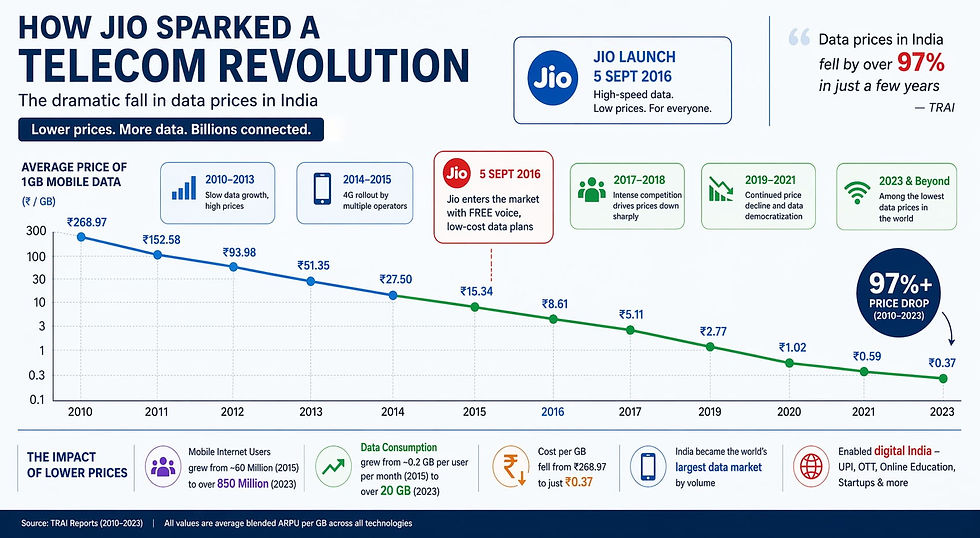
Before September 2016, Indian data prices were reasonable but not exceptional. Then Reliance Jio launched.
Jio did something its competitors couldn't easily match - it built a fully IP-based 4G network from scratch. No legacy 2G or 3G infrastructure to maintain. No circuit-switched systems dragging up costs. Just a clean, modern LTE network designed from the ground up for data.
Then it offered free voice calls and extremely cheap data to everyone.
The existing operators - Airtel, Vodafone, Idea had no real choice. They slashed prices to stay relevant. Some merged to survive. The entire market repriced almost overnight.
That competitive shock is probably the single biggest reason data is cheap in India today. Everything else either enabled it or followed from it.
The Scale Factor
India has over a billion mobile subscribers. That number matters enormously.
When you spend billions building out a national network, you need to spread that cost across your user base. In a country with 300 million potential subscribers, each person effectively carries a bigger share of that infrastructure burden. In India, that same cost gets divided across three or four times as many people.
And it's not just subscriber count. Indian users actually consume a lot of data in form of video streaming, social media, online content. High consumption means the network is being used efficiently, and an efficient network costs less per gigabit to run.
This is the core of why cheap data in a country like India is somewhat self-reinforcing. More users drive down unit costs, lower prices attract more users, higher usage improves efficiency.

Network Engineering That Keeps Costs Down
Jio's all-IP architecture is worth dwelling on because it had a real cost impact. Older telecom networks were built around voice calls, which use circuit-switched technology. In this, you reserve a dedicated connection for the duration of a call. Packet-switched networks like LTE work differently. Data gets broken into packets and routed efficiently, which is far cheaper per bit to run.
Beyond architecture, Indian operators use modern radio technologies that squeeze more data out of available spectrum. OFDMA, Massive MIMO, and carrier aggregation all let operators transmit more data per unit of spectrum which matters because spectrum is expensive and finite.
Urban areas also benefit from high tower density and fiber backhaul connections between towers. More towers close together means each one handles less traffic, which improves both quality and efficiency.
Infrastructure Sharing
Building separate towers for every operator would be wasteful and expensive. Indian operators have broadly embraced sharing passive infrastructure like towers, fiber, and equipment through companies like Indus Towers.
Instead of each operator running its own poles in every city and town, they share the physical infrastructure and just run their own radios on top. This cuts capital costs significantly and speeds up deployment. It's a practical arrangement that makes economic sense for everyone involved, and it's one reason India could build out coverage so quickly.

Low Prices, High Volumes
Indian telecom operates on unusually thin margins. Average Revenue Per User is much lower than in Western markets. A subscriber in Germany or the US might pay €30–50 a month; in India, operators are often working with figures closer to a few hundred rupees.
The business model compensates through sheer volume. Low ARPU times a very large subscriber base can still produce meaningful revenue, especially when you've optimized costs aggressively. It's a fundamentally different approach to telecom economics than what most developed markets use and it's only viable if you have both the scale and the operational efficiency to back it up.
Regulatory and Government Policy
India's telecom regulator, TRAI, has generally pushed for competitive markets and consumer-friendly pricing. While spectrum auctions have been expensive (a genuine pressure point for operators), the overall regulatory environment has encouraged competition rather than letting one or two players sit comfortably.
The government has also invested in fiber infrastructure, which helps reduce backhaul costs for operators and underpins the overall efficiency of the network.
The Technology Behind Cost Optimization
Modern operators cut costs in ways that weren't available a decade ago. Network functions that used to require dedicated hardware can now run as software, reducing equipment expenses. Automation handles tasks that once needed technicians. Cloud-based network infrastructure scales more flexibly than physical hardware.
These are incremental improvements, but across a network the size of India's, they add up to meaningful savings.

How India Compares to Wealthier Countries
In most developed markets, mobile data is expensive for a combination of reasons. Competition tends to be lower - many countries effectively have two or three major operators who have settled into stable market positions. Infrastructure costs are higher per user because the subscriber base is smaller. And because operators can charge more, they do.
India's situation inverted several of those dynamics simultaneously. A massive addressable market, intense price competition starting from Jio's launch, and modern infrastructure built for efficiency rather than inherited from earlier generations - all of these converged.
What Happens With 5G
5G adds new costs: new spectrum, new equipment, denser deployment in urban areas. Indian operators are currently navigating that investment while still operating in a market where users expect cheap data.
The longer-term expectation is that 5G will improve efficiency enough to justify the investment, but the transition period is financially difficult, especially for operators that already carry substantial debt from the price wars of the past decade.
The Challenges That Come With Cheap Data
Low prices have been great for consumers, but they've created real strain for operators. Vodafone Idea has struggled financially for years. Profit margins across the industry are thin. Investment in future infrastructure competes with debt repayment.
The concern isn't that prices will suddenly spike - competition and regulatory pressure make that unlikely in the near term but operators may underinvest in network quality if they can't generate enough revenue to fund it. That's the tension India's telecom sector is living with right now.
The Bottom Line
India's cheap mobile data is the product of a specific sequence of events, not an inherent feature of the country. A massive population provided the scale. A new entrant with deep pockets and a modern network triggered a price war. Efficient technology and shared infrastructure kept costs down. And regulators didn't get in the way of competition.
The combination is fairly rare globally, which is why the price differential is so stark. Whether it remains this way as 5G investment escalates is an open question, but for now, India remains one of the most affordable mobile markets anywhere in the world.


Comments