Airtel SA 5G: A Genuine Upgrade for Postpaid Users, or a Quiet Downgrade for Prepaid?

India's telecom sector has been buzzing with a question that's harder to answer than it first appears: is Airtel's rollout of Standalone 5G actually good for everyone, or is it quietly drawing a line between two classes of mobile users?
Reliance Jio launched with Standalone 5G from the beginning, making a big deal about it being "true 5G." Airtel, meanwhile, went the non-standalone route first, then started enabling Standalone selectively and if you look at who's getting it, the pattern is pretty clear. It's primarily landing with postpaid subscribers.
That choice isn't random. And understanding why it happened, and what it means for the 350-odd million prepaid users on Airtel's network, requires going deeper than most telecom coverage tends to go. This isn't just a story about speeds. It's about radio architecture, spectrum physics, business economics, and a regulatory question that India hasn't fully resolved yet.
Let's start from the ground up.
What NSA and SA Actually Mean (and Why It Matters)
People hear "Standalone 5G" and assume it just means faster speeds. That misses the
point almost entirely.
Non-Standalone 5G, which is what Airtel built first, uses the existing 4G LTE core network as its backbone. The 5G radio layer sits on top and acts as a capacity booster. You get faster downloads in good coverage areas, but the underlying intelligence of the network - how it manages traffic, enforces quality, handles voice - still runs on 4G infrastructure. It's essentially a 4G network wearing a 5G jacket.
Standalone 5G is different. It runs on a native 5G Core - a completely separate architecture with its own control and session management. This unlocks things that NSA simply cannot do: real network slicing (where different users or services can be given logically isolated network paths), Voice over New Radio without falling back to 4G, much lower latency at the core level, and granular Quality of Service control down to individual data flows.

The honest way to put it: the speed you see on a speedtest is roughly comparable between NSA and SA in good conditions. The difference isn't visible on a benchmark. It's visible in how the network behaves when things get complicated. Under congestion. Indoors. During a voice call. When a dozen other users are on the same cell.
That's where SA earns its reputation. Or doesn't.
Airtel's Spectrum Situation Is the Root of Every Decision It Makes
You can't understand Airtel's 5G strategy without understanding its spectrum holdings, because spectrum is the physical resource everything else is built on.
Airtel holds frequencies across several bands: 900 MHz for wide-area coverage, 1800 and 2100 MHz as the backbone of its 4G network, 2300 MHz for additional 4G capacity, 3.5 GHz as its primary 5G band, and a 26 GHz mmWave holding for future dense deployments.
The problem is in what's missing, or more precisely, in what's there in insufficient quantities.
Airtel's 900 MHz holding is roughly 7 MHz on a weighted average basis. That number matters because low-band spectrum is what makes 5G work in the real world. It's not glamorous. You won't read breathless tech coverage about 900 MHz. But 700 or 900 MHz is what gets 5G signals through walls, across kilometres of suburban sprawl, into basements and rural areas. Without a deep low-band foundation, 5G coverage becomes a patchwork. It works brilliantly in the right spot and disappears in the next room.
Jio understood this early. It acquired substantial 700 MHz spectrum before launching SA 5G, which is a large part of why it could go Standalone from day one and build something that approximates nationwide coverage.
Airtel is working with 3.5 GHz as its primary 5G band. That band has excellent capacity. You can carry enormous amounts of data across it, but its range is moderate and its indoor penetration is genuinely poor. In a dense urban area with line-of-sight to a tower, it's great. In a concrete apartment building, it struggles.
This constraint shapes everything that follows.

AirFiber, Not Mobile, Is the Real Driver of Airtel's SA Push
Here's something that gets buried in most coverage of this topic: Airtel's Standalone 5G rollout isn't primarily about your phone. It's about AirFiber.
Fixed Wireless Access is a way of delivering broadband internet to homes and offices using wireless rather than physical fiber. Instead of digging trenches and laying cable, you mount an outdoor CPE device on a rooftop or windowsill, it talks directly to the nearest 5G tower, and you get broadband-grade internet through a wireless link.
From a physics standpoint, FWA devices have a significant advantage over smartphones. A fixed outdoor antenna can use more transmit power than a handset, it has a stable physical orientation rather than bouncing around in a pocket, and it can be positioned to maximise line-of-sight to the tower. All of this makes for a more reliable, efficient connection which means better use of the spectrum it consumes.
From a business standpoint, FWA customers tend to pay more. They generate higher ARPU (average revenue per user) than prepaid mobile customers, they stay longer, and their usage patterns are more predictable. For a company like Airtel competing aggressively with Jio's JioFiber, getting AirFiber right on 5G is strategically important.
So, when Airtel built its Standalone 5G Core, one of the first things it did was route FWA traffic through it. This makes sense: the 5G Core gives Airtel the policy controls it needs to keep FWA quality stable and predictable, while its NSA mobile traffic stays on the 4G Core where it's always been.
The issue is that FWA users and mobile users share the same 3.5 GHz spectrum. Both are drawing from the same pool. And once you put FWA on a higher-priority core network, the question of how mobile users get treated becomes pressing.
How Prioritisation Actually Works at the Radio Layer
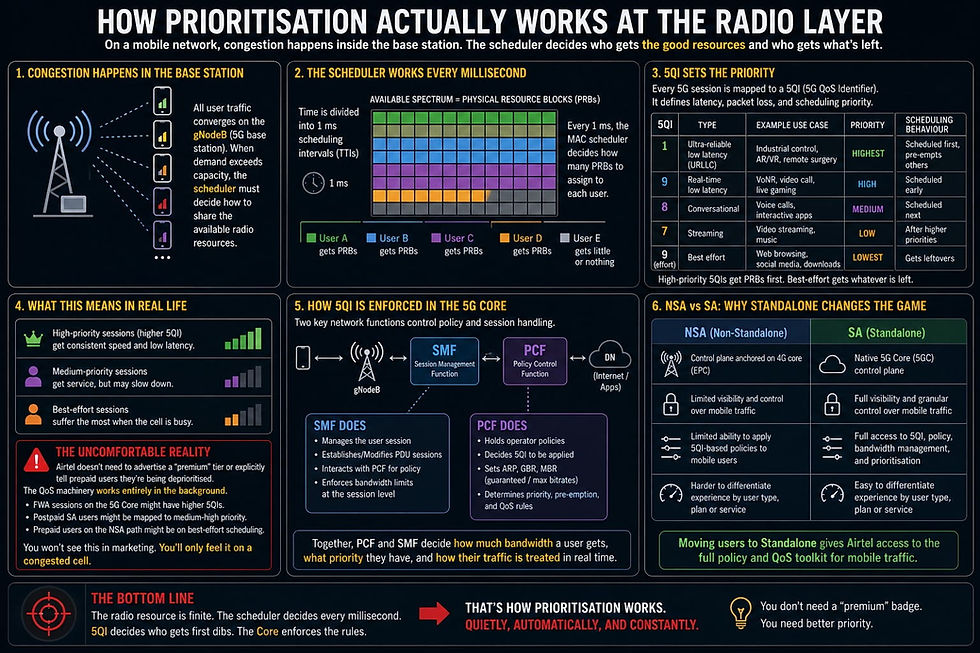
Most people picture network congestion as something that happens somewhere on the internet - a distant server being overloaded, a data centre running hot. That's usually wrong. Congestion on a mobile network happens inside the base station itself, specifically in the scheduler of what's called the gNodeB (the 5G equivalent of a cell tower).
Every millisecond, the base station's MAC scheduler has to decide how to divide the available spectrum — measured in Physical Resource Blocks, or PRBs among all the users connected to that cell. Different users get different allocations. The scheduler's decisions determine who gets fast, consistent service and who gets the leftovers.
This is where the concept of 5QI comes in. Every data session in a 5G network is mapped to a 5G QoS Identifier, which sets parameters like maximum latency, acceptable packet loss, and scheduling priority. A session with a high priority 5QI gets PRBs allocated to it first. A best-effort session gets whatever is left after higher-priority sessions are served.
Here's the uncomfortable reality: Airtel doesn't need to advertise a "premium" tier or explicitly tell prepaid users they're being deprioritised. The QoS machinery can work entirely in the background. FWA sessions on the 5G Core might have higher 5QI values. Postpaid SA users might be mapped to medium-high priority. Prepaid users on the NSA path might be on best-effort scheduling. None of this is visible in marketing materials. You'd only notice it when you're on a congested cell and wondering why your 5G indicator hasn't translated into usable speeds.
Inside the 5G Core, two functions - the PCF (Policy Control Function) and the SMF (Session Management Function) - govern exactly this kind of traffic handling. They set bandwidth caps, enforce QoS rules, and determine how different sessions are treated in real time. Moving users to Standalone gives Airtel access to these controls for mobile traffic in ways it simply couldn't do on an NSA architecture.
The Two Scenarios Worth Being Honest About
There's a temptation in tech writing to pick the dramatic narrative and run with it. The honest answer here is that the reality depends on something Airtel hasn't made public: whether it's actually applying priority differentiation between mobile user classes.
Scenario one: No meaningful prioritisation. In this case, SA gives postpaid mobile users access to the 5G Core, but they're on best-effort scheduling just like everyone else. They might get marginally lower latency in some situations, and they'll eventually benefit from features like VoNR when Airtel builds out sufficient low-band coverage to support it. But right now, the improvement is modest. SA becomes more of an architectural upgrade than a noticeable experience difference for most users. Prepaid users aren't meaningfully harmed — they're on NSA, which works the same way it always did.
Scenario two: Prioritisation exists. This is where things get genuinely concerning. If Airtel is using the policy controls available in its 5G Core to allocate better QoS to postpaid SA users, while prepaid users remain on best-effort scheduling, then on a congested cell the difference in experience can be significant. Postpaid users hold their speeds. Prepaid users get squeezed. The gap isn't visible in normal conditions — 3.5 GHz has enough raw capacity that even best-effort users might see 100+ Mbps — but it becomes real during peak hours in dense areas.
Which scenario is actually happening? Genuinely unclear. Airtel hasn't disclosed its QoS policies in the detail that would answer this question, and the regulatory framework hasn't forced that disclosure.
The Net Neutrality Question India Hasn't Resolved
India's net neutrality rules, developed under TRAI's oversight, are built on a clear principle: internet traffic should be treated equally, without discrimination based on who the user is, what service they're accessing, or how much they're paying for network access.
Paid prioritisation - where users or services can pay for a faster lane - is explicitly prohibited. Traffic cannot be throttled or boosted based on commercial relationships.
There's a meaningful exception carved out for what TRAI calls "Specialised Services." These are services that have specific quality requirements such as Voice over New Radio, IPTV, enterprise network slicing. They're allowed to use dedicated QoS resources as long as two conditions hold. First, they cannot replace the public internet. Second, they cannot degrade the general internet capacity available to other users.
FWA sits in an interesting grey area relative to these rules. It looks like fixed broadband in many respects. It has tiered speed plans, it's sold as a home internet service and that framing has allowed Airtel to treat it differently from mobile internet under the same spectrum. Whether that framing would survive a rigorous regulatory challenge is a question that hasn't been tested.
Where the rules become clearly at risk is if Airtel extends the same logic to mobile users - creating a de facto premium lane for postpaid subscribers within the mobile internet service itself. That would be paid prioritisation. The question is whether it's happening, and whether regulators are equipped to detect and prove it.
Three factors explain why this hasn't triggered enforcement yet. The sheer capacity of 3.5 GHz spectrum means that even in scenario two, prepaid users might not notice obvious degradation in normal conditions. QoS policies aren't published or auditable by end users. And the technical complexity of proving that scheduler-level discrimination is occurring as opposed to ordinary variation in radio conditions - is genuinely high.
None of that means it's not happening. It means the accountability mechanisms aren't strong enough to surface it.

Why VoNR Is Going to Stay Broken for a While
One of the headline features of Standalone 5G is VoNR - Voice over New Radio - which allows voice calls to travel over the 5G network natively rather than falling back to 4G. In theory, this means better call quality, faster call setup, and no switching between network generations mid-call.
In practice, VoNR requires something Airtel currently lacks: continuous 5G coverage. Not "you're near a 5G tower" coverage, but genuine blanket coverage that follows you everywhere your call does.
This is a physics problem. 3.5 GHz simply cannot provide the indoor penetration and range needed for seamless coverage, and Airtel doesn't have the deep low band 5G spectrum to fill the gaps. Without a strong 700 or 900 MHz 5G layer, every time a VoNR call encounters a coverage hole, just like stepping into an elevator, walking into a basement carpark, moving away from windows, where the call has to fall back to 4G. If that handoff isn't handled perfectly, the call drops.
Until Airtel either acquires substantial low-band 5G spectrum or builds out a density of mid-band cells that eliminates coverage gaps (a much more expensive proposition), VoNR remains more of a roadmap feature than a working product for most users.
Network Slicing: Technically Possible, Practically Stalled
Network slicing is the other SA feature that gets a lot of attention. The basic idea is that a single physical network can be divided into multiple logical networks, each with its own dedicated resources, quality guarantees, and isolation from other slices. An enterprise customer could get a slice with guaranteed low latency for a manufacturing application. An emergency services network could get a slice that's isolated from consumer traffic entirely.

Airtel's 5G Core is technically capable of slicing. The hardware and software architecture supports it. The problem is regulatory: TRAI hasn't clearly approved network slicing for general commercial use in mobile internet, and the existing net neutrality framework creates ambiguity about whether slicing for different consumer tiers would constitute paid prioritisation.
Until those frameworks are resolved, slicing for mobile users is largely theoretical. The practical use today is within FWA and enterprise fixed connections, where the regulatory picture is somewhat clearer.
Airtel vs Jio: The Strategic Gap
It's worth being direct about where these two operators stand, because the gap is significant and it doesn't entirely favour either side.
Jio launched Standalone 5G from day one. It had the low-band spectrum with substantial 700 MHz holdings to support it. Its SA coverage is genuinely broader than Airtel's current footprint, and its ability to offer VoNR at scale is correspondingly better.
Airtel's countervailing advantage is spectrum efficiency and, arguably, network quality in areas where both operators have strong coverage. Its 4G network has a long reputation for being well-engineered. The company has shown it can do more with available spectrum than raw MHz numbers might suggest.
But the SA transition is exposing a structural disadvantage. Airtel's spectrum portfolio was assembled in an era when sub-1 GHz 5G wasn't the priority it turned out to be, and catching up is expensive. The next major spectrum auction in India will be telling: if Airtel doesn't make significant low-band acquisitions, the SA limitations described throughout this piece will remain limitations for years.
The Economics Are Driving Everything
Here's something worth sitting with: none of what Airtel is doing is irrational from a business perspective. It might be concerning from a regulatory or consumer fairness perspective, but the economic logic is consistent.
Postpaid users generate more revenue. They're on plans that typically run three to four times what a prepaid user pays monthly. They have lower churn. They're more likely to take additional services like AirFiber, enterprise SIM packages, or roaming add-ons. In a market where every operator is trying to improve ARPU - average revenue per user - postpaid subscribers are the ones worth fighting for.
FWA customers are even more valuable on a per-connection basis. Getting AirFiber working well on 5G SA, and keeping FWA customers happy, is worth a significant investment in core network architecture.
Prepaid users, by contrast, are high-volume and low-margin. They're important for overall network revenue, but they're not where Airtel is investing its strategic energy on the 5G front.
The question is where the line sits between commercially rational differentiation - offering postpaid users access to newer technology and unlawful discrimination that actively degrades the service prepaid users are paying for. That line exists in the regulations. The problem is that determining whether it's been crossed requires transparency that the current regime doesn't enforce.
What Would Have to Change for SA to Actually Deliver on Its Promise
The path from "Airtel SA is mostly an FWA play" to "Airtel SA is transforming mobile connectivity" has a few clear requirements.
Low-band spectrum is the most fundamental. Whether Airtel acquires 700 MHz 5G rights, or builds out 600 MHz capacity, or finds another way to put a low-band 5G layer under its network, that step cannot be skipped. Without it, coverage gaps mean VoNR doesn't work reliably, SA coverage remains patchy, and the upgrade remains invisible to most users most of the time.
Regulatory clarity on slicing would allow Airtel to offer differentiated services transparently between enterprise QoS, specialised latency guarantees all without the ambiguity about whether it's violating neutrality rules. TRAI has been moving toward this, but it's a slow process.
Denser infrastructure in urban areas would help 3.5 GHz punch above its weight on coverage, though small cell rollout in Indian cities faces its own bureaucratic and cost challenges.
None of these happen quickly. The realistic near-term picture is continued incremental SA expansion, primarily serving FWA and selected postpaid users, with the low-band gap remaining unaddressed until the next spectrum auction cycle.
What This Actually Means if You're an Airtel User
If you're a postpaid Airtel customer in a city with SA coverage, the experience right now is probably fine - maybe slightly better than it was. You may notice more consistent performance in some situations. You won't notice revolutionary changes, because the underlying low-band gap means coverage still has holes, and VoNR isn't working seamlessly for most people yet. What you're getting is positioning for future benefits rather than dramatic improvements today.
If you're an Airtel prepaid user, the honest situation is that nothing has obviously gotten worse. You're on the same NSA network you were on before. The risk isn't in what's happened so far, it's in what happens when that 3.5 GHz spectrum gets more congested as SA FWA adoption grows and more postpaid users get shifted to the 5G Core. If scheduler prioritisation is in place, congestion will affect you more than it used to.
If you're using AirFiber or considering it, the SA architecture is genuinely good news. FWA is what Airtel's 5G Core was built to serve first, and the quality and stability for fixed wireless connections is likely to be better under SA than it was under NSA.
The Bottom Line
Airtel's SA 5G rollout is a real architectural change with real implications — but most of those implications are about FWA and revenue strategy rather than the mobile experience most people will notice.
The honest verdict: SA today is a network control mechanism built around fixed wireless economics, with postpaid mobile users as secondary beneficiaries. Whether prepaid users are being actively disadvantaged depends on whether Airtel is using the QoS tools now available to it in ways that go beyond what net neutrality permits.
That question remains unanswered. Not because the answer is necessarily bad, but because the industry lacks the transparency standards that would let anyone verify it.
The technology is real. The potential is real. The low-band gap is also real, and it's the constraint that keeps most of the SA promise theoretical for now. Watch what Airtel does in the next spectrum auction, because that decision will reveal more about its actual 5G ambitions than any press release about SA rollouts.
Until then, the only people reliably benefiting from Airtel's SA investment are the ones with an outdoor CPE device on their rooftop.


Comments