How Fiber Internet Works: A Complete Technical Guide

Every time you stream a video, load a webpage, or send a message, there's a good chance your data is traveling through thin strands of glass at close to the speed of light. That's fiber internet and the physics behind it are genuinely fascinating.
Fiber is fundamentally different from older copper-based systems, not just faster. It uses light instead of electrical signals, which changes everything about how data moves and how far it can go without degrading.
Why Copper Ran Out of Road
For decades, internet connectivity meant copper - DSL lines, coaxial cable, phone lines repurposed for broadband. These worked well enough when data demands were modest. The problems showed up as usage scaled.
Copper carries electrical signals, and electrical signals have real limitations: they weaken over distance (attenuation), they pick up interference from nearby electronics and power lines, and there's a ceiling on how much bandwidth a copper wire can carry. You can engineer around some of these constraints, but you can't engineer around physics.
Fiber optics sidestep most of these issues by using light instead of electricity.

The Basics: Light as Data
An optical fiber system has three core parts: a transmitter that converts electrical data into light, the fiber cable itself, and a receiver at the other end that converts light back into electrical signals.
The transmitter uses either a laser diode (for long distances) or an LED (for shorter runs). Data is encoded as pulses. Light on means 1, light off means 0. It's binary, just like any digital signal, but the carrier is photons instead of electrons.
The fiber cable is usually glass, sometimes plastic, and roughly the diameter of a human hair.
What's Inside a Fiber Cable
An optical fiber has three layers:
Core - The central glass strand where light actually travels. It's extremely thin, typically between 8 and 62 microns in diameter depending on the fiber type.
Cladding - A layer of glass surrounding the core with a slightly lower refractive index. This difference is the key to why light stays inside the fiber.
Protective coating - A plastic jacket that protects the fiber from physical damage.

Total Internal Reflection
The phenomenon that makes fiber optics work is total internal reflection. When light travels through a medium and hits a boundary with a lower refractive index at a shallow enough angle, it doesn't pass through - it bounces back. The cladding's lower refractive index creates this boundary, so light stays trapped in the core and bounces its way along the length of the cable.
The minimum angle at which this works is called the critical angle, and it depends on the specific refractive indices of the core and cladding materials. Engineers choose these materials carefully to optimize transmission.

Single-Mode vs. Multi-Mode Fiber
There are two main categories of optical fiber, and the difference matters:
Single-mode fiber (SMF) has a very narrow core, around 8 to 10 microns which allows light to travel in only one path. This means no interference between paths, very low signal loss, and high bandwidth over long distances. It's used in backbone networks, submarine cables, and most residential fiber connections.
Multi-mode fiber (MMF) has a wider core, typically 50 or 62.5 microns, which allows multiple light paths simultaneously. It's cheaper and easier to work with, but the multiple paths cause dispersion - pulses spread out over distance and interfere with each other. Multi-mode is used for short runs: within buildings, data centers, and enterprise networks.

Wavelength Division Multiplexing (WDM)
One of the most powerful capabilities of fiber is the ability to carry multiple data streams through a single cable simultaneously, using different wavelengths of light for each stream. This is wavelength division multiplexing, or WDM.
Think of it like sending different colors of light down the same fiber at the same time, each carrying completely separate data. Dense wavelength division multiplexing (DWDM) can pack dozens or even hundreds of channels onto a single fiber strand, which is how backbone cables carry terabits of data.

How Fiber Networks Are Structured
Fiber networks operate in layers:
Core network - Long-haul infrastructure connecting cities and countries, usually using single-mode fiber and DWDM at very high speeds.
Metro network - Regional infrastructure connecting the core network to neighborhoods and local exchange points.
Access network - The last mile (or last kilometer) that actually reaches homes and businesses.
For residential fiber, the most common deployment model is Fiber to the Home (FTTH), where the fiber cable runs directly to the premises. This gives users dedicated fiber rather than fiber-to-a-neighborhood-cabinet with copper for the final stretch.
Passive Optical Networks (PON)
Most residential fiber uses a Passive Optical Network architecture. "Passive" means there are no powered components between the provider's central office and the customer — just fiber and passive optical splitters.
The key components:
Optical Line Terminal (OLT) - Located at the provider's central office, this manages traffic to and from customers.
Optical Network Unit (ONU) - Installed at the customer's premises, often called an optical network terminal (ONT). It converts optical signals to electrical signals for your router.
Optical splitters - These split the signal from a single fiber to serve multiple customers, typically 32 or 64 users sharing one upstream fiber run.
The dominant standard is GPON (Gigabit Passive Optical Network), which supports downstream speeds up to 2.5 Gbps and upstream up to 1.25 Gbps shared across users, using time division multiplexing to allocate bandwidth.

Data Flow: What Actually Happens When You Load a Page
When you request a webpage, here's the rough sequence:
Your request leaves your device as an electrical signal and hits the ONT
The ONT converts it to an optical signal
The signal travels through fiber to the optical splitter, then to the OLT at the provider's central office
The OLT routes it to the internet via the provider's upstream connections
The response from the web server travels the reverse path back to your device
The whole round trip, in a well-functioning fiber network, takes milliseconds.
Latency and Signal Attenuation
Fiber's low latency comes from a combination of factors: light travels fast, there's minimal interference to cause retransmissions, and routing is direct. In practice, residential fiber latency runs 1–5 ms to nearby servers which is noticeably better than cable or DSL for latency-sensitive applications like gaming or video calls.
Signal does attenuate over long distances, even in fiber. The loss is measured in decibels per kilometer, and single-mode fiber achieves losses as low as 0.2 dB/km. For runs beyond a few hundred kilometers as in submarine cables. Erbium-Doped Fiber Amplifiers (EDFA) are used to boost the optical signal directly, without converting it back to electrical form first.
Fiber vs. Copper: The Practical Differences
The gap between fiber and copper isn't just raw speed. Fiber carries data farther before degrading significantly, which is why you don't see repeaters every few kilometers the way older telephone networks needed them. It doesn't pick up electromagnetic interference from power lines or industrial equipment and bandwidth scales more easily. Adding capacity often means adding wavelengths to existing fiber rather than laying new cable.
Copper networks can still carry substantial bandwidth, particularly with DOCSIS 3.1 cable technology, but they're working against the inherent physics of electrical transmission.
Submarine Cables and Global Connectivity
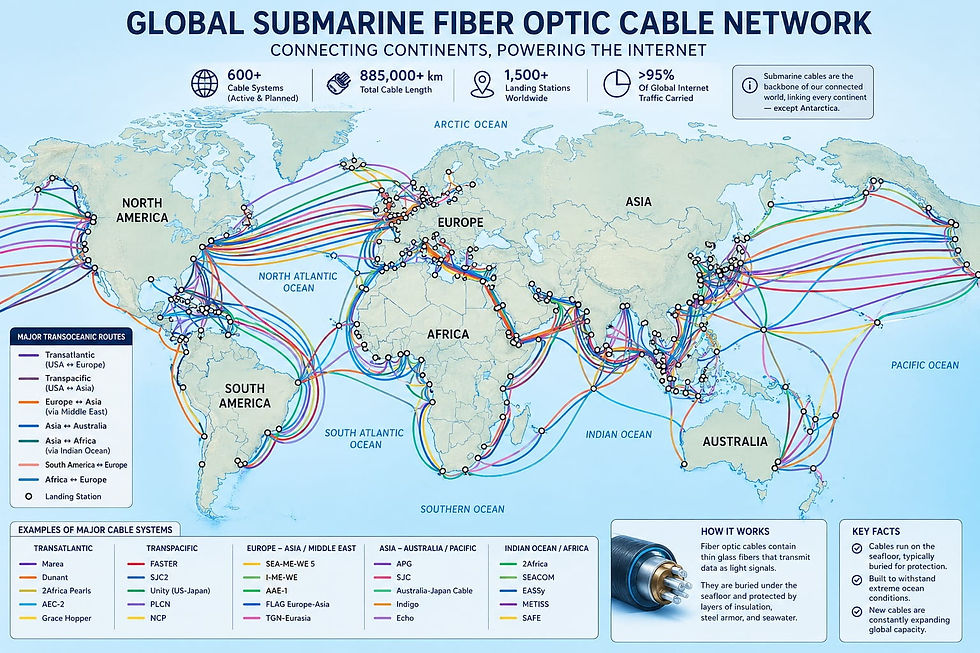
Intercontinental internet traffic runs almost entirely over submarine fiber optic cables - not satellites, despite what people sometimes assume. There are hundreds of these cables crossing the ocean floors, each carrying multiple fiber pairs, each fiber pair using DWDM to carry dozens of channels simultaneously. A modern submarine cable might carry 200+ terabits per second total capacity.
These cables make up the physical backbone of global internet connectivity and are critical infrastructure in a very literal sense.
Where the Technology Is Going
Current research focuses on increasing the capacity of existing fiber infrastructure, better optical amplification across wider wavelength ranges, and more efficient multiplexing. Space division multiplexing - using multiple cores or modes within a single fiber cable is an active research area that could push per-fiber capacities well beyond current limits.
Fiber is also the backhaul for 5G networks. The dense small-cell deployments that 5G requires each need fast, low-latency fiber connections back to the core network. In that sense, fiber and wireless are complementary rather than competing.
The Short Version
Fiber internet works by encoding data as light pulses, sending those pulses through glass fibers using total internal reflection to keep the light on course, and using multiplexing to run multiple data streams through the same cable simultaneously. The result is a transmission medium that's fast, low-latency, resilient to interference, and capable of carrying enormous amounts of data over long distances with minimal signal loss.
It's one of those technologies that feels almost too elegant for how much we depend on it.


Comments