Sub-6 GHz vs mmWave: A Technical Look at 5G's Two Frequency Worlds
Updated: Apr 25

The rollout of 5G isn't just about faster phones. It's a genuinely different approach to wireless engineering - one that requires juggling two very different parts of the radio spectrum, each with its own physics, tradeoffs, and deployment headaches.
The two categories that matter most: Sub-6 GHz and millimeter wave (mmWave). They behave differently, get deployed differently, and serve different purposes in the same network. Here's a real breakdown of what sets them apart.
A Quick Primer on Radio Frequency Physics
Wireless systems transmit information using electromagnetic waves. The frequency of those waves determines almost everything about how they behave.
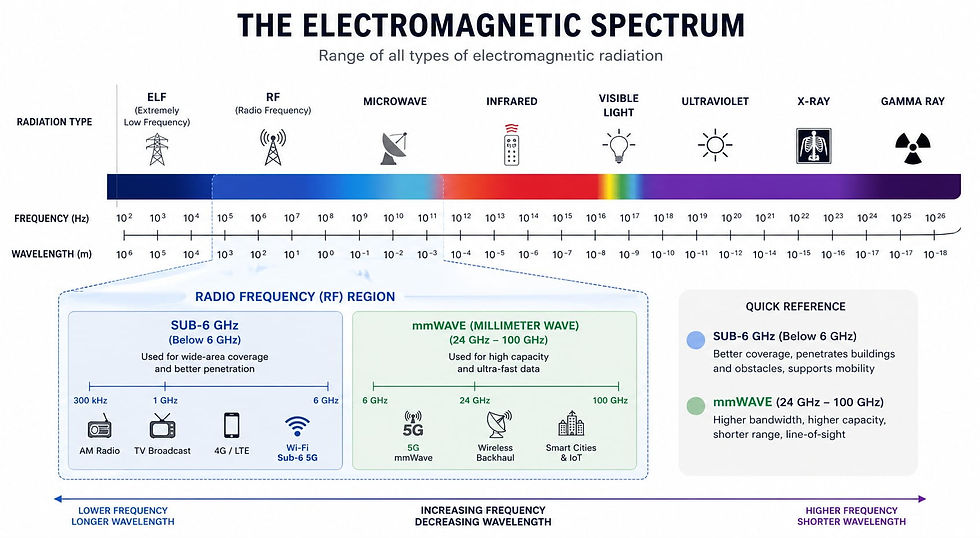
Lower frequencies travel farther and punch through walls. Higher frequencies carry more data but fade fast. The math is straightforward: wavelength equals the speed of light divided by frequency (λ = c/f). As frequency goes up, wavelength shrinks and so does range.
That tradeoff shapes every decision in 5G network design.
What Sub-6 GHz Actually Covers
Sub-6 GHz is exactly what it sounds like - any 5G band below 6 GHz. In practice, that covers a fairly wide range:
Low band (below 1 GHz): 600 MHz, 700 MHz, 800 MHz — long range, good building penetration, lower speeds
Mid band (1–6 GHz): 1800 MHz, 2100 MHz, 2300 MHz, 3500 MHz — a middle ground between coverage and capacity
Most 5G networks around the world are built primarily on sub-6 GHz. It's not glamorous, but it's reliable and it scales.
What mmWave Actually Covers
Millimeter wave sits above 24 GHz, where wavelengths shrink to between 1 mm and 10 mm. Common 5G mmWave bands include 24 GHz, 26 GHz, 28 GHz, and 39 GHz.
The appeal is bandwidth. These frequencies offer channel widths that can exceed 400 MHz, compared to the 10 - 100 MHz typical of sub-6 bands. More bandwidth means more data throughput - potentially gigabits per second.
The catch is everything else.

Propagation: Where the Physics Gets Uncomfortable
This is where mmWave's limitations become concrete. Free space path loss scales with the square of frequency. Double the frequency, quadruple the loss. At 28 GHz, you're dealing with far more attenuation than at 3.5 GHz and that's in open air. Add a wall, a tree, a person standing between the transmitter and receiver, and the signal can drop to nothing.
Sub-6 GHz signals can travel several kilometers from a single tower and still provide usable signal indoors. mmWave cells typically cover tens to a few hundred meters under favorable conditions. Move indoors, and you may lose the connection entirely. There are documented cases of mmWave signals being blocked by a human hand on the phone.
Sub-6 GHz doesn't have that problem. It handles obstacles and distance without needing perfect line-of-sight.
Bandwidth, Speeds, and What the Numbers Mean
mmWave's big selling point is raw throughput. Channel bandwidths over 400 MHz translate to peak speeds of 1-10 Gbps under ideal conditions. Sub-6 GHz tops out at more like 100 Mbps to 1 Gbps depending on spectrum and network configuration.
In practice, mmWave's advertised peaks are rarely achieved outside of testing environments or extremely dense deployments. The speeds are real; the availability is not widespread.

Latency
Frequency alone doesn't determine latency. Sub-6 GHz networks, when properly configured with network slicing and edge computing, can hit latencies competitive with mmWave. That said, mmWave deployments often integrate naturally with edge infrastructure due to their dense, short-range architecture which help latency in the right setup.
Neither band has an inherent latency advantage at the physics level. It's more about how the network is built around the antenna.
Coverage and Deployment Reality
A single sub-6 GHz tower can serve an area several kilometers across. A single mmWave small cell serves a few hundred meters. The infrastructure math for mmWave is therefore brutal. You need many more nodes to cover the same geography, each requiring power, fiber backhaul, and mounting hardware.
mmWave deployments make sense in high-density venues: sports stadiums, convention centers, airports, dense city blocks. Trying to cover a suburb or a rural area with mmWave would be economically absurd given current technology.
Sub-6 GHz handles the coverage layer. mmWave handles capacity in specific hotspots. That's essentially how carriers are deploying them, not as competitors, but as a layered system.

Beamforming: How mmWave Compensates for Its Range Problem
Because mmWave wavelengths are so short, antenna arrays can pack dozens or hundreds of elements into a small form factor. This makes sophisticated beamforming practical. The antenna system steers a narrow, highly directional beam toward the receiver rather than broadcasting in all directions.
This helps mmWave recover some of the gain it loses to path loss, and it reduces interference between nearby cells. Sub-6 GHz systems use beamforming too, but the antenna arrays are physically larger and the beams are wider due to the longer wavelengths.

Infrastructure and Cost
mmWave demands more from the network:
Dense small cell deployment (one cell per building entrance in some cases)
Fiber backhaul at every node
Advanced antenna hardware capable of beamforming at high frequencies
More power consumption due to complex signal processing
Sub-6 GHz is more forgiving. You can cover a city with macro towers, which is why it got deployed first and fastest.
Where Each Band Gets Used
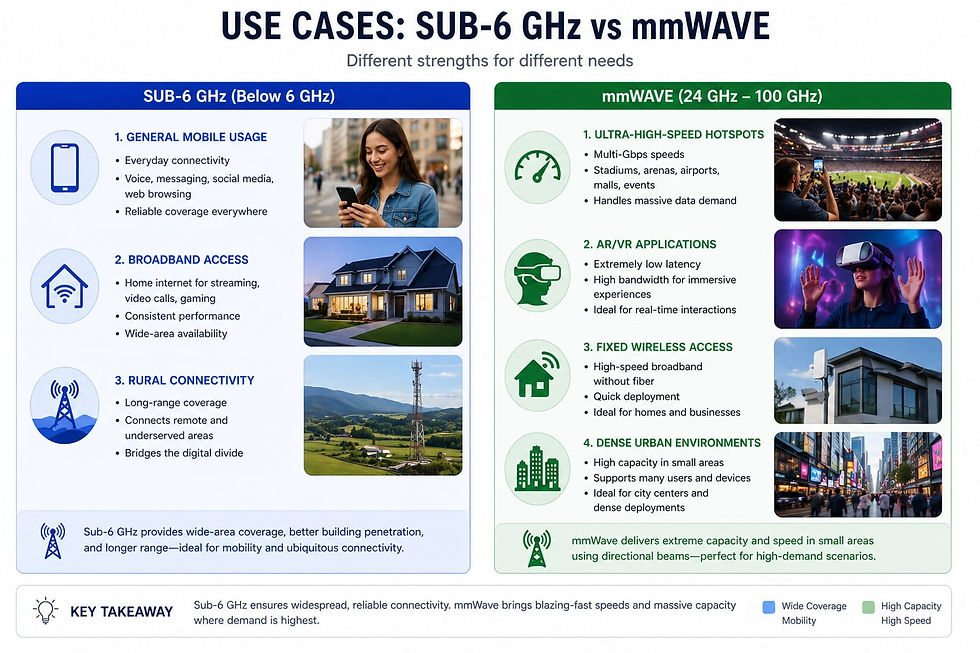
Sub-6 GHz makes sense for general mobile use, home broadband, rural connectivity, and any situation where coverage area and building penetration matter. It's the default 5G experience for most users most of the time.
mmWave makes sense for ultra-high-speed hotspots, fixed wireless in dense urban areas, AR/VR applications that need very high throughput, and venues where thousands of people are simultaneously connected.
What Comes Next
5G spectrum strategy is still evolving. Dynamic spectrum sharing in which 4G and 5G share the same band simultaneously is already deployed in some markets. Satellite integration, AI-driven beamforming, and the development of even higher frequency bands (sub-terahertz) are in research stages.
The physics aren't going to change. Higher frequencies will always mean more bandwidth and less range. But the engineering around those constraints keeps getting more sophisticated.
The Bottom Line
Sub-6 GHz and mmWave aren't competing visions for 5G, they're two tools solving different problems. Sub-6 gives carriers the coverage footprint to call something a "5G network." mmWave gives them the capacity to handle serious throughput in the places that actually need it.
Most people experience 5G on sub-6 spectrum most of the time. The mmWave speeds you see in carrier ads exist, but they require being in the right place, ideally standing still, near a small cell, without anything in the way.
That's not a knock on the technology. It's just what the physics demands.


Comments