What Happens When You Make a Phone Call: The Complete Technical Guide
Updated: Apr 25

Making a phone call is one of the most common technological actions humans perform every day. You tap a contact, press the call button, and within seconds your voice reaches another person—possibly across the world.
Although this process appears simple from the user’s perspective, it involves a highly sophisticated chain of telecommunications systems, including radio communication, authentication protocols, signal processing, switching systems, and global network infrastructure.
Modern phone calls travel through complex layered networks involving cell towers, radio access networks, core networks, signaling systems, and sometimes the internet itself. The process varies depending on the technology used, such as traditional circuit-switched networks, Voice over LTE (VoLTE), or Voice over 5G.
This article explores the complete technical journey of a phone call, beginning the moment you press the call button and ending when the other person hears your voice.
The Layers of Modern Telecommunications
Before diving into the call process itself, it is important to understand that telecommunications networks operate in multiple layers.
These layers include:
User Device Layer – smartphones and SIM cards
Radio Access Network (RAN) – cellular towers and base stations
Transport Network – fiber and microwave backhaul
Core Network – switching systems and subscriber management
Interconnection Networks – global routing infrastructure
Each layer performs specific functions required to establish and maintain communication.

Initiating the Call on Your Smartphone
When you tap the call button on your smartphone, the device begins the call initiation procedure.
Internally, the smartphone performs several actions simultaneously.
First, the device generates a call setup request containing information such as:
The phone number being dialed
The identity of the calling subscriber
The device’s current cell location
The requested service type (voice call)
The smartphone then sends this request to the nearest base station using the radio interface.
Modern smartphones communicate with the network using the Uu interface, which is the standardized air interface between the mobile device and the base station.
Before any communication occurs, the phone must already be registered with the cellular network.
This registration process occurs when the device powers on or moves into a new location area.
Radio Communication with the Cell Tower
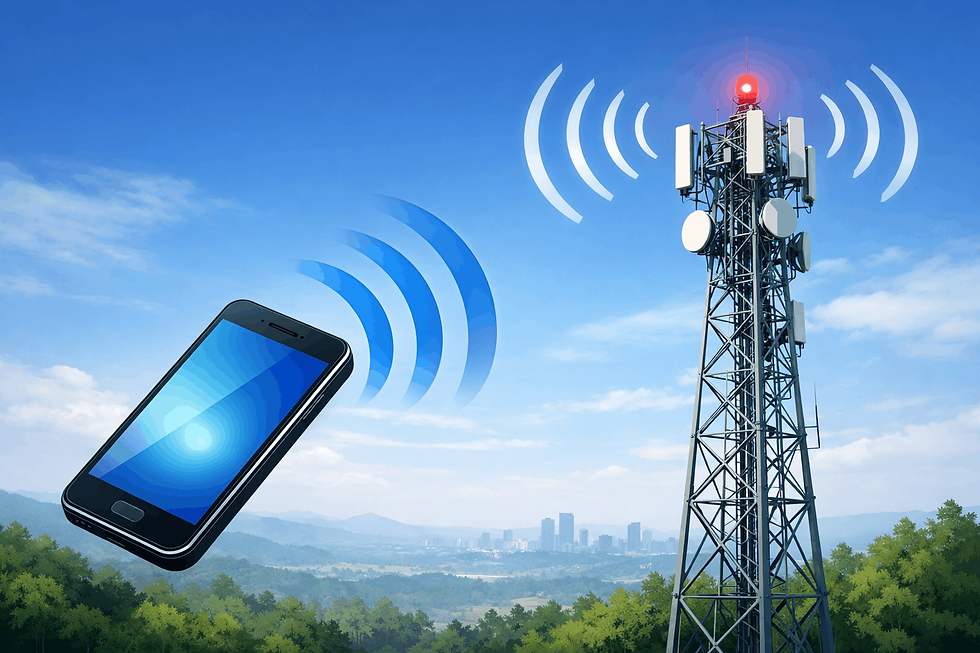
Once the call request is generated, the smartphone transmits the request using radio frequency signals.
These signals are transmitted through the device’s cellular antenna and travel through the air toward the nearest cell tower.
The tower that receives the signal is known as the serving base station.
Depending on the network technology, the base station may be called:
BTS (Base Transceiver Station) in GSM networks
NodeB in 3G networks
eNodeB in LTE networks
gNodeB in 5G networks
The base station receives the radio signal and forwards it to its baseband processing equipment.
This equipment performs several operations:
Signal amplification
Filtering and noise reduction
Demodulation
Decoding of digital data
Once decoded, the call setup request is forwarded to the mobile core network.

Authentication and Subscriber Verification
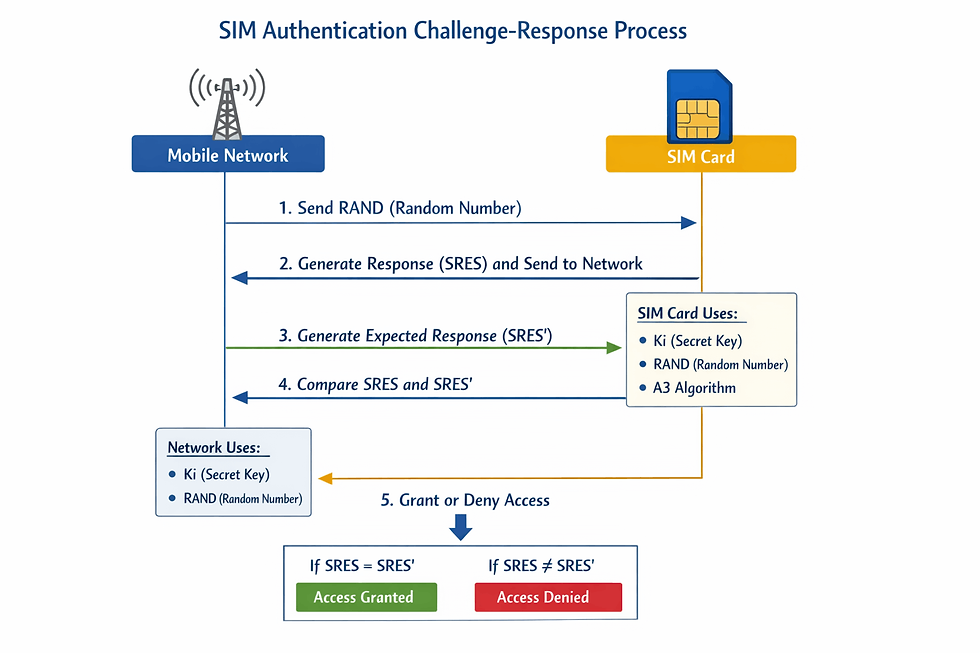
Before the network allows a call to proceed, it must verify that the caller is a legitimate subscriber.
Authentication is performed using the SIM card, which contains several critical identifiers.
These include:
IMSI (International Mobile Subscriber Identity)
Ki authentication key
Temporary identifiers used for privacy
The network sends a challenge to the device using a cryptographic algorithm.
The SIM card calculates a response using its secret key.
If the response matches the network’s expected value, the subscriber is authenticated successfully.
This process prevents unauthorized devices from accessing the network.
Determining the Call Routing Path
Once the caller is authenticated, the network must determine how to route the call to the recipient.
This decision depends on several factors:
Whether the recipient is on the same network
Whether the recipient is on another telecom operator
Whether the recipient is using VoLTE, traditional voice, or internet calling
The geographic location of the recipient
To determine the recipient’s location, the network queries databases such as:
Home Subscriber Server (HSS)
Visitor Location Register (VLR)
These databases store information about where subscribers are currently registered.

Call Setup in the Core Network
The core network acts as the central control system of a telecommunications provider.
Its responsibilities include:
Call routing
Subscriber management
Mobility management
Billing and charging
Inter-network connectivity
In modern LTE networks using VoLTE, voice calls are handled by the IP Multimedia Subsystem (IMS).
IMS is a complex architecture designed to support multimedia communication services.
Key IMS components include:
Call Session Control Function (CSCF)
Media Gateway
Application Servers
Subscriber Databases
These components work together to establish a voice session between the caller and the recipient.

Locating the Recipient
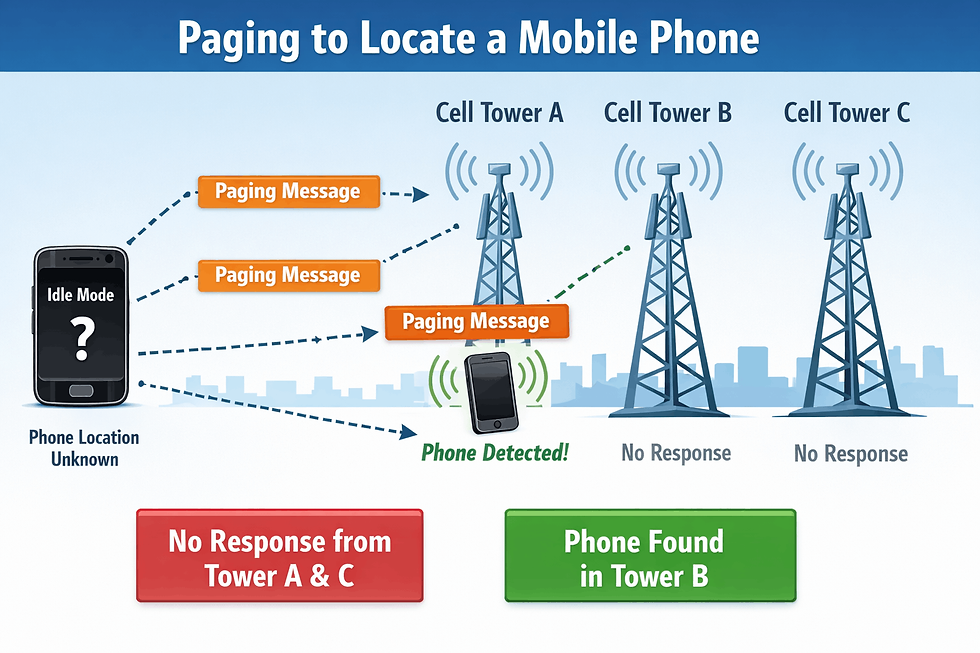
The next step is to locate the recipient’s device. When a phone is powered on, it periodically updates its location with the network. This allows the network to determine which cell tower currently serves that device.
When a call arrives, the network sends a paging request to the relevant cell towers. Paging messages are broadcast across the recipient’s last known coverage area. If the phone is present in that area, it responds to the paging request.
Establishing the Voice Channel
Once the recipient’s device responds, the network establishes a dedicated communication channel between the two phones. Depending on the network technology, this channel may be created using different methods.
Circuit-Switched Calls
In older networks such as GSM and 3G, voice calls use circuit switching.
This method reserves a dedicated communication channel for the entire duration of the call.
Although reliable, circuit switching is inefficient because the channel remains reserved even when no one is speaking.
Packet-Switched Voice (VoLTE)
Modern networks use packet-switched voice communication. In this method, voice data is converted into digital packets and transmitted over IP networks. This approach allows the network to share bandwidth more efficiently.
Voice packets are transmitted using Real-time Transport Protocol (RTP).

Converting Your Voice into Digital Data
When you speak into your phone, the microphone converts sound waves into electrical signals.
These signals are processed by the phone’s digital signal processor. The audio signal undergoes several transformations:
First, the signal is sampled, typically at 8 kHz or higher.
Next, the signal is quantized and converted into digital data.
Compression algorithms such as AMR (Adaptive Multi-Rate codec) reduce the amount of data required for transmission.
This process ensures efficient use of network bandwidth.

Transmitting Voice Packets Through the Network
Once encoded, voice data is transmitted through the network in small packets.
Each packet contains:
A portion of audio data
Timestamps for synchronization
Addressing information
These packets travel through the cellular network using IP routing mechanisms. If the call is between two users on the same operator network, packets remain within the
operator’s infrastructure.
If the call crosses networks, it may pass through interconnection gateways.
Delivering the Voice to the Recipient
When the packets reach the recipient’s base station, they are transmitted over the air interface to the receiving phone.
The receiving phone performs the reverse of the earlier process.
It:
Receives the radio signal
Decodes the digital packets
Reconstructs the audio waveform
Sends the signal to the speaker
The recipient then hears the caller’s voice.

Latency and Call Quality
Modern voice calls must maintain extremely low latency to enable natural conversation.
Typical latency values include:
4G VoLTE latency: 30–50 ms
5G voice latency: as low as 10 ms
Several factors affect call quality:
Network congestion
Signal strength
Interference
Codec efficiency
Technologies such as Quality of Service (QoS) ensure that voice packets receive priority over less time-sensitive traffic.
Handover During a Call
If you move while on a call, the network must transfer your connection to another cell tower. This process is known as handover.
During handover:
The network measures signal strength from neighboring towers
The best target tower is selected
The connection is transferred seamlessly
This process typically occurs within milliseconds.
Without handovers, calls would drop whenever users moved between coverage areas.

Security in Voice Calls
Modern cellular voice communication includes multiple security mechanisms.
These include:
Encryption of radio signals
Subscriber authentication
Protection against identity tracking
Encryption algorithms ensure that voice data cannot be intercepted easily. Security improvements in newer generations of cellular networks further enhance privacy.
The Global Telecommunications Infrastructure
A single phone call may travel across enormous distances.
The infrastructure enabling this communication includes:
Millions of cell towers
Global fiber optic networks
Satellite links
International telecom exchanges
These systems together form the backbone of modern telecommunications.
Conclusion
A phone call may seem like a simple interaction, but it involves an intricate sequence of processes spanning multiple layers of telecommunications infrastructure.
From the moment a call is initiated, signals travel through radio networks, base stations, authentication systems, switching centers, and routing infrastructure before reaching the recipient.
Advances in technologies such as VoLTE, IMS, and 5G have transformed how voice communication operates, replacing traditional circuit switching with highly efficient packet-switched networks.
Understanding the technical journey of a phone call highlights the remarkable engineering that enables instant global communication in the modern world.


Comments