Understanding Reliance Jio’s 5.5G Network Features: Truly Revolutionary or Just Marketing Hype?
Updated: Apr 25
Key Highlights
Reliance Jio is pioneering the 5.5G network, an advancement on existing 5G technology.
5.5G boasts significantly faster speeds, reaching up to 10 Gbps download and 1 Gbps upload.
This new technology utilizes Component Carrier Aggregation (3CC), allowing devices to connect to multiple network cells, including towers, simultaneously.
The OnePlus 13 series is leading the charge as the first line of smartphones compatible with Jio’s 5.5G network.
Benefits for consumers include smoother streaming, faster downloads, enhanced gaming experiences, and improved call quality.
Introduction
Reliance Jio is making waves in the tech world with the rollout of its 5.5G network, a leap forward that promises to redefine mobile connectivity in India. Building upon the foundation of 5G, this advancement aims to unlock significantly faster speeds and lower latency, enhancing user experiences across a variety of applications.
Unveiling 5.5G: The Evolution of Connectivity
The journey of wireless networks has been one of constant evolution, with each generation bringing substantial improvements in speed, capacity, and functionality. From the early days of 1G to the current landscape of 5G, the goal has remained consistent: to provide faster, more reliable, and feature-rich connectivity.
5.5G signifies the next chapter in this evolution, picking up where 5G leaves off and pushing the boundaries of what wireless networks can achieve. With a focus on higher data rates, lower latency, and greater capacity, 5.5G is poised to revolutionize how we live, work, and play.
Defining 5.5G: Beyond Standard 5G Networks
While 5G ushered in an era of unprecedented speed and responsiveness, 5.5G takes these advancements several steps further. It’s not simply an incremental upgrade; it introduces fundamental changes that enable a new class of applications and experiences.
One of the defining features of 5.5G is its ability to aggregate multiple network cells, resulting in significantly higher speeds compared to standard 5G networks. This aggregation, facilitated by technologies like Component Carrier Aggregation (3CC), allows devices to harness the combined bandwidth of multiple towers, leading to a substantial boost in download and upload speeds.
Beyond speed, 5.5G also focuses on enhancing capacity and coverage. It achieves this by employing advanced antenna technologies and optimizing network resources, ensuring a more robust and reliable connection even in densely populated areas.
The Leap from 5G to 5.5G: Key Enhancements and Capabilities
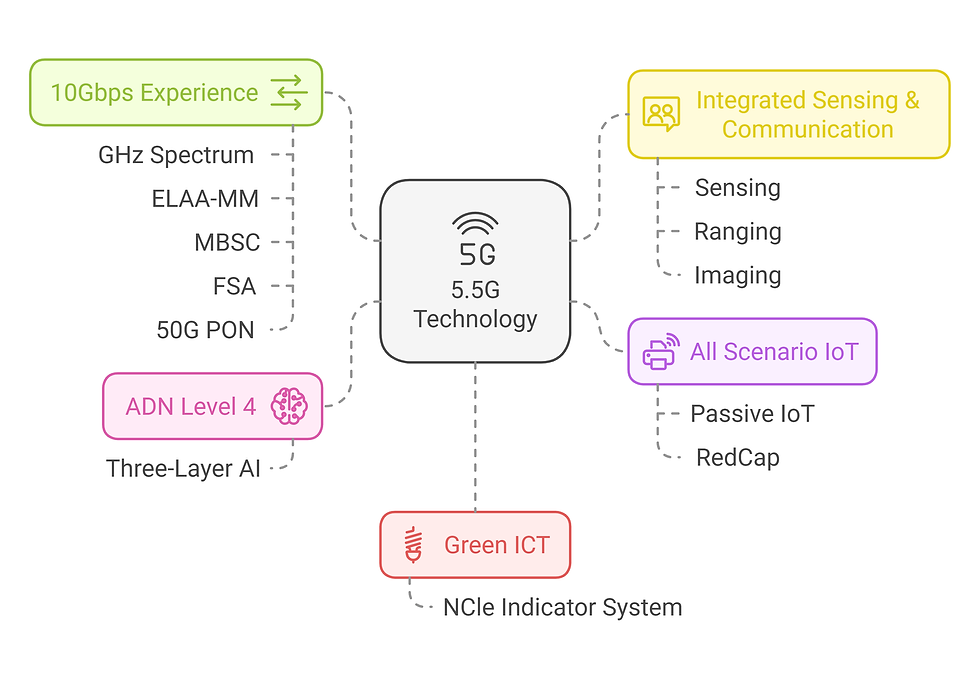
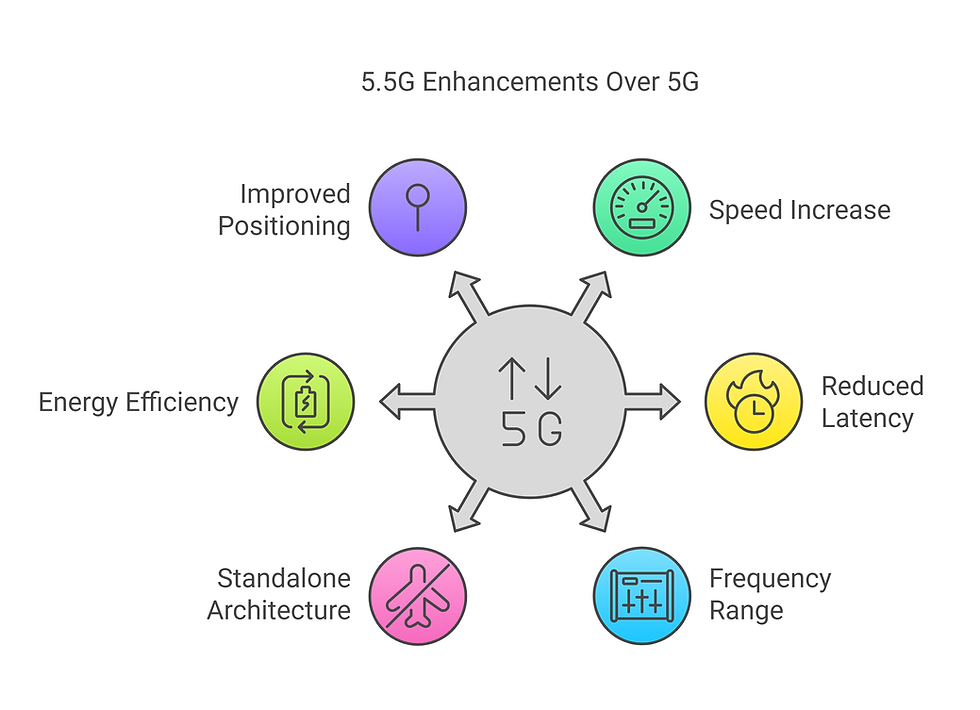
The transition from 5G to 5.5G brings several key enhancements that directly translate to a better user experience. Faster download speeds are just the tip of the iceberg. This new generation of network technology unlocks a world of possibilities, from immersive XR experiences to seamless cloud gaming.
One of the most notable improvements is in the realm of latency. 5.5G drastically reduces latency, the delay between sending a request and receiving a response, enabling near-instantaneous interactions. This is particularly crucial for applications that demand real-time responsiveness, such as online gaming, video conferencing, and augmented reality.
Furthermore, 5.5G introduces advanced intelligence features that optimize network performance based on real-time demands. This ensures consistent connectivity and quality of service, even in scenarios with high user density.
Technical Specifications and Performance Metrics of 5.5G
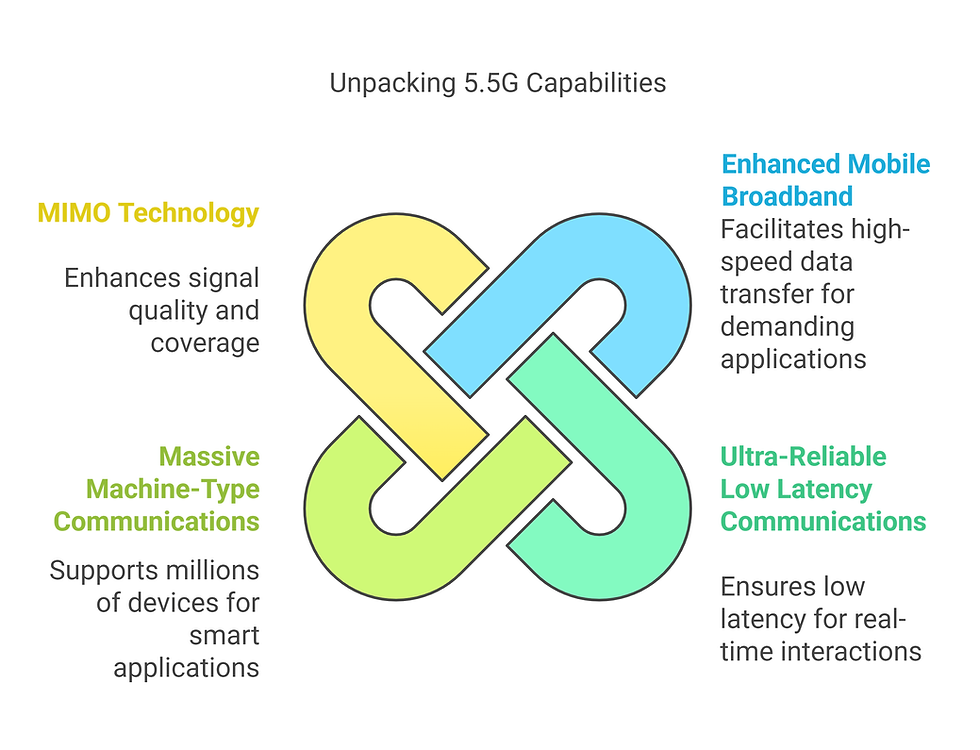
To fully grasp the capabilities of 5.5G, it is essential to delve into its technical specifications and performance metrics that set it apart from its predecessor. The cornerstone of 5.5G technology lies in its implementation of advanced features such as Enhanced Mobile Broadband (eMBB), Ultra-Reliable Low Latency Communications (URLLC), and massive Machine-Type Communications (mMTC).
eMBB facilitates high-speed data transfer, achieving peak download speeds of up to 10 Gbps. This improvement supports high-definition video streaming, augmented reality (AR), and virtual reality (VR) applications. On the other hand, URLLC ensures low latency of around 1 millisecond, enabling applications that require real-time interactions, such as remote surgery and autonomous vehicles.
Additionally, 5.5G brings improved network efficiency, with the ability to support millions of connected devices in a single area. This capability makes it ideal for smart cities and IoT applications, where numerous sensors and devices need to communicate seamlessly.
Furthermore, with the use of Multiple Input Multiple Output (MIMO) technology, 5.5G enhances signal quality, allowing for better coverage and performance in densely populated environments. Overall, the technical specifications of 5.5G herald a new era of connectivity that promises unprecedented performance and reliability for consumers and businesses alike.
The Impact of 5.5G on Consumer Technology
The advent of 5.5G is set to have a profound impact on consumer technology, pushing the boundaries of what’s possible on mobile devices. As smartphones and other connected gadgets become more powerful and feature-rich, the demand for faster, more reliable connections will only continue to grow.
5.5G empowers device manufacturers to create experiences that were previously unimaginable, blurring the lines between the physical and digital worlds. The implications span across industries, from entertainment and communication to healthcare, education, and beyond.
5.5G Smartphones: Adapting to New Speeds
As with any generational leap in network technology, new smartphones are being designed to harness the full potential of 5.5G. The OnePlus 13 series, launched in collaboration with Jio, is the first line of smartphones to support the 5.5G service. These devices come equipped with advanced modems and antennas capable of handling the unprecedented speeds and low latency that 5.5G offers, and they are specially engineered to integrate seamlessly with Jio’s advanced network.
During the OnePlus 13 showcase, Jio demonstrated the 5.5G capabilities. On the standard carrier, download speeds peaked at 277.78 Mbps, while on the 3CC component carrier, speeds exceeded 1,014 Mbps, showcasing the potential of the new network.
With peak speed capabilities exceeding 1 Gbps, 5.5G smartphones will fundamentally change how we interact with data-intensive applications. Streaming 4K and even 8K video content becomes seamless, large file downloads take a matter of seconds, and online gaming reaches new heights of responsiveness.
These advancements go beyond mere entertainment. 5.5G smartphones pave the way for innovative applications in fields such as augmented and virtual reality, enabling highly immersive and interactive experiences that rely on lightning-fast data transfer and ultra-low latency.
Compatibility: Can Current 5G Devices Upgrade to 5.5G?
One of the most common questions surrounding the emergence of 5.5G is whether current 5G devices can be upgraded to support this new technology. Unfortunately, a simple software update isn’t sufficient to bridge the gap.
5.5G requires specialized hardware components, including different modems and antennas, that are not present in existing 5G devices. To access the full spectrum of 5.5G capabilities, consumers will need to upgrade to smartphones and devices specifically designed for this new standard.
Feature | 5G | 5.5G |
Network Standard | 5G NR | 5G-Advanced (5.5G) |
Peak Download Speeds | Up to 1 Gbps | Up to 10 Gbps |
Latency | Low | Ultra-low |
Component Carrier Aggregation | Supported (2CC) | Enhanced with 3CC |
5.5G’s Potential Hinges on Backhaul Capacity in India
As the world moves towards the deployment of 5.5G, or 5G Advanced, the conversation has shifted from merely achieving higher speeds to ensuring that the underlying infrastructure can support the massive influx of data. One of the most significant challenges for 5.5G, particularly in India, is the sufficiency of backhaul capacity. Despite the advancements in radio access technology, the backhaul — the part of the network that connects the cell sites to the core network — often becomes a bottleneck, especially in densely populated areas.
Understanding Backhaul and Its Role in Network Performance
Backhaul refers to the intermediate links between the core network and the smaller subnetworks at the edge of the network, such as cell towers or base stations. In the context of 5G and 5.5G, backhaul serves as the conduit through which vast amounts of data generated by users are transmitted back to the core network. The capacity and performance of this backhaul determine the overall efficiency, speed, and reliability of the network.
In advanced networks like 5.5G, which promise ultra-reliable low latency communications (URLLC), enhanced mobile broadband (eMBB), and massive machine-type communications (mMTC), the backhaul infrastructure must handle exponentially more data than its predecessors. A high-capacity backhaul is crucial for realizing the potential of these use cases, particularly in a market like India, where the demand for mobile data is continually on the rise.
The Challenge of Backhaul Saturation in India
India’s mobile networks serve one of the largest user bases in the world. This dense user environment means that even backhaul links with a capacity of 10 Gbps can become overwhelmed during peak hours. In many urban centers, the sheer number of concurrent users, each demanding high-speed, low-latency connections, leads to significant congestion. Despite being connected through fiber backhaul, these networks can see performance degrade to levels reminiscent of 3G speeds, especially during times of heavy usage.
The introduction of Fixed Wireless Access (FWA) services over 5G has further strained backhaul resources. FWA aims to deliver high-speed broadband to homes and businesses through wireless connections, utilizing the 5G network. While this offers an alternative to traditional wired broadband services, it places additional load on the already saturated backhaul links. As more users switch to FWA for their primary internet needs, the backhaul demand surges, leading to potential slowdowns and increased latency.
Technical Considerations for Enhancing Backhaul Capacity
For 5.5G to function as intended, Indian network operators must focus on significantly upgrading the backhaul infrastructure. Here are some of the key technical strategies that could help alleviate the backhaul bottleneck:
Fiber Expansion: Increasing the fiber penetration is a straightforward but critical step. Fiber-optic cables offer significantly higher bandwidth and lower latency compared to traditional microwave or copper-based backhaul solutions. Expanding fiber to more cell sites will help manage the increased data load.
Microwave and Millimeter-Wave Backhaul: While fiber is ideal, deploying fiber to every cell site, especially in remote or urban-dense areas, may not be feasible. In such cases, microwave and millimeter-wave backhaul can provide high-capacity, low-latency alternatives. Technologies like E-band (70/80 GHz) can offer multi-gigabit speeds and can be used to complement fiber deployments.
Network Slicing and QoS Prioritization: Implementing network slicing allows operators to allocate specific slices of the network for different services, ensuring that critical applications receive the necessary bandwidth. Quality of Service (QoS) prioritization ensures that essential traffic, such as emergency services or industrial applications, is not affected by congestion.
Edge Computing and Local Caching: By deploying edge computing solutions closer to the user, data can be processed locally rather than being sent back to the core network. This reduces the load on the backhaul and minimizes latency. Similarly, local caching of frequently accessed content can alleviate backhaul congestion.
Software-Defined Networking (SDN) and Network Function Virtualization (NFV): SDN and NFV can help operators dynamically manage network resources, optimize traffic flow, and scale capacity as needed. This flexible approach allows for better utilization of existing backhaul resources and can help mitigate congestion during peak periods.
The Road Ahead for 5.5G in India
For 5.5G to deliver on its promises of enhanced speed, ultra-low latency, and massive connectivity, a robust backhaul infrastructure is non-negotiable. Indian telecom operators and policymakers need to invest in upgrading the backhaul network to meet the growing demands of modern mobile usage. Without these investments, the advanced features of 5.5G could be rendered moot, leaving users with subpar experiences.
The success of 5.5G in India will not be determined solely by the deployment of advanced radio technologies but by the backbone that supports them. Only by addressing the backhaul capacity challenges can the full potential of 5.5G be realized, ensuring a future of seamless, high-speed connectivity for all.
Conclusion
Reliance Jio’s 5.5G network marks a significant leap in connectivity, offering enhanced speeds and capabilities beyond standard 5G networks. As consumer technology evolves to adapt to this new era, the impact of 5.5G on smartphones and device compatibility is a key consideration. With the promise of improved user experiences and faster speeds, the transition to 5.5G presents exciting possibilities for consumers. Stay informed about the advancements in connectivity and how they may shape the future of technology.
Frequently Asked Questions
What Differentiates 5.5G from 5G in Terms of Speed?
5.5G offers significantly faster speeds compared to 5G. While 5G peaks at around 1 Gbps, 5.5G can reach up to 10 Gbps, making downloads, streaming, and data-intensive tasks incredibly faster.
How Will 5.5G Improve User Experience Compared to 5G?
5.5G will improve user experience by delivering lower latency for near-instantaneous responses, significantly faster download and upload speeds, and more stable connections, even in crowded areas.
Are There Any 5.5G Smartphones Available in the Market?
Yes, the first line of smartphones supporting 5.5G, including the OnePlus 13 series, are now available in the market, offering a glimpse into the future of mobile connectivity.
Can Existing 5G Phones Be Updated to Support 5.5G?
Unfortunately, existing 5G phones cannot be updated to support 5.5G. The new technology requires different hardware components that are not present in current 5G devices.
What Are the Expected Benefits of 5.5G for Average Consumers?
Average consumers will enjoy faster download and upload speeds, smoother streaming, lag-free gaming, enhanced call quality, and seamless connectivity thanks to 5.5G’s advanced intelligence features.


Comments