Airtel Launches Priority Postpaid With 5G Network Slicing: What It Means for Indian Users

Airtel has rolled out Priority Postpaid, a new tier for postpaid customers that uses 5G network slicing to deliver a more stable mobile experience, particularly in congested areas. The service is available across Airtel postpaid plans, and existing customers get it automatically on compatible devices. You'll need a 5G SA-enabled smartphone with up-to-date software to actually see any difference.
It's a notable shift from the usual "everyone gets the same pipe" model toward something that actually accounts for network quality. Airtel is calling itself the first Indian telecom to introduce slicing-based 5G for consumers, placing it alongside operators in the US, Singapore, the UK, and Malaysia.
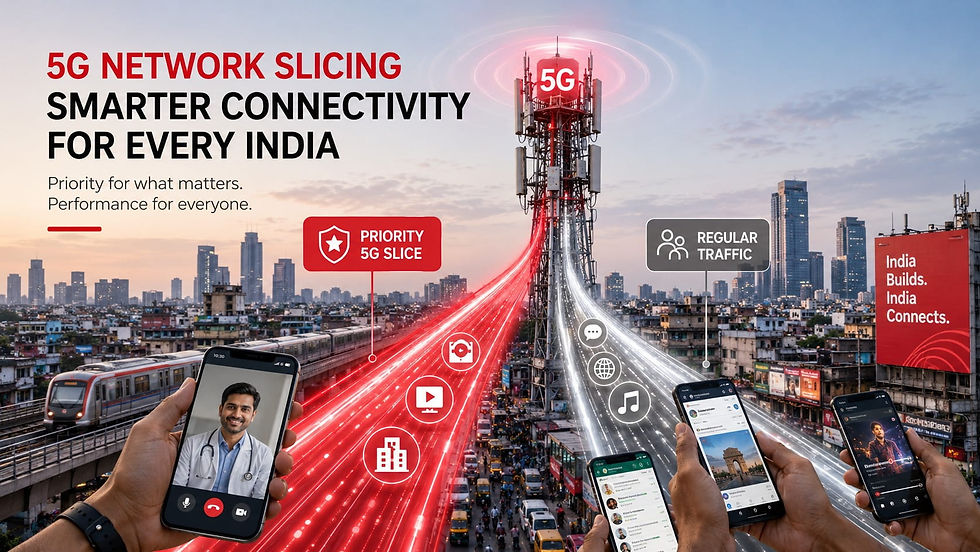
What Is 5G Network Slicing?
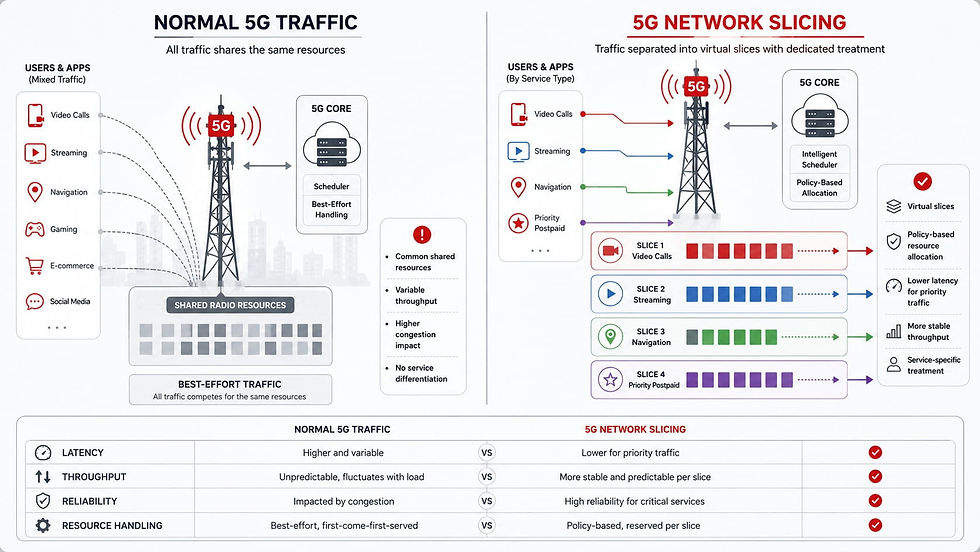
Network slicing is one of those 5G features that rarely gets explained well. Here's the short version: it lets a telecom carve one physical 5G network into several virtual layers, each tuned for a different purpose.
One slice might be set up for high-speed broadband, another for low-latency industrial use, another for IoT devices, and so on. The physical infrastructure is shared but the network treats each slice differently based on what it's supposed to do.
For Priority Postpaid, users don't get a private tower or a reserved chunk of spectrum. What they get is a smarter allocation of available resources when the cell is under load. Airtel says its slicing setup can dynamically segment network capacity to improve stability during high-traffic periods.
Why This Matters in Real Life
Here's something most people don't realize - full signal bars don't guarantee good performance. A tower can be completely overwhelmed even when your phone shows five bars. You might see that in railways stations, concerts, markets, airports, stadiums - anywhere thousands of people are attached to the same cell sector simultaneously. The tower then has to divide limited time-frequency resources across all of them, and things get messy fast.
That's exactly the scenario Airtel is going after with Priority Postpaid - client calls stuck in traffic, streaming at a packed event, booking a cab at a crowded market. The situations where mobile data tends to fall apart right when you need it most.

The Engineering Behind It
To understand what's actually happening, it helps to separate speed, coverage, and quality of service - the three things that get lumped together but behave very differently.
Traditional mobile networks serve users based on radio conditions, available spectrum, and traffic load. When a tower is lightly loaded, even a regular user can get great speeds. When demand rises, performance becomes unpredictable for everyone.
5G slicing lets operators apply more precise traffic treatment across both the radio access network and the 5G core. A slice can be configured with specific characteristics: how bandwidth is handled, how latency behaves, how traffic is prioritized. In practical terms, the network makes smarter decisions about whose traffic gets what treatment during congestion.
This doesn't create extra capacity out of thin air. A tower still has physical limits. But it can manage whatever capacity exists in a more controlled way, which for priority users can translate to fewer sudden experience drops and more consistent app performance.
How well this actually works depends on how deeply Airtel has integrated slicing across its 5G SA network - device compatibility, policy control, core configuration, scheduler behavior. The mention of "5G SA-enabled smartphone" is an important detail here, not just marketing language.
Why 5G SA Specifically
5G NSA uses 4G as an anchor for control signals. 5G SA runs on a dedicated 5G core. Most of the advanced features people associate with 5G including proper network slicing are better supported in the SA architecture.
So, when Airtel specifies "5G SA-enabled smartphone," that actually narrows things down. A phone being labeled "5G" doesn't automatically mean it supports Airtel's SA configuration. Users may also need carrier-specific software updates, modem compatibility, and support for the particular 5G bands Airtel has deployed.
Is This Good for Consumers?
For Airtel postpaid users, it's potentially useful if it holds up in real congested scenarios. And the benefit isn't peak speed but it's consistency. A steady 20-50 Mbps when everyone around you is struggling to load a webpage is genuinely more useful than a connection that flips between 200 Mbps and unusable.
That said, expectations should stay grounded. Priority doesn't mean guaranteed performance everywhere. Indoor coverage, weak signal, poor SINR, backhaul limitations, and device modem quality all still matter. If you're in poor coverage, slicing alone doesn't fix that.
The broader industry angle is arguably more interesting. Until now, network slicing has mostly been talked about in enterprise contexts - private 5G for factories, ports, hospitals. Bringing it to postpaid consumers changes what 5G monetization actually looks like in India.
Final Take
Airtel Priority Postpaid isn't rebranded marketing. It's an early, concrete example of Indian operators using 5G SA infrastructure to create actual service tiers rather than just advertising faster numbers. Whether it delivers depends on the depth of the implementation, but the direction is the right one. 5G is slowly moving from speed benchmarks toward something more useful: networks that behave intelligently under pressure.


But Jio already uses network slicing.
Airtel has just rebranded it and reserved this feature for postpaid only.
Since it is for limited number of customers, they'll benefit from it. But Airtel needs to use any other FDD band also for better coverage. n78 can't go far, so many Airtel customers won't be able to benefit from it. Better if they refarm any one band either 20 MHz B3 or 15 MHz whichever is available for 5G, could boost their offerings.