Restoring Over-the-Air Television in New York City After 9/11: The Complete Technical Story of Broadcast Engineering’s Greatest Emergency Recovery

How a shattered antenna farm, a race against time, and decades of RF expertise converged to bring New York’s TV signals back from silence—and eventually to the top of One World Trade Center
The Morning Everything Changed: What 9/11 Took From New York’s Airwaves
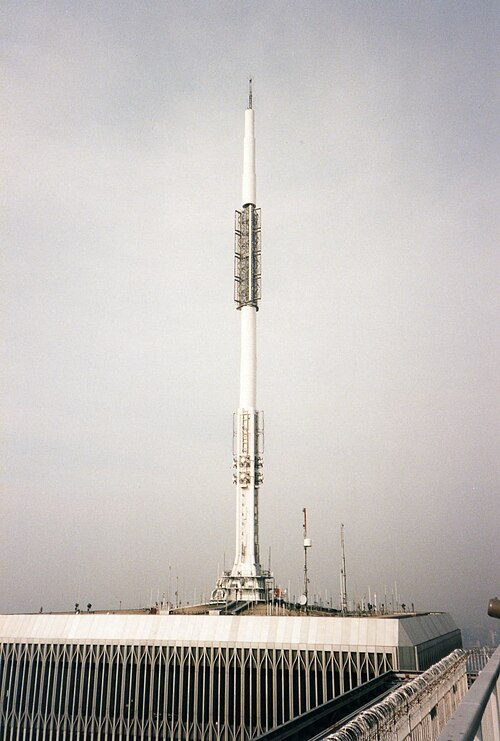
On September 11, 2001, the collapse of the World Trade Center towers didn’t just claim nearly 3,000 lives and reshape American foreign policy. It also obliterated the single most critical over-the-air television transmission site in the United States. Perched atop the North Tower’s 360-foot broadcast mast was an antenna farm serving approximately 10 million television households across five boroughs, northern New Jersey, Connecticut, and parts of Pennsylvania. When that mast fell, the signals of nine full-power television stations—including WNBC (NBC), WABC (ABC), WCBS (CBS), WNYW (Fox), WPIX, WNET (PBS), WWOR, WNJU (Telemundo), and WPXN—vanished instantaneously. For a city already reeling from unprecedented trauma, the loss of free over-the-air television meant the loss of an essential emergency communication lifeline precisely when residents needed it most.
The technical magnitude of what was destroyed cannot be overstated. The WTC broadcast facility had served as New York’s primary television transmission point since the early 1970s, when broadcasters migrated from the Empire State Building seeking the superior height advantage of the twin towers. The antenna system comprised multiple high-power transmitters operating across the VHF and UHF spectrum, each station’s signal carefully engineered for maximum coverage while managing adjacent-channel interference. The analog television infrastructure of 2001 demanded enormous physical plant: multi-kilowatt transmitters weighing thousands of pounds, rigid coaxial transmission lines running hundreds of feet up the building’s interior, and precisely tuned antenna arrays whose radiation patterns had been optimized over decades. All of it—every transmitter, every feedline, every panel antenna—was gone in under two hours.
What followed was arguably the most ambitious and emotionally charged broadcast engineering recovery operation in American history. Over the subsequent sixteen years, a rotating cast of RF engineers, tower climbers, equipment manufacturers, real estate developers, and FCC regulators would execute a multi-phase restoration that moved New York’s television signals from an emergency patchwork in rural New Jersey to a creatively compromised perch atop the Empire State Building, and ultimately to a purpose-built facility on the 90th floor and spire of One World Trade Center. This is the technical story of how that happened, told with the depth it deserves.
The Alpine Tower Emergency: Five Stations on the Air in Weeks
Within hours of the collapse, broadcast engineers across the New York metropolitan area faced a question with no modern precedent: how do you restore television service to the nation’s largest media market when its primary transmission infrastructure has been physically annihilated? The answer, arrived at almost simultaneously by multiple station engineering teams, pointed toward the Alpine Tower in Alpine, New Jersey—a 425-foot broadcast tower perched on the Palisades cliffs overlooking the Hudson River, roughly 13 miles northwest of Midtown Manhattan.
Charles Sackermann and his engineering team at Alpine Tower Company were already developing plans to house broadcasters in an adjacent building when the phones began ringing on September 11. Doug Lung, then Vice President of Engineering at Telemundo and a 50-year veteran of broadcast engineering, recalls initiating contact with Alpine while simultaneously calling equipment vendors to determine what could be sourced and delivered under emergency conditions. The logistics were staggering. This was the analog television era, meaning each station required not merely a transmitter but an entire signal chain: waveform monitors, stereo generators, distribution amplifiers, video and audio processing equipment, and patchbays. None of this equipment existed in surplus quantities sufficient to outfit five stations simultaneously.
What happened next demonstrated something remarkable about the broadcast engineering community under crisis. Manufacturers who normally quoted six-to-twelve-month delivery timelines for transmitters found units and shipped them within one to two weeks. Dielectric Communications, a leading antenna manufacturer, repurposed raw materials from existing inventory to fabricate replacement antennas. Customers in other markets voluntarily accepted delayed equipment deliveries so that New York stations could be prioritized. General Electric, which owned NBC at the time, dispatched trailer-mounted generators with uninterruptible power supplies to the Alpine site when it became clear that local utility infrastructure could not immediately support the combined electrical load of five high-power television transmitters.
The engineering challenges at Alpine were non-trivial. Five stations—WNBC, WABC, WPIX, WNET, and WNJU—needed antenna positions on a single tower structure, each requiring sufficient separation to prevent mutual coupling and intermodulation products. Daily coordination meetings addressed antenna placement, power distribution, rooftop cooling system installation, and transmission line routing. WNJU benefited from a fortunate circumstance: the station had an Inductive Output Tube (IOT) transmitter in storage in Brooklyn, originally procured for installation at the World Trade Center. That transmitter became the backbone of Telemundo’s emergency restoration.
WCBS-TV, the CBS owned-and-operated station, had maintained a backup transmission facility at the Empire State Building and was able to resume broadcasting almost immediately from that location. For the remaining stations, Alpine represented the fastest path back to the air. The result was extraordinary by any engineering standard: five major-market television stations restored to full-power operation within weeks of losing their entire transmission plant. For context, constructing a single new television transmission facility under normal circumstances typically requires eighteen months to three years of planning, permitting, fabrication, and installation.

The Empire State Building Interim Solution: Creative RF Engineering Under Constraint
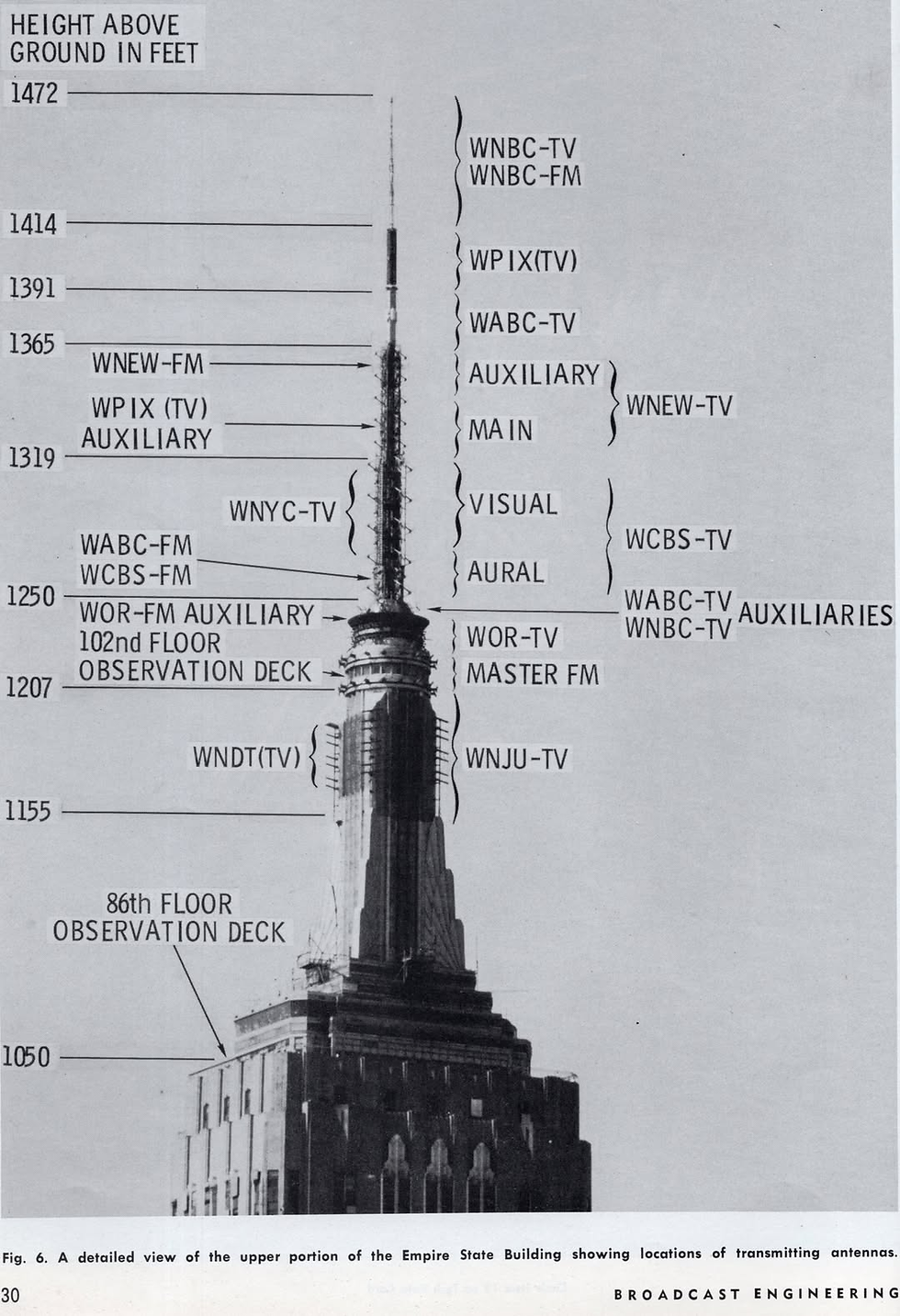
Alpine Tower was always understood to be a stopgap. While its elevation on the Palisades provided reasonable coverage into Manhattan and the western boroughs, it could not replicate the omnidirectional coverage pattern that the World Trade Center’s central Manhattan location and extreme height had provided. Signals to eastern Long Island, southern Brooklyn, and portions of Connecticut were degraded. The broadcast community recognized that returning to Manhattan’s skyline was essential for full service restoration, and the Empire State Building—New York’s original television transmission site from the 1950s through the early 1970s—was the logical destination.
However, the Empire State Building in 2001 was not the broadcast-friendly facility it had been in 1965. Decades of telecommunications evolution had filled its upper floors and mast structure with FM radio antennas, cellular infrastructure, and point-to-point microwave links. Space for television antennas and their associated transmission lines was severely constrained. The engineering solutions that emerged were, in Doug Lung’s characterization, necessarily creative.
For analog television restoration, some stations resorted to unconventional installations. One station essentially mounted a temporary low-band VHF panel antenna outside a window—a solution that would have been unthinkable under normal engineering review but was accepted under emergency circumstances. The final analog antenna configuration at Empire State Building placed several stations’ antennas below the mast structure rather than at its apex. WNJU, WPXN, and WNYW (Fox) had their antennas mounted between the structural “wings” below the mooring mast at the building’s crown.
Doug Lung personally designed the analog antenna system for WNJU at Empire using CAD modeling of the building’s geometry. His solution employed a standard wide-cardioid slot antenna oriented toward the northeast to cover the station’s primary audience area, supplemented by a fill-in panel antenna positioned between the structural wings to serve the southwest quadrant. The building’s wings themselves were exploited as natural RF shields to minimize the overlap zone where out-of-phase signals from the two antennas would create destructive cancellation nulls. The southeast overlap region, where pattern interference was unavoidable, fell predominantly over water, minimizing viewer impact. Installing the transmission line required routing it through a vertical shaft that, for fire code compliance, had to be sealed with brick after the line was pulled through—a permanent commitment that underscored the semi-permanent nature of what was intended as temporary infrastructure.
The digital television complication added another layer of difficulty. Broadcasters had begun DTV transmissions prior to 9/11 using a broadband panel antenna installed by WNBC. After the attacks, WNBC-DT operated temporarily from 30 Rockefeller Center using a 1 kW Comark transmitter and an Andrew AL-8 slot antenna mounted on the roof—a dramatic reduction in effective radiated power but sufficient for interim service. WCBS eventually installed a broadband panel antenna at Empire State Building that served a shared-signal arrangement covering WNBC, WWOR-TV, WABC-TV, WPIX, and WNET for their digital broadcasts. Space limitations meant this antenna was, by engineering admission, a compromise. WNJU could not accommodate a DTV antenna at Empire at all and instead built out a facility at the Richland tower site in West Orange, New Jersey, later supplementing coverage in Queens and Long Island with a Distributed Transmission System (DTS) transmitter at 4 Times Square.
The Search for a Permanent Home: Why One World Trade Center Wasn’t Obvious
In the years following 9/11, the Metropolitan Television Association (MTVA) and the Television All-Industry Committee—a coalition representing most New York City area broadcasters—actively explored the possibility of constructing a dedicated broadcast tower independent of any commercial real estate development. Multiple sites were evaluated, including Governor’s Island in New York Harbor and the Liberty Science Center campus in Jersey City. Engineering studies examined designs for towers reaching up to 2,000 feet that could fit within relatively small footprints. The goal was a structure purpose-built for broadcasting, unencumbered by the structural and aesthetic compromises that came with mounting antennas on office buildings.
None of these proposals materialized. The financing models never closed, political alignment among multiple jurisdictions proved elusive, and the broadcast industry was simultaneously navigating the federally mandated digital television transition, which consumed enormous capital and engineering attention. Meanwhile, the Empire State Building remained “good enough” for most stations, particularly as cable and satellite penetration in the New York market exceeded 80 percent, reducing the percentage of viewers who relied exclusively on over-the-air reception.
The calculus shifted decisively in 2016 when the FCC announced the broadcast television spectrum incentive auction. This proceeding, authorized by Congress in 2012, required many stations to change their operating channels to free up UHF spectrum for wireless broadband deployment. Critically, the FCC committed to covering the costs of stations displaced by the repack. Simultaneously, engineering studies revealed that upgrading the aging antenna systems at Empire State Building to accommodate post-repack channel assignments would be enormously expensive and physically constrained. One World Trade Center, then under construction with a 1,776-foot architectural height including its 408-foot spire, suddenly became financially and technically attractive.
Redesigning the One WTC Broadcast Facility: John Lyons and the Simplified Antenna System
The original broadcast engineering designs for One World Trade Center envisioned multiple antennas operating on different channels, enclosed within a radome at the spire’s apex. This approach, while technically conventional, presented two significant problems: maintenance access to antennas inside a radome at over 1,300 feet above street level would be extraordinarily difficult and expensive, and the cost of building out individual transmission systems for each station was prohibitive given that Empire State Building remained operational.
John Lyons, Assistant Vice President and Director of Operations at the Durst Organization—which co-owns One World Trade Center with the Port Authority of New York and New Jersey—reimagined the entire broadcast plant. Lyons discarded the multi-antenna, multi-channel approach and designed a simplified system built around two UHF antennas using Radio Frequency Systems (RFS) panels capable of variable polarization. The upper array consisted of 40 panels mounted near the top of the spire, while a larger 96-panel array was positioned lower on the spire structure. Additional antennas were provided for VHF television service. This configuration allowed multiple stations to share combiner systems feeding common antenna arrays, dramatically reducing the physical infrastructure required.
Lyons also convinced One WTC management to eliminate the radome entirely, opting for exposed antenna panels that could be accessed and serviced via the building’s spire maintenance systems. The transition from analog-era vacuum tube transmitters to modern solid-state transmitters eliminated the need for the massive transmitter rooms and dedicated cooling systems that had characterized broadcast facilities of previous decades. Without analog transmitters, without separate physical rooms for each station, and with consolidated combiner systems, Lyons fit the entire broadcast operation onto half of the building’s 90th floor. This consolidation reduced construction costs sufficiently to make One WTC financially competitive with continued Empire State Building operation.
One persistent engineering concern required resolution before broadcasters would commit: whether signals transmitted from One WTC’s lower Manhattan location would adequately penetrate the “midtown mountain”—the dense cluster of skyscrapers between the Financial District and Midtown—and whether coverage to northern Manhattan, the Bronx, and Westchester County would suffer compared to the more geographically centralized (though lower) Empire State Building. The height advantage of One WTC’s spire was significant, but RF propagation in a dense urban canyon environment is notoriously difficult to model. The MTVA determined that empirical field measurements were essential before any station would commit to the move.

The One WTC Signal Test: 3,096 Measurements Per Antenna in Under Ten Minutes Per Site
The testing methodology designed for the One WTC evaluation was itself an engineering innovation. Conventional FCC field-strength measurements require a technician to take readings at 30-foot antenna height along defined grids or radials—a slow, labor-intensive process unsuitable for the rapid multi-signal comparison this project demanded. Doug Lung designed an alternative approach that prioritized speed and statistical robustness.
The test platform was a van provided by CBS engineer Jeff Birch, with an engineer dedicated to driving the measurement routes. Bill Beam of Ion Media constructed a custom antenna support structure and test panel mounted on the van’s roof. The configuration employed four receive antennas: two horizontally polarized and two vertically polarized, mounted at opposite corners of the roof structure with orthogonal orientation to provide space diversity. This arrangement measured signal approximately eight feet above ground level—representative of typical indoor or low outdoor reception conditions—while the four-antenna diversity captured multipath variations that a single antenna would miss.
At each of 258 measurement sites across Manhattan, Brooklyn, Queens, the Bronx, Staten Island, and surrounding suburban areas, the system captured signals from ten transmitters at Empire State Building and two test signals (one VHF, one UHF) from One WTC. A complete measurement set—recording minimum, maximum, and average signal levels plus signal-to-noise ratio from each of the four antennas, along with lock acquisition data from a Hauppauge Aero-M mobile TV tuner and a Rohde & Schwarz ETL television analyzer—took under ten minutes. The total dataset comprised 3,096 individual measurements per antenna. Lung analyzed the results overnight and produced spreadsheet pivot-table summaries distributed to all MTVA member stations.
The data confirmed what modeling had suggested: One WTC’s extreme height compensated for its southern location. Coverage into midtown Manhattan and the northern boroughs was comparable to or better than Empire State Building in most locations, while coverage into Brooklyn and Queens improved significantly. The results gave broadcasters the confidence to proceed.
WNJU Signs On: The First Broadcast From One World Trade Center
On June 23, 2017, WNJU—Telemundo’s New York owned-and-operated station, Channel 47—became the first television station to broadcast from One World Trade Center. The station transmitted using a Rohde & Schwarz 108 kW solid-state transmitter, a dramatic technological evolution from the multi-megawatt analog transmitters that had occupied the original WTC broadcast rooms. The event was marked by a ceremony at the transmitter facility, attended by station executives, engineers, and representatives from the Durst Organization and Port Authority.
The choice of WNJU as the inaugural station carried historical resonance. The station had been among those whose signal was extinguished on September 11, 2001, and whose engineers had scrambled to restore service from Alpine Tower within weeks. Doug Lung, who had led Telemundo’s engineering response in 2001 and later contributed to the One WTC testing and design process, was present for the sign-on. The moment represented the closing of a sixteen-year arc from catastrophic loss to full restoration at a site that honored the memory of what had been destroyed.
Following WNJU, six MTVA member stations that had participated in the signal testing transitioned to One WTC. Eventually, five additional full-power and low-power stations joined, with other stations holding construction permits for the site. The two-antenna, two-combiner architecture proved its operational value during the July 2019 FCC repack channel changes, when stations could switch between the two combiner systems to maintain continuous broadcast while new channel assignments were integrated. This redundancy—designed into the system by Lyons from the outset—meant that no station suffered extended downtime during the most complex channel reassignment process in American broadcast history.
The Technical Architecture of One WTC Broadcasting: What Makes It Work

Understanding the One WTC broadcast facility requires appreciating several interrelated engineering decisions. The building’s 1,776-foot architectural height places its spire apex at approximately 1,368 feet above mean sea level, with the antenna arrays positioned between roughly 1,250 and 1,350 feet. This provides a height-above-average-terrain (HAAT) figure that exceeds the original World Trade Center mast and significantly surpasses Empire State Building’s 1,454-foot roof height (with its broadcast mast topping out around 1,454 feet as well, but from a lower base elevation).
The RFS panel antennas employed at One WTC support variable polarization, meaning they can be configured for horizontal, vertical, or elliptical polarization depending on the needs of the stations sharing the array. This flexibility was critical because the FCC repack reassigned stations to channels with different propagation characteristics, and some stations’ licenses specified particular polarization modes. The 96-panel lower array provides broader azimuthal coverage, while the 40-panel upper array offers enhanced gain for specific directional requirements.
The transmitter floor on the 90th level houses solid-state transmitters from manufacturers including Rohde & Schwarz, GatesAir, and others. Modern solid-state transmitters offer critical advantages over the klystron and IOT tube transmitters of the analog era: they are more power-efficient, generate less waste heat, require less physical space, offer graceful degradation (the failure of individual amplifier modules reduces power rather than causing total transmitter failure), and can be remotely monitored and controlled. A 108 kW solid-state transmitter occupies a fraction of the floor space and requires a fraction of the cooling capacity that an equivalent analog transmitter demanded.
The combiner systems that allow multiple stations to share a single antenna represent some of the most precise RF engineering in the facility. Each combiner must manage the simultaneous transmission of multiple carriers separated by as little as 6 MHz (the ATSC channel spacing) without generating intermodulation products that would cause interference. The isolation between ports, the insertion loss through the combiner network, and the VSWR (voltage standing wave ratio) at each interface must be maintained within tight tolerances across the full operating bandwidth. The dual-combiner architecture at One WTC provides the operational flexibility to take one combiner offline for maintenance or reconfiguration while the other continues serving its complement of stations.
The Human Element: Engineers Who Lost Friends and Built Anyway
Technical histories of broadcast infrastructure often omit the emotional dimension of the work, but any account of the post-9/11 restoration that ignores it is incomplete. Doug Lung has spoken publicly about the experience of arriving at Alpine Tower in the weeks after the attacks and finding a workforce—engineers, electricians, tower climbers, plumbers, contractors—united by a single purpose but individually carrying fresh grief. Most of the people working at the site had lost friends or colleagues on September 11. The act of pulling transmission line, bolting antenna panels, and aligning transmitters was, for many of them, an act of memorial as much as engineering.
John Lyons ensured that the broadcasters and broadcast engineers lost in the World Trade Center attacks were remembered during the launch events for the One WTC facility. Tower climbers and electricians who installed the new antenna arrays on the spire left handwritten messages at the base of the structure, memorializing colleagues who had not survived. These inscriptions remain visible beneath the rigging and transmission lines near the spire’s base—a quiet, permanent acknowledgment that the signals now radiating from that structure carry forward the work of those who were taken.
The broader broadcast community’s response extended beyond the engineers physically installing equipment. Network operations centers worked to ensure that cable headends and satellite uplinks could receive station programming via alternative paths when over-the-air signals were unavailable. Station groups provided personnel, funding, and logistical support. Manufacturers dispatched field engineers to New York on short notice. The FCC expedited special temporary authority (STA) filings and waived normal processing timelines. The recovery was, in every meaningful sense, an industry-wide mobilization.
The Broader Significance: Why Over-the-Air Television Still Matters in the Streaming Era
A reader in 2024 might reasonably ask why the restoration of over-the-air television signals merited such extraordinary effort, particularly in a market where cable and satellite penetration was already high and streaming services were on the horizon. The answer lies in the unique role broadcast television plays in emergency communications and universal information access.
Over-the-air television requires no subscription, no internet connection, no cable infrastructure, and no satellite dish. A battery-powered television with a simple antenna can receive emergency alerts, news coverage, and public safety information during power outages, natural disasters, or infrastructure failures that disable other communication systems. The 9/11 attacks themselves demonstrated this principle: when telephone networks were overwhelmed and internet connectivity was disrupted, broadcast television remained the primary means by which information reached the public. The FCC’s Emergency Alert System (EAS) is built on broadcast infrastructure. The loss of New York’s broadcast signals on September 11 created a genuine public safety gap that extended beyond entertainment programming into the realm of emergency preparedness.
The subsequent evolution of broadcast technology has only increased the relevance of robust OTA infrastructure. The ATSC 3.0 standard (commercially branded as NextGen TV), now being deployed across the United States, transforms broadcast television into a platform for 4K HDR video, immersive audio, mobile reception, targeted advertising, and broadband-like data services. In New York, One WTC’s broadcast facility is positioned to serve as a transmission point for ATSC 3.0 single-frequency networks (SFNs) that could use distributed transmitters throughout the metropolitan area to provide uniform coverage in an environment where traditional single-point transmission struggles with urban multipath and building penetration.
Current State and Future Considerations
As of 2024, One World Trade Center serves as the primary broadcast transmission site for the New York television market, with the Empire State Building maintaining a secondary role for certain stations and FM radio broadcasters. The July 2019 repack was completed successfully, with all stations operating on their post-auction channel assignments. The facility’s dual-combiner architecture has proven operationally sound, and the exposed antenna design (without radome) has facilitated maintenance access as John Lyons intended.
The broadcast engineering community continues to evaluate the site’s performance, particularly as ATSC 3.0 deployment advances and as the 600 MHz band clearance (which removed television from channels 38-51) has concentrated remaining broadcast signals into a narrower UHF range. The physics of RF propagation in Manhattan’s canyon environment remain a subject of ongoing study, with distributed transmission and booster networks under consideration to fill coverage gaps that no single transmission point—regardless of height—can fully address.
For the engineers who lived through the 2001 restoration and the sixteen-year journey to One WTC, the completed facility represents something beyond technical achievement. It is proof that infrastructure destroyed by violence can be rebuilt, that institutional knowledge survives the loss of physical plant, and that the broadcast engineering community’s commitment to serving the public with information does not yield to catastrophe. The signals radiating from that spire carry, in a very real sense, the accumulated expertise and determination of every engineer who pulled cable at Alpine, threaded transmission line through a bricked-up shaft at Empire, drove a measurement van through Manhattan at 3 a.m., and left a handwritten memorial at the base of a steel tower 1,300 feet in the sky.
One WTC Broadcast Facility at a Glance
The One World Trade Center broadcast facility operates with two UHF antenna arrays manufactured by Radio Frequency Systems (RFS), utilizing panel elements with variable polarization capability. The upper array comprises 40 panels positioned near the spire apex, while the lower array uses 96 panels mounted at a lower elevation on the spire structure. VHF television service is provided by additional dedicated antennas. Transmitter equipment is housed on the 90th floor, occupying approximately half the available floor plate, and includes solid-state transmitters from Rohde & Schwarz (including the 108 kW unit used by WNJU), GatesAir, and other manufacturers. The dual-combiner architecture allows stations to be distributed across two independent combining systems, providing operational redundancy during maintenance and channel changes. The facility serves multiple full-power stations including WNJU, WNBC, WABC, WCBS, WNYW, WPIX, WNET, and WWOR, along with several low-power stations.
Frequently Asked Questions
How quickly were New York TV stations back on the air after 9/11?WCBS-TV resumed broadcasting almost immediately via its Empire State Building backup facility. Five other major stations—WNBC, WABC, WPIX, WNET, and WNJU—were restored to full-power operation from Alpine Tower, New Jersey within weeks of the September 11 attacks, an extraordinary timeline given that normal broadcast facility construction takes eighteen months to three years.
Why did broadcasters eventually choose One World Trade Center over staying at Empire State Building?The 2016 FCC spectrum incentive auction required many stations to change channels, with the government covering relocation costs. Upgrading Empire State Building’s constrained antenna systems for new channel assignments proved expensive and physically difficult. One WTC’s height, modern infrastructure, and simplified antenna design made it more cost-effective and technically superior for long-term operation.
What is the height advantage of One WTC’s broadcast antennas compared to the original World Trade Center?The original WTC broadcast mast topped out at approximately 1,360 feet above street level (building roof plus 360-foot mast). One WTC’s spire reaches 1,776 feet at its architectural peak, with antenna arrays positioned between approximately 1,250 and 1,350 feet, providing comparable or superior height-above-average-terrain for signal coverage.
How does the One WTC antenna system handle multiple stations on shared infrastructure?The facility uses two independent UHF combiner systems feeding two separate antenna arrays. Multiple stations’ signals are combined through precision RF combiners that maintain isolation between carriers. The dual-system design allows one combiner to be taken offline for maintenance or reconfiguration while the other continues broadcasting, ensuring no station loses service during transitions.
This article draws on the firsthand account of Doug Lung, former VP of Engineering at Telemundo and a 50-year broadcast engineering veteran, as published in TV Technology (September 2021), supplemented by FCC public filings, MTVA records, and industry technical documentation. All technical specifications referenced are drawn from publicly available engineering records and manufacturer documentation.


Comments