Mobile Networks Explained

Mobile networks look simple from the user side. You unlock your phone, open an app, and data appears. A voice call connects, a video stream starts, or a payment goes through. But behind that small signal icon is one of the most complex engineering systems ever deployed: radio physics, signal processing, antennas, scheduling algorithms, fiber transport, IP routing, authentication systems, mobility management, and large-scale distributed infrastructure all working together in real time.
This article explains mobile networks from the ground up. We will start with the basic idea of cellular communication, then move into LTE and 5G architecture, radio access networks, spectrum, modulation, backhaul, core networks, mobility, and the engineering trade-offs that shape real deployments.
What Is a Mobile Network?
A mobile network is a wireless communication system that allows user devices such as smartphones, tablets, IoT sensors, cars, and routers to connect to a larger telecom network without using a physical cable.
At a high level, a mobile network has three major parts:
User Equipment, or UE - Your phone, modem, smartwatch, or IoT device.
Radio Access Network, or RAN - Cell towers, antennas, radios, and baseband processing.
Core Network - The system that authenticates users, routes traffic, manages mobility, connects to the internet, and applies policies.
The phone does not directly connect to “the internet.” It first connects over radio waves to a nearby base station. That base station sends the traffic over fiber, microwave, or other transport links into the operator’s core network. The core then connects the traffic to the public internet, voice network, enterprise network, or another subscriber.

First Principle: Wireless Communication Is Energy Over Space
A mobile network starts with a physical problem: how do we send information through the air?
The answer is electromagnetic waves. A transmitter creates a radio-frequency signal, changes some property of that signal to carry information, and radiates it through an antenna. The receiver detects a weak version of that signal and reconstructs the data.
A simplified transmitted RF signal can be written as:
s(t)=A(t)cos(2πf꜀t+ϕ(t))
Where:
s(t) is the transmitted radio signal.
A(t) is the amplitude.
f꜀ is the carrier frequency.
ϕ(t) is the phase.
t is time.
Modern mobile systems encode data by carefully changing amplitude, phase, and frequency-related properties of the signal. LTE and 5G use advanced modulation schemes such as QPSK, 16-QAM, 64-QAM, and 256-QAM, where each transmitted symbol carries multiple bits.

Why Cellular Networks Use Cells
If one huge tower tried to cover an entire country, it would need enormous power and would serve only a limited number of users because spectrum is finite. Cellular networks solve this by dividing geography into smaller coverage areas called cells.
Each cell has a base station that serves users nearby. The same frequency resources can be reused in different locations if the cells are far enough apart to avoid harmful interference. This is called frequency reuse, and it is one of the most important ideas in mobile networks.
The cellular model improves:
Coverage
Capacity
Power efficiency
Spectrum reuse
Mobility support
The trade-off is complexity. Users move between cells, interference must be managed, and the network must decide which base station should serve each phone.

The Radio Access Network: Where Wireless Becomes Network Traffic
The Radio Access Network, or RAN, is the part of the mobile network that directly talks to user devices over the air.
In LTE, the base station is called an eNodeB. In 5G, it is called a gNodeB. These base stations perform several jobs:
Transmit and receive RF signals.
Schedule radio resources for users.
Encode and decode data.
Manage handovers.
Measure signal quality.
Control power levels.
Forward packets toward the core network.
A modern base station is not just an antenna. It includes radio units, power amplifiers, filters, digital signal processors, baseband units, timing systems, and network interfaces.

Spectrum: The Scarce Resource Behind Mobile Networks
Radio spectrum is the range of frequencies used for wireless communication. Mobile operators buy or receive licenses to use specific frequency bands.
Lower frequencies such as 700 MHz or 900 MHz travel farther and penetrate buildings better. Higher frequencies such as 3.5 GHz offer more bandwidth but have shorter range. Millimeter wave bands such as 26 GHz or 28 GHz can support very high capacity, but they suffer from poor coverage and blockage.
A useful propagation relationship is the free-space path loss equation:

Where:
FSPLdB is free-space path loss in decibels.
d is distance in kilometers.
f is frequency in MHz.
32.44 is a constant used for these units.
This equation shows why higher frequencies lose more power over the same distance. If frequency increases, path loss increases. That is why a 700 MHz signal covers much more area than a 28 GHz signal.

From Bits to Radio: Modulation and OFDM
Mobile networks must transmit digital bits over an analog radio channel. LTE and 5G use Orthogonal Frequency Division Multiplexing, or OFDM, for downlink transmission.
Instead of sending data on one wide carrier, OFDM splits the channel into many narrow subcarriers. Each subcarrier carries symbols independently. This makes the system more robust against multipath fading, where signals reflect from buildings, trees, vehicles, and terrain.
A simplified OFDM signal can be written as:

Where:
x(t) is the time-domain OFDM signal.
Xₖ is the data symbol on subcarrier kkk.
N is the number of subcarriers.
Δf is subcarrier spacing.
t is time.
In LTE, the common subcarrier spacing is 15 kHz. In 5G NR, subcarrier spacing is flexible:

Where μ is the numerology index. This flexibility allows 5G to support low-band coverage, mid-band capacity, and high-frequency mmWave deployments with different latency and channel conditions.

Signal Quality: RSSI, RSRP, SINR, and Throughput
A common mistake is assuming that more signal bars always mean better internet. In real mobile networks, performance depends not only on signal strength but also on interference and noise.
A key metric is Signal-to-Interference-plus-Noise Ratio:
SINR=S/(I+N)
Where:
S is desired signal power.
I is interference power.
N is noise power.
A user may have strong signal strength but poor SINR if the cell is congested or interference is high. This often happens in dense urban areas, campuses, events, and markets. The phone shows full bars, but data feels slow because the radio channel is polluted or overloaded.
Throughput depends on bandwidth, SINR, modulation, coding rate, antenna configuration, and scheduler decisions. A simplified capacity limit is given by Shannon’s equation:
C=B log₂(1+SNR)
Where:
C is channel capacity in bits per second.
B is bandwidth in Hz.
SNR is signal-to-noise ratio.
This equation explains why operators want more spectrum and better signal quality. More bandwidth increases capacity directly, while better SNR allows higher-order modulation.

LTE Network Architecture
LTE introduced an all-IP architecture. Unlike older 2G and 3G systems, LTE was designed primarily around packet data.
The main LTE components are:
UE - The user device.
eNodeB - LTE base station.
EPC, or Evolved Packet Core - LTE core network.
MME - Mobility Management Entity for signaling and authentication.
SGW - Serving Gateway for user-plane traffic.
PGW - Packet Data Network Gateway connecting to the internet.
HSS - Home Subscriber Server storing subscriber data.
When your phone attaches to LTE, it authenticates with the network using SIM credentials. The network establishes bearers, which are logical connections with certain quality-of-service properties. Your app traffic then travels through the eNodeB, SGW, PGW, and onward to the internet.

5G Network Architecture
5G changes both the radio interface and the core network. The 5G base station is called the gNodeB, and the 5G Core uses a service-based architecture.
Important 5G Core functions include:
AMF - Access and Mobility Management Function.
SMF - Session Management Function.
UPF - User Plane Function.
AUSF - Authentication Server Function.
UDM - Unified Data Management.
PCF - Policy Control Function.
One major architectural idea in 5G is separation of control plane and user plane. Control functions manage registration, authentication, session setup, and policy. User-plane functions forward actual data packets.
This separation allows operators to place UPFs closer to users for lower latency. For example, a factory using private 5G may route traffic to a local edge server instead of sending everything to a distant national core.

Backhaul and Fiber: The Hidden Network Behind Cell Towers
A cell tower is only useful if it can move traffic to the rest of the network. The connection from the base station to the operator’s aggregation or core network is called backhaul.
Backhaul may use:
Fiber optic links
Microwave radio links
Millimeter wave transport
Ethernet over leased infrastructure
Satellite in remote locations
Fiber is preferred because it offers high capacity, low latency, and long-distance reliability. As mobile networks move from LTE to 5G, backhaul demand rises sharply because cell sites support wider channels, more antennas, and higher user density.
A 5G site using 100 MHz of mid-band spectrum with massive MIMO can generate far more traffic than an older LTE site using 10 or 20 MHz. Without strong backhaul, the radio side may be capable, but the user still experiences congestion.

Mobility: How Calls and Data Continue While You Move
The word “mobile” is not just about wireless access. It also means the network must support movement.
As a user travels, the phone continuously measures neighboring cells. The network decides when to move the connection from one cell to another. This process is called handover.
Handover decisions depend on:
Serving cell signal quality
Neighbor cell signal quality
Load conditions
User speed
Frequency layer
Mobility parameters
Handover margins and timers
If handovers are too aggressive, the phone may bounce between cells. If they are too slow, the user may stay connected to a weak cell and experience drops. Mobility optimization is one of the most practical and difficult parts of radio network engineering.

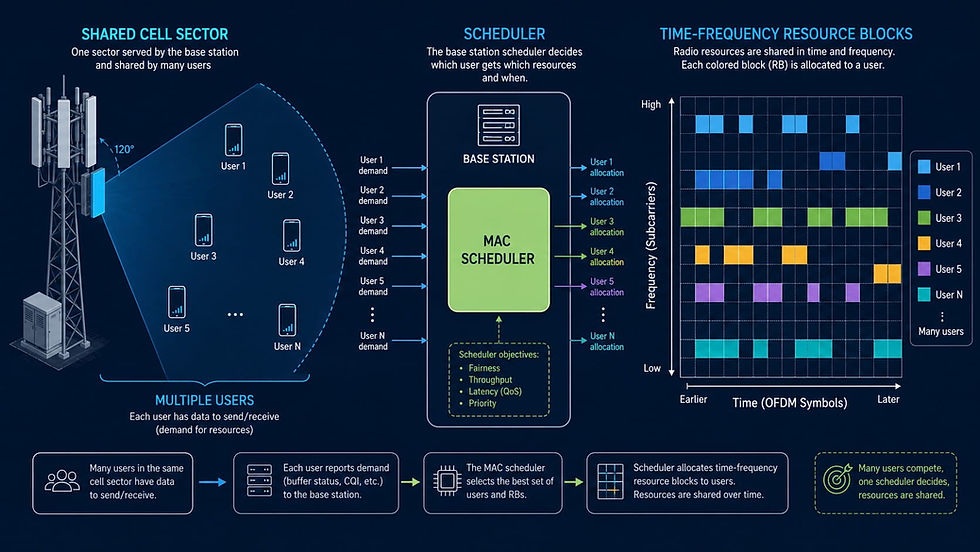
Why Mobile Networks Are Shared Systems
Mobile networks are not dedicated pipes to each user. They are shared systems. Many users compete for the same spectrum, base station capacity, backhaul, and core resources.
The scheduler inside the base station decides which users get radio resources at each moment. It considers channel quality, fairness, quality-of-service requirements, buffer status, and network policies.
This creates important real-world behavior. At night, a user may get excellent speed because fewer people are active. During peak evening hours or crowded events, speeds drop because more users share the same cell resources.
Capacity planning therefore depends on both coverage and demand. A site may provide good signal but still perform badly if there are too many active users and not enough spectrum, sectors, antennas, or backhaul.
Antennas, MIMO, and Beamforming
Modern LTE and 5G networks use multiple antennas to improve performance. This is called MIMO: Multiple Input, Multiple Output.
MIMO can improve mobile networks in different ways:
Diversity: Improves reliability by using multiple signal paths.
Spatial multiplexing: Sends multiple data streams at once.
Beamforming: Focuses energy toward a user.
Massive MIMO: Uses large antenna arrays, especially in 5G mid-band.
Beamforming is especially important at higher frequencies. Instead of radiating energy equally in all directions, the antenna array shapes the signal pattern toward the user. This improves signal quality and reduces interference, but it requires accurate channel estimation and fast adaptation as users move.

Engineering Trade-Offs in Real Deployments
Mobile network design is full of trade-offs.
Low-band spectrum gives wide coverage but limited capacity. Mid-band offers a strong balance between coverage and speed. mmWave provides huge bandwidth but requires dense small-cell deployment.
Large cells reduce infrastructure cost but increase congestion and reduce edge performance. Small cells improve capacity but require more sites, fiber, power, permissions, and maintenance.
Higher modulation gives better throughput but requires cleaner signal quality. More aggressive frequency reuse increases capacity but also increases interference risk. Stronger error correction improves reliability but reduces spectral efficiency.
Even “5G speed” depends on many layers: spectrum bandwidth, MIMO rank, SINR, scheduler load, backhaul capacity, core routing, server distance, and application behavior. The radio link is only one part of the end-to-end path.

What Most Blogs Miss: Mobile Networks Are Control Systems
A mobile network is not just a data pipe. It is a real-time control system.
The phone and network constantly exchange measurements, timing corrections, power control commands, scheduling grants, acknowledgments, retransmissions, and mobility messages. The network must react to fading, interference, congestion, and movement within milliseconds.
For example, if a phone transmits too weakly, the base station cannot decode it. If it transmits too strongly, it creates interference for others. So uplink power control continuously adjusts transmit power.
A simplified power control idea is:
Pₜₓ=P₀+αPL+Δ
Where:
Pₜₓ is transmit power.
P₀ is a baseline power setting.
PL is path loss.
α is a compensation factor.
Δ includes adjustments from scheduling and modulation requirements.
This is why mobile networks require careful parameter tuning. Good performance is not just about installing towers. It is about optimizing thousands of interacting radio and core parameters.

Conclusion: A Mobile Network Is a Layered Engineering System
Mobile networks are best understood as layered systems. At the bottom, electromagnetic waves carry energy through space. Above that, modulation and OFDM turn bits into radio symbols. The RAN schedules users, manages interference, and maintains mobility. Transport networks carry traffic through fiber and aggregation routers. The mobile core authenticates subscribers, manages sessions, applies policy, and connects users to the internet.
The reason mobile networks are difficult is that every layer affects every other layer. A user’s experience may be limited by weak signal, poor SINR, overloaded spectrum, bad handover parameters, insufficient backhaul, congested core paths, or even distant application servers.
That is also what makes telecom engineering fascinating. A mobile network is not a single technology. It is radio physics, signal processing, IP networking, distributed systems, security, economics, and field engineering combined into one living infrastructure. Understanding mobile networks means understanding how all these pieces interact under real-world constraints - spectrum scarcity, user mobility, interference, cost, power, regulation, and demand.
For beginners, the key idea is simple: your phone talks to a nearby cell site, and that site connects you to the wider network. For engineers, the deeper truth is more interesting: every successful mobile connection is the result of thousands of fast, coordinated decisions across the radio, transport, and core network.


Comments