Massive MIMO: How Modern Cellular Networks Multiply Capacity Using Advanced Antenna Systems
Wireless communication has always run into the same wall: there's only so much radio spectrum to go around. As more devices come online and applications start demanding serious bandwidth, you can't just crank up the power and hope for the best.
That's where advanced antenna technology comes in. And among those technologies, Massive MIMO - Multiple Input Multiple Output has arguably done more to reshape modern cellular networks than anything else in the past decade. It's the backbone of 4G LTE-Advanced and the reason 5G can actually deliver on its promises.
This piece breaks down how Massive MIMO works, from the core idea to the math to how it shows up in real-world networks.
From One Antenna to Many: How We Got Here
To understand why Massive MIMO matters, it helps to trace where antenna systems started.
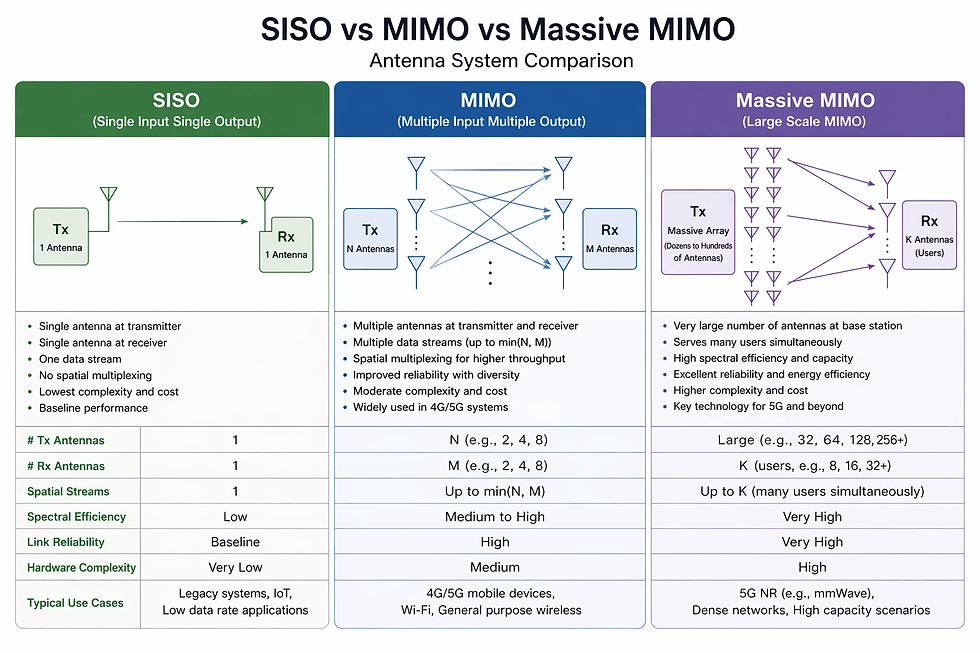
Early wireless systems used a single antenna on each end - one transmit, one receive. Simple, but severely limited. Then came MIMO, which put multiple antennas at both the base station and the device. This allowed engineers to do something clever: transmit multiple independent data streams over the same frequency band at the same time. Signal processing at the receiver could then untangle those streams, boosting throughput without needing any additional spectrum.
Traditional MIMO systems, though, typically used only a handful of antennas, four, maybe eight. Massive MIMO takes that idea and runs with it. We're talking dozens to hundreds of antennas at the base station.
The Core Idea: Space as a Resource
The fundamental insight behind Massive MIMO is that space itself can carry information.
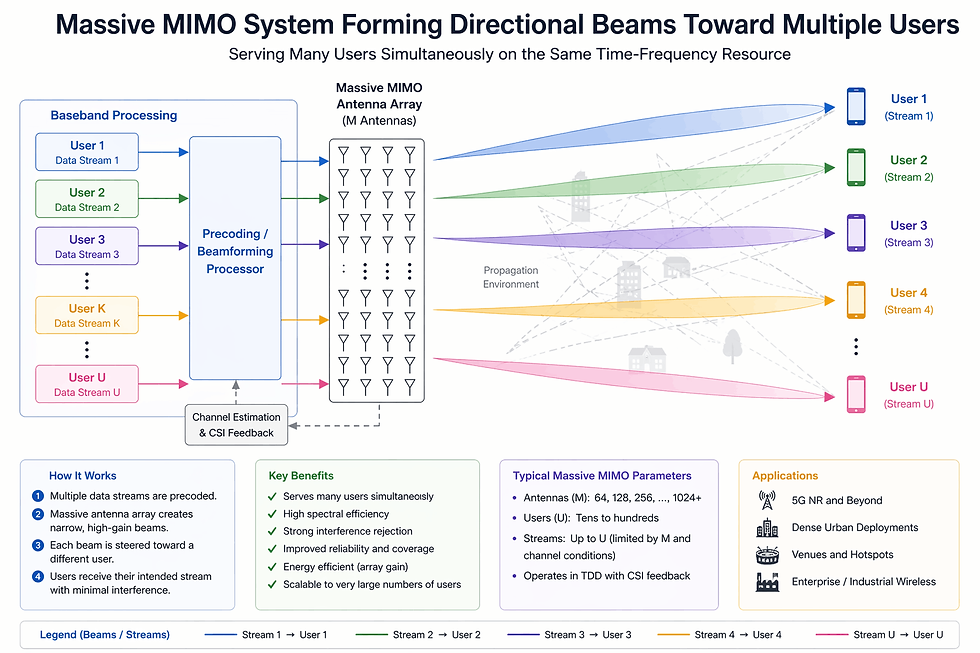
When you have a large antenna array, you can direct different signals toward different users at the same time, on the same frequency, without them stepping on each other. You're not just broadcasting into the air and hoping the right device picks it up, you're sculpting the signal spatially.
This works through three mechanisms working together: spatial multiplexing, beamforming, and sophisticated signal processing.
Spatial Multiplexing
Spatial multiplexing lets you transmit multiple independent data streams simultaneously over the same frequency band. Each stream goes out from a different antenna, and signal processing at the receiver separates them. How many streams you can run at once depends on how many antennas you have, the state of the channel, and your signal-to-noise ratio. More antennas generally mean more streams.

Beamforming
Rather than radiating energy in every direction, beamforming focuses it. In a Massive MIMO system, the base station calculates exactly how to drive each antenna element, so the signals combine constructively in the direction of a specific user and cancel out elsewhere. Each user gets their own dedicated beam. This increases received signal strength and cuts down interference between users - two problems that usually trade off against each other in conventional systems.
The Channel and Why Multipath Isn't the Enemy
Wireless signals don't travel in straight lines. They bounce off buildings, scatter off terrain, and arrive at the receiver via dozens of different paths. This multipath propagation was historically seen as a problem to manage.
Massive MIMO treats it differently. All those reflections create distinct spatial signatures - each path arrives from a slightly different direction, with its own amplitude and phase. A large antenna array can resolve these differences, effectively seeing the environment in higher spatial resolution. Rather than fighting multipath, the system uses it to create independent channels to multiple users simultaneously.
Channel State Information
To pull this off, the base station needs to know how signals are propagating at any given moment. That knowledge is called Channel State Information, or CSI. It captures signal attenuation, phase shifts, and the characteristics of each propagation path. Without accurate CSI, the beamforming and multiplexing calculations fall apart. Getting good CSI and keeping it up to date as users move is one of the core engineering challenges in Massive MIMO deployment.
The Math (Briefly)
At its core, a Massive MIMO system is a linear algebra problem.
Let H be the channel matrix, x the vector of transmitted signals, y the received signal vector, and n the noise. The received signal is:
y = Hx + n
The goal is to recover x from y given knowledge of H. Several techniques handle this:
Zero Forcing (ZF): Inverts the channel matrix to null out interference between users. Works well when the channel is well-conditioned.
Minimum Mean Square Error (MMSE): Balances interference suppression against noise amplification which is generally better than ZF at low SNR.
Maximum Likelihood Detection: Optimal but computationally expensive at scale.

With a large number of antennas, the channel matrix tends to become well-behaved. This is one of the mathematical reasons Massive MIMO works so well in practice.
Multi-User Operation
In real deployments, a Massive MIMO base station is almost always serving multiple users at once. Each user gets assigned a spatial beam, and the system dynamically adjusts those beams as users move and channel conditions shift.
On the uplink (users transmitting to the base station), signals from multiple devices arrive simultaneously. The base station uses the same spatial processing techniques to separate them.
On the downlink (base station transmitting to users), the beamforming directs each user's data toward them specifically, reducing the interference that other users would otherwise experience.
Massive MIMO in 4G and 5G
LTE-Advanced introduced Massive MIMO concepts, but real-world deployment was constrained by hardware costs, available spectrum, and the need to maintain compatibility with older devices.
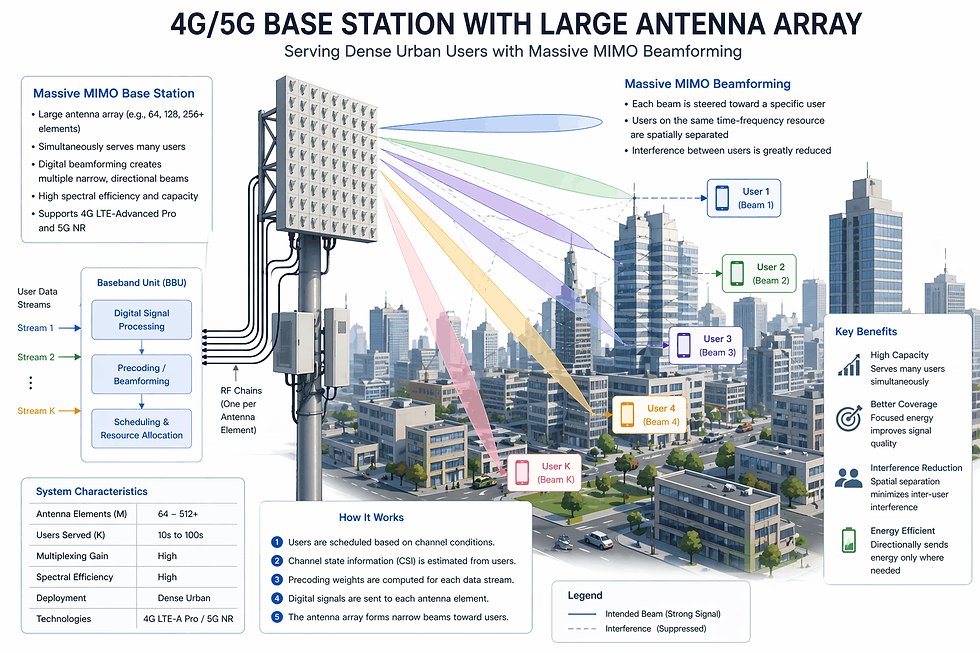
5G removed most of those constraints. Modern 5G base stations, particularly those operating at millimeter wave frequencies use large antenna arrays as a standard feature. At millimeter wave, path loss is high, so you need beamforming just to maintain a reliable link at any useful distance. Massive MIMO provides exactly the spatial gain needed to make high-frequency operation practical in dense urban environments.
Energy efficiency also improves at scale. Counterintuitively, adding more antennas while keeping total power roughly constant and focusing it precisely on users tends to reduce energy per bit delivered, which matters both for operating costs and for network-wide environmental impact.
Challenges in Practice
None of this is free. The hardware required to independently control hundreds of antenna elements is complex and expensive. Each element needs its own radio chain - amplifier, filter, converter. Keeping those chains calibrated relative to each other is an ongoing engineering problem, since even small drifts in phase or amplitude degrade beamforming accuracy.
The signal processing requirements are also substantial. Running MMSE precoding for 64 or 128 antennas serving 20 simultaneous users in real time requires serious compute. As antenna counts increase toward what some researchers call "ultra-massive MIMO," the processing burden becomes a genuine bottleneck.
Where This Is Heading
The trajectory is toward more antennas, more intelligence in the signal processing, and tighter integration with other technologies. Researchers are exploring how AI and machine learning can improve CSI estimation, beam management, and interference coordination and for tasks that become increasingly difficult to handle with hand-engineered algorithms as system complexity grows.
6G discussions already treat Massive MIMO as a baseline assumption rather than an advanced feature, with proposed extensions including extremely large aperture arrays and reconfigurable intelligent surfaces that can reshape the propagation environment itself.
Massive MIMO changed what cellular networks can do with a fixed piece of spectrum. The idea that you can turn spatial dimensions into a communication resource turned out to be surprisingly powerful in practice. It's not a simple technology, but the results in deployed networks have justified the complexity. As long as demand for wireless capacity keeps growing, the pressure to keep pushing antenna counts higher and signal processing smarter isn't going away.


Comments