How Mobile Data Works: Complete Technical Guide to Cellular Internet
Updated: Apr 25

Mobile data has become one of the most essential technologies in modern society. Every time you open a website, stream a video, send a message, or load a social media feed on your phone without Wi-Fi, your device is using mobile data.
Behind this seemingly simple process lies a highly complex telecommunications infrastructure consisting of radio communication systems, cellular towers, advanced signal processing, fiber optic networks, and large-scale telecom core networks.
Mobile data networks must support billions of connected devices, manage limited radio spectrum, and deliver high-speed internet with low latency across large geographic areas. Achieving this requires sophisticated engineering across multiple layers of the telecommunications stack.
This article explains how mobile data works from the ground up, covering everything from radio signals and cellular towers to packet routing and the mobile core network.
The Foundations of Mobile Data Communication
Mobile data relies on wireless communication using radio waves. Radio waves are electromagnetic waves that travel through space and allow devices to communicate without physical connections.
Unlike wired internet connections, which rely on cables such as fiber optics or Ethernet, mobile data must transmit information through the air.
This introduces several challenges:
Limited radio spectrum
Signal interference
Signal attenuation over distance
Obstacles such as buildings and terrain
To overcome these challenges, mobile networks use the cellular network architecture.

The Cellular Network Concept
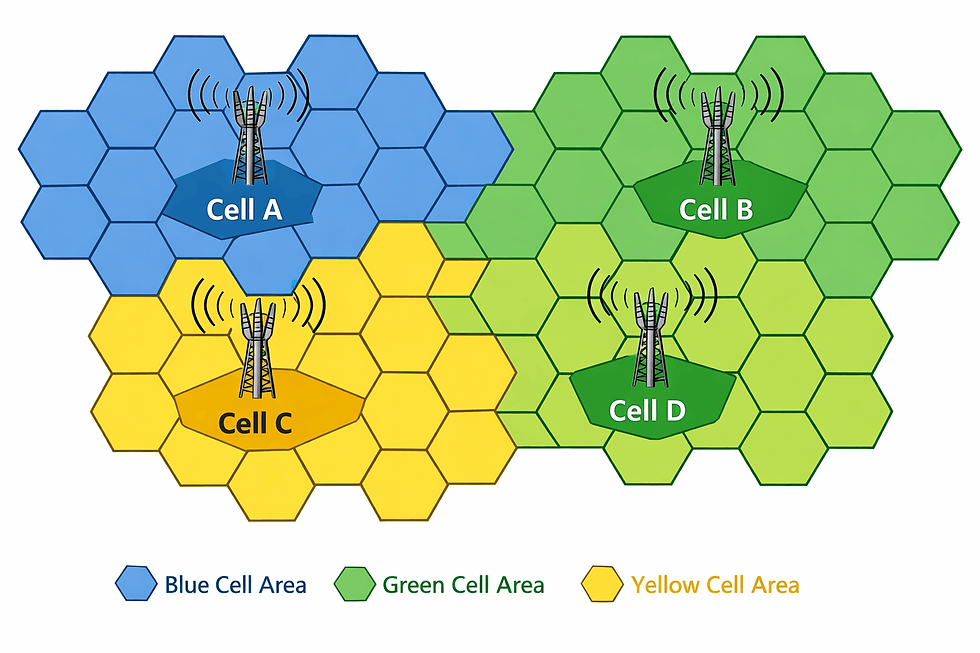
The cellular network architecture divides large geographic regions into smaller coverage areas called cells. Each cell is served by a cell tower, also known as a base station.
Instead of relying on a single transmitter to cover an entire region, multiple towers distribute the workload.
This allows networks to:
Reuse radio frequencies efficiently
Increase network capacity
Reduce interference
Improve signal quality
When you move from one location to another, your phone automatically switches between different cell towers through a process called handover.
The Components of a Mobile Data Network
A mobile data network consists of several interconnected systems working together.
The major components include:
1. User Equipment (UE)
User equipment refers to devices such as smartphones, tablets, IoT devices, and laptops with cellular modems.
These devices contain:
Cellular radios
Antennas
Baseband processors
SIM or eSIM modules
2. Radio Access Network (RAN)
The RAN connects mobile devices to the telecommunications infrastructure through wireless communication.
Components include:
Cellular towers
Antennas
Remote radio units
Baseband units
3. Transport Network
The transport network connects base stations to the telecom core network using high-speed links.
These links may use:
Fiber optic cables
Microwave links
Millimeter wave links
4. Core Network
The core network handles routing, authentication, mobility management, and connectivity to external networks such as the internet.

How a Smartphone Connects to Mobile Data
When a smartphone connects to mobile data, it first establishes a connection with the nearest cell tower. This process begins with network discovery.
The phone scans nearby radio frequencies for signals broadcast by cellular base stations.
These broadcast signals contain important information such as:
Network identifier
Supported technologies
Synchronization signals
Available radio channels
Once the phone detects a compatible network, it initiates a connection request.
Authentication Using the SIM Card
Before granting access to mobile data services, the network must verify the identity of the subscriber. This is performed using the SIM card.
A SIM card stores several key pieces of information.
These include:
IMSI (International Mobile Subscriber Identity)
Authentication keys
Subscriber service profile
When the phone attempts to connect to the network, the network sends an authentication challenge.
The SIM card calculates a response using cryptographic algorithms. If the response matches the expected value, the subscriber is authenticated successfully.

Allocating Radio Resources
After authentication, the network allocates radio resources to the device. Radio resources refer to portions of the radio spectrum used to transmit data.
Modern cellular networks use advanced technologies such as:
Orthogonal Frequency Division Multiple Access (OFDMA)
Multiple Input Multiple Output (MIMO)
Dynamic spectrum allocation
These technologies allow multiple devices to share the same spectrum efficiently.
Radio Transmission of Data
Once the connection is established, data transmission begins. When a user requests a website or application, the phone converts that request into digital data packets.
These packets are transmitted using radio signals.
The radio signal transmission process involves several steps.
First, the digital data is modulated onto a radio frequency carrier wave.
Modulation techniques used in modern networks include:
QPSK
16-QAM
64-QAM
256-QAM
These modulation schemes determine how much data can be transmitted per signal.
Higher-order modulation allows faster speeds but requires stronger signal quality.

Base Station Processing
When the radio signals reach the cell tower, they are received by the tower’s antennas.
The signals are processed by equipment called Remote Radio Units (RRU) and Baseband Units (BBU).
The radio units perform:
Signal amplification
Noise filtering
Analog-to-digital conversion
The baseband unit performs complex signal processing tasks such as:
Demodulation
Error correction
Channel decoding
Packet extraction
Once the packets are decoded, they are forwarded into the telecom transport network.

Backhaul: Connecting Towers to the Network
Cell towers must connect to the broader telecommunications network. This connection is known as backhaul.
Backhaul links are typically high-capacity connections using:
Fiber optic cables
Microwave links
Millimeter wave communication
Fiber optic backhaul is preferred because it offers extremely high bandwidth and low latency.
Through these links, data travels from the tower to the telecom operator’s core network.

The Mobile Core Network
The mobile core network is responsible for managing and routing data across the telecommunications system.
In LTE networks, the core network architecture is known as Evolved Packet Core (EPC).
Key components include:
Mobility Management Entity (MME): Handles device authentication and mobility management.
Serving Gateway (SGW): Routes user data between base stations and the core network.
Packet Data Network Gateway (PGW): Connects mobile networks to external IP networks such as the internet.
Home Subscriber Server (HSS): Stores subscriber information and authentication credentials.

Packet Switching in Mobile Networks
Modern mobile networks use packet switching. In packet-switched networks, data is broken into small packets. Each packet travels independently through the network and may take different routes before reaching its destination.
Packet switching allows networks to:
Share bandwidth among many users
Maximize efficiency
Support high data throughput
This approach is similar to how data travels across the internet.
Routing Data to the Internet
Once the data reaches the Packet Gateway in the core network, it is routed to the public internet.
If the user requests a webpage, the request is forwarded to the destination web server. The server then sends the requested content back through the internet to the telecom operator’s network.
The data travels back through:
Core network
Backhaul network
Cell tower
Radio interface
Finally, the smartphone receives the packets and reconstructs the data.

Data Speeds in Mobile Networks
Mobile data speeds depend on several factors.
These include:
Radio signal strength
Network congestion
Spectrum bandwidth
Device capabilities
Network technology
Typical theoretical speeds include:
3G: up to 42 Mbps
4G LTE: up to 1 Gbps
5G: up to 10 Gbps
However, real-world speeds are often lower due to environmental factors and network load.
Frequency Spectrum and Mobile Data
Mobile networks operate using licensed portions of the radio frequency spectrum. The spectrum is a limited resource managed by governments and allocated through auctions. Different frequency bands offer different advantages.
Low frequencies provide wider coverage.
Higher frequencies allow faster data transmission but have shorter range.
Modern networks often combine multiple frequency bands using carrier aggregation.

Advanced Technologies in Mobile Data Networks
Modern cellular networks rely on several advanced technologies to improve performance.
Carrier Aggregation: Combines multiple frequency bands to increase bandwidth.
Massive MIMO: Uses large antenna arrays to transmit multiple data streams simultaneously.
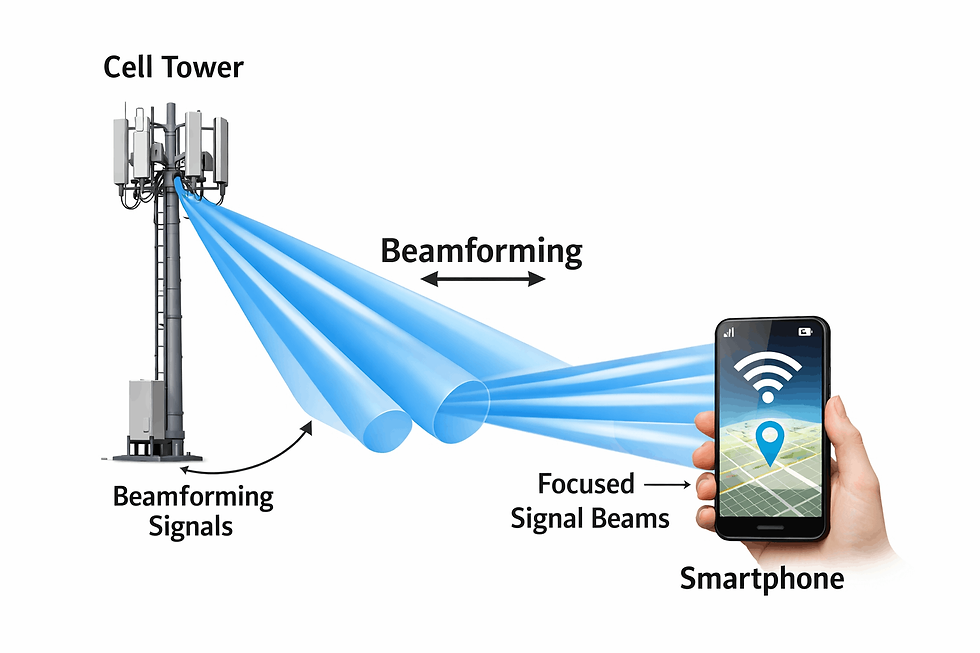
Beamforming: Focuses radio signals toward specific devices to improve signal strength.
Network Densification: Deploys additional small cells to increase network capacity.
5G and the Future of Mobile Data
The introduction of 5G networks represents a significant evolution in mobile data technology.
5G networks use new technologies such as:
Millimeter wave spectrum
Massive MIMO antenna systems
Edge computing
Network slicing
These innovations allow networks to deliver faster speeds, lower latency, and support billions of connected devices.

Conclusion
Mobile data networks are among the most complex technological systems ever developed. From the moment a user sends a request on their smartphone, data travels through a sophisticated chain of wireless communication, signal processing, network routing, and internet infrastructure.
Cellular networks must efficiently manage radio spectrum, coordinate millions of devices, and deliver high-speed internet across vast geographic regions. Technologies such as packet switching, advanced modulation, massive MIMO, and fiber backhaul make this possible.
Understanding how mobile data works reveals the remarkable engineering behind the seamless connectivity that powers modern digital life.


Comments