eSIM Explained: How Embedded SIM Technology Works in Modern Mobile Networks
Updated: Apr 25

Mobile connectivity has traditionally relied on one small but essential component: the SIM card. For decades, SIM cards have been the mechanism through which mobile devices authenticate themselves to cellular networks and gain access to telecommunications services.
However, the rapid growth of connected devices, globalization of mobile services, and increasing demand for flexible connectivity have driven the development of a new technology known as the embedded SIM, or eSIM.
Unlike traditional SIM cards that must be physically inserted into a device, eSIM technology allows mobile network profiles to be digitally provisioned and managed remotely. This innovation fundamentally changes how mobile devices connect to networks and how telecom operators manage subscriber identities.
This article provides an in-depth technical explanation of eSIM technology, covering its architecture, provisioning mechanisms, security features, and role in the future of telecommunications.
The Evolution of SIM Technology
The concept of the SIM card dates back to the early days of digital cellular networks.
SIM cards were introduced with the GSM standard in the early 1990s. The purpose of the SIM card was to separate the subscriber identity from the physical mobile device.
This design provided several advantages.
Users could move their SIM cards between different devices while maintaining the same phone number and network subscription. Operators could authenticate users securely without permanently binding them to a specific handset.
Over time, SIM cards evolved in size and capabilities.
Full-Size SIM: The earliest SIM cards were the size of credit cards.
Mini SIM: Later generations reduced the size while retaining the same chip.
Micro SIM: Smartphones eventually adopted smaller SIM formats.
Nano SIM: Modern smartphones widely use nano SIM cards.
Despite these size reductions, the basic architecture remained unchanged: a removable smart card storing subscriber credentials.
The next step in this evolution was the embedded SIM.

What Is an eSIM?
An eSIM (Embedded Subscriber Identity Module) is a programmable SIM chip that is permanently integrated into a device. Instead of inserting a physical SIM card, network credentials are downloaded electronically and stored inside the eSIM chip. This allows mobile network profiles to be installed, updated, or removed without physically accessing the device.
The eSIM is defined by specifications developed by the GSMA (Global System for Mobile Communications Association).
The GSMA created standards for Remote SIM Provisioning (RSP), which allow operators to securely deliver subscriber profiles over the air.

The Components of eSIM Technology
eSIM technology consists of multiple components working together to enable remote provisioning.
These components include:
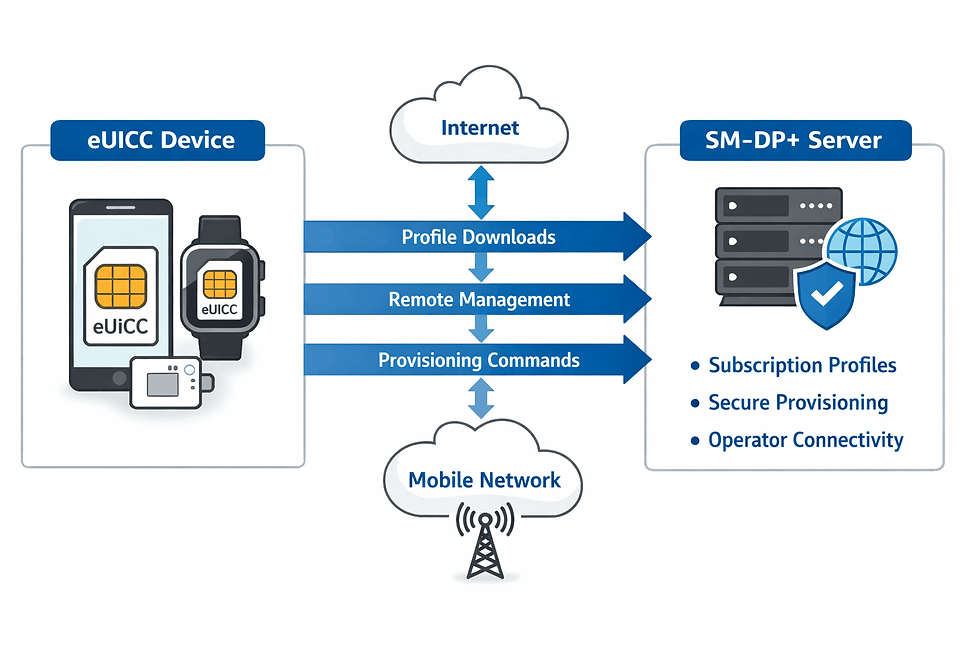
Embedded Universal Integrated Circuit Card (eUICC): The eUICC is the physical chip embedded in the device. It functions similarly to a traditional SIM but can store multiple operator profiles.
Subscription Manage: Subscription management systems handle the provisioning and management of eSIM profiles.
These systems include:
SM-DP+ (Subscription Manager Data Preparation)
SM-DS (Subscription Manager Discovery Server)
Mobile Network Operator Systems: Operators maintain backend infrastructure that interacts with the subscription management platform.
The eUICC: The Core of eSIM
The eUICC (Embedded Universal Integrated Circuit Card) is the hardware component responsible for storing and managing mobile network profiles.
Unlike traditional SIM cards that store a single operator profile, eUICCs can store multiple profiles simultaneously.
Each profile contains information such as:
IMSI (International Mobile Subscriber Identity)
Authentication keys
Operator configuration parameters
Network access rules
Profiles can be activated or deactivated depending on user preferences or operator policies.
This multi-profile capability enables seamless switching between different mobile networks.
Remote SIM Provisioning
One of the defining features of eSIM technology is Remote SIM Provisioning (RSP).
Remote provisioning allows mobile network operators to deliver subscriber profiles to devices through secure internet connections.
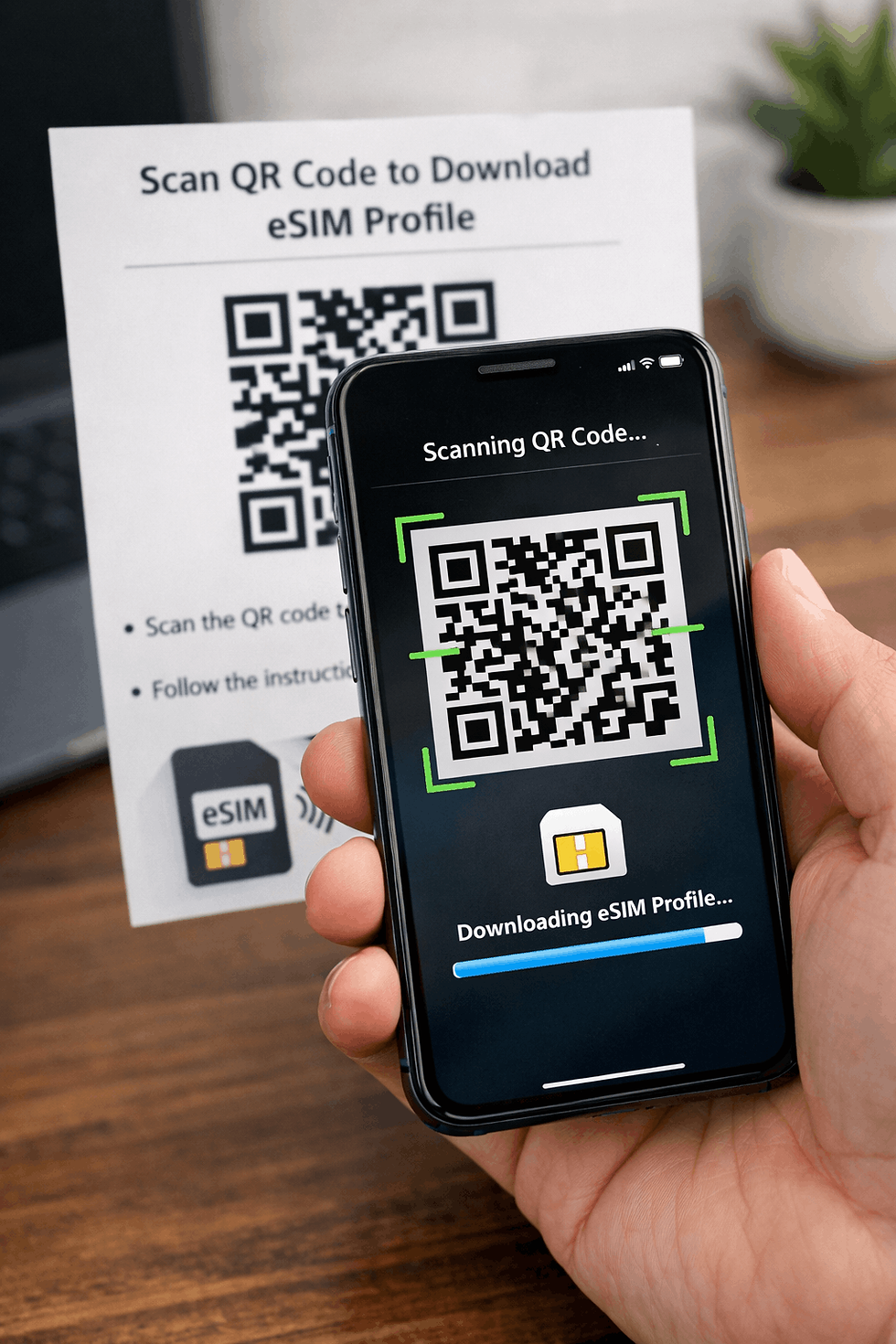
The provisioning process typically occurs when a user scans a QR code provided by the telecom operator. The QR code contains a link to the operator’s provisioning server.
Once scanned, the device contacts the Subscription Manager Data Preparation server (SM-DP+) to download the profile.
eSIM Profile Download Process
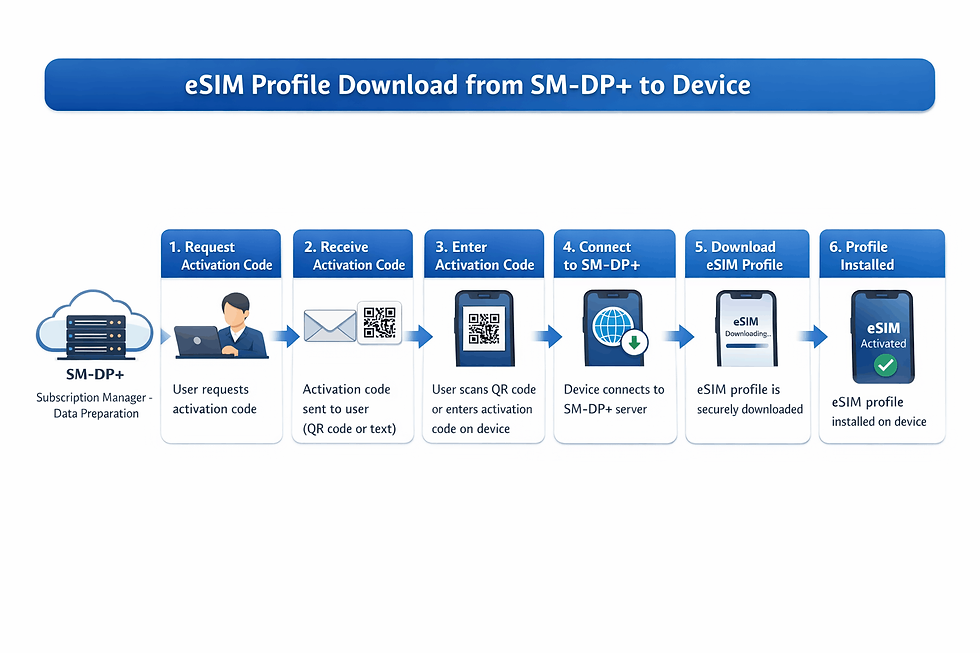
The eSIM profile installation process follows several steps:
First, the user initiates profile activation by scanning a QR code or selecting an operator profile.
The device then establishes a secure connection to the SM-DP+ server.
Next, the server verifies the device’s eUICC credentials and prepares the subscriber profile.
The profile is encrypted and transmitted securely to the device.
The eUICC then installs the profile and activates it as the current network subscription.
Security Architecture of eSIM
Security is a critical aspect of telecommunications systems. Because eSIM provisioning occurs remotely, strong cryptographic protections are required.
The eSIM security model relies on several mechanisms.
Secure Elements: The eUICC contains a tamper-resistant secure element that stores sensitive data.
Encryption: Profile data is encrypted during transmission using public key cryptography.
Authentication: Mutual authentication ensures that both the device and the subscription manager are legitimate.
Trusted Platform: Devices must implement secure operating environments to protect profile data.
These security mechanisms ensure that unauthorized parties cannot intercept or modify subscriber profiles.

eSIM vs Physical SIM
Although both technologies perform the same core function, they differ in several ways. Physical SIM cards require manual insertion and removal. eSIM profiles can be downloaded and managed digitally.
eSIM devices can store multiple operator profiles simultaneously, allowing users to switch networks without replacing hardware.
From a manufacturing perspective, eSIM also saves physical space within devices. This is particularly valuable for compact devices such as smartwatches and IoT sensors.
eSIM in Smartphones
Many modern smartphones now support eSIM technology. Devices such as flagship smartphones include both a nano SIM slot and an embedded eSIM chip.
This configuration enables dual SIM functionality, where one subscription uses a physical SIM and the other uses an eSIM. Users can switch between operators through device settings without changing hardware.

eSIM for IoT Devices
One of the most significant applications of eSIM technology is in the Internet of Things (IoT). IoT devices are often deployed in remote or inaccessible locations.
Examples include:
Smart meters
Industrial sensors
Vehicle tracking systems
Environmental monitoring devices
With traditional SIM cards, changing network providers would require physically replacing the SIM card.
eSIM eliminates this limitation by enabling remote network switching.

eSIM and Global Connectivity
eSIM technology also simplifies international connectivity.
Travelers can download local operator profiles instead of purchasing physical SIM cards.
Some service providers offer global eSIM plans that allow devices to automatically connect to partner networks worldwide.
This capability improves user convenience and reduces roaming costs.
eSIM in 5G Networks
The growth of 5G networks further increases the importance of eSIM technology.
5G is expected to connect billions of devices across industries.
Managing such large numbers of devices using physical SIM cards would be impractical.
eSIM enables automated provisioning and large-scale device management required for massive IoT deployments.
Challenges and Limitations
Despite its advantages, eSIM technology faces several challenges.
Operator Adoption: Not all mobile network operators support eSIM provisioning.
Device Compatibility: Some devices still lack eSIM hardware.
User Awareness: Many consumers remain unfamiliar with how eSIM works.
However, adoption continues to grow as more devices integrate eSIM capabilities.
The Future of eSIM
The future of SIM technology is moving toward even more integrated solutions.
One emerging concept is the iSIM (Integrated SIM).
In iSIM technology, the SIM functionality is integrated directly into the device’s processor rather than existing as a separate chip. This further reduces hardware complexity and manufacturing costs.
As mobile connectivity expands into new industries and billions of devices, technologies like eSIM and iSIM will play a critical role in enabling scalable network access.
Conclusion
eSIM technology represents a major evolution in the way mobile devices connect to cellular networks. By replacing physical SIM cards with embedded programmable chips, eSIM enables flexible connectivity, remote provisioning, and simplified device management.
Through secure provisioning systems and GSMA standards, telecom operators can remotely deliver subscriber profiles to devices anywhere in the world. This capability is particularly valuable for IoT deployments, international travelers, and next-generation connected devices.
As telecommunications networks continue evolving toward 5G and beyond, eSIM technology will become an increasingly important component of global connectivity infrastructure.


Comments