Beamforming Explained: How Modern Wireless Networks Focus Signals for Maximum Performance

Radio signals have a fundamental problem left to their own devices; they spread in every direction. It doesn't matter whether you're the intended receiver or someone sitting three floors away - a traditional antenna treats everyone equally, which sounds fair until you realize it means wasting most of your energy broadcasting into walls, ceilings, and empty air.
That inefficiency was tolerable when wireless networks were simple. It's much harder to ignore when you're trying to support thousands of devices in a dense city block or pushing multi-gigabit speeds over 5G. This is where beamforming comes in.
What Beamforming Actually Does
Beamforming lets a wireless system steer its signal toward a specific device rather than scattering it everywhere. The result is stronger reception at the target, less interference for everyone else, and a more efficient use of spectrum overall.
The underlying idea isn't complicated. Instead of a single antenna, beamforming systems use an array of antenna elements. Each element transmits the same signal, but with a slightly different phase - a small timing offset. These phase differences cause the individual signals to combine constructively in one direction (reinforcing each other) and destructively in others (canceling out). The net effect is a focused beam of radio energy that can be steered electronically, without physically moving anything.

The Physics Behind It: Wave Interference
To appreciate why beamforming works, you need to understand how waves interact. Radio signals are electromagnetic waves with three key properties: amplitude, frequency, and phase.
When two waves meet, they add together according to the principle of superposition. Waves that are in phase reinforce each other with doubling the amplitude for a stronger signal. Waves that are out of phase cancel which weakens or eliminates the signal altogether.
Beamforming deliberately engineers this behavior across an antenna array. By controlling the phase of each element, the system shapes where constructive interference occurs (toward the user) and where destructive interference occurs (everywhere else).

Phased Arrays and Electronic Beam Steering
The hardware that makes beamforming possible is called a phased array antenna. Multiple elements are arranged at specific distances from each other; each fed the same signal with a carefully calculated phase offset. Change the offsets, and the beam direction shifts with no mechanical movement required.
This electronic beam steering is especially useful in mobile networks. As a user moves, the system continuously updates the phase and amplitude values across the array to track them in real time. It happens fast enough to be essentially invisible from the user's perspective.

Types of Beamforming
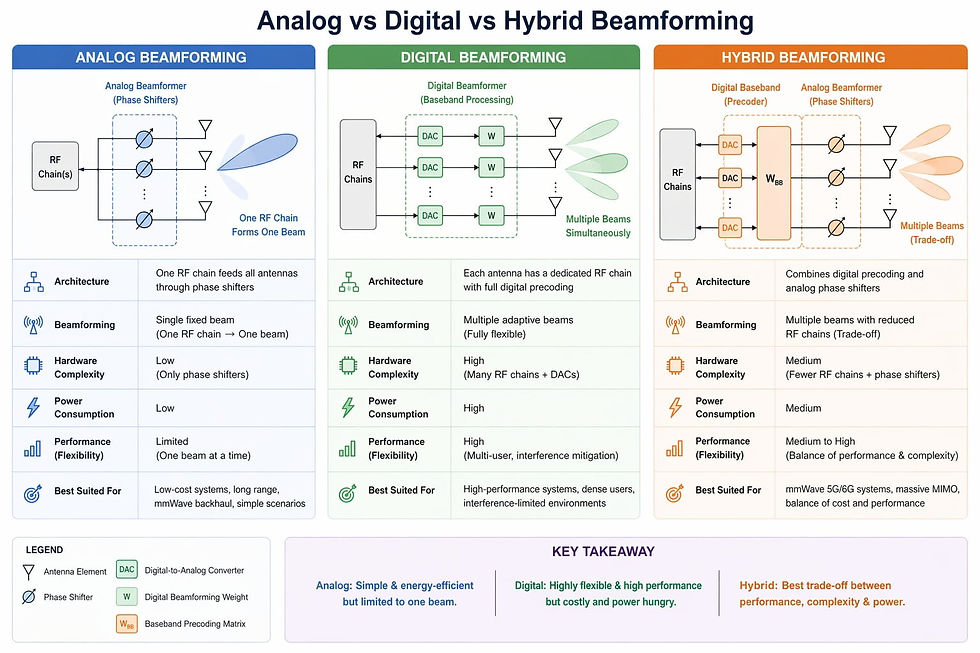
Not all beamforming systems work the same way. There are three main approaches:
Analog beamforming applies phase adjustments using analog hardware like phase shifters. It's the simplest implementation but offers limited flexibility.
Digital beamforming handles phase control entirely in software, processing each antenna element independently. This gives much more precision and flexibility, though it requires more hardware per element.
Hybrid beamforming combines both approaches - digital control at a higher level with analog steering at the element level. It's the dominant architecture in 5G systems because it balances performance against cost and complexity reasonably well.
Beamforming and MIMO
Modern networks pair beamforming with MIMO (Multiple Input Multiple Output) technology, which uses multiple antennas on both the transmitter and receiver side. Combine the two and you get Massive MIMO - antenna arrays with dozens or even hundreds of elements, capable of serving multiple users at once on the same frequency.
This is where things get interesting. Massive MIMO lets a base station simultaneously direct different beams at different users, each carrying independent data streams. Spectral efficiency improves substantially because the same slice of spectrum is doing more work at the same time.

Beamforming in 4G and 5G Networks
Beamforming made its way into 4G LTE as part of advanced MIMO techniques, where it improved signal quality and data rates to a modest degree. The role it plays in 5G is considerably larger.
5G, especially at millimeter wave frequencies (above 24 GHz), relies on beamforming to function at all. Millimeter wave signals offer enormous bandwidth, but they don't travel far, struggle to penetrate obstacles, and attenuate quickly in most environments. Beamforming compensates by concentrating energy toward the receiver instead of letting it dissipate in all directions. Without it, millimeter wave 5G simply wouldn't be practical outside of very short ranges.
Adaptive beamforming takes this further by continuously monitoring signal quality and interference in real time, adjusting beam direction and shape to match changing conditions like user movement, network congestion, shifting obstacles.

The Signal Processing Underneath
Beamforming depends on several layers of signal processing working together. Channel estimation figures out how signals are actually propagating through the environment between transmitter and receiver. Precoding adjusts the signals before transmission to account for those propagation conditions. Spatial filtering separates signals arriving from different directions.
Together, these processes allow the system to make intelligent decisions about where to point its energy and how to extract clean signals from a noisy radio environment.
Interference Reduction: The Overlooked Benefit
Most discussions of beamforming focus on signal strength, but interference reduction might be equally important in dense deployments. When transmissions are focused, the radio energy reaching unintended receivers drops. That means more users can share the same spectrum without stepping on each other, which directly translates to higher network capacity which is a bigger deal than raw speed in crowded environments.
Deployment Challenges
Beamforming isn't free. Large antenna arrays are expensive to build and calibrate. Each additional element adds hardware and power consumption. Keeping phase calibration accurate across dozens or hundreds of elements in a base station that's exposed to temperature swings and physical stress is a real engineering challenge.
That said, advances in semiconductor manufacturing have brought costs down considerably over the past decade, and beamforming has become practical enough that it's now standard in 5G base stations and even consumer Wi-Fi like Wi-Fi 5 and above both support it for improving indoor coverage.
What Beamforming Enables
Strip away the technical detail and the practical upshot is fairly straightforward. Beamforming makes wireless networks faster, more reliable, and more efficient per unit of spectrum. It's what allows 5G to deliver the speeds it promises at millimeter wave frequencies. It's why Wi-Fi 6 performs better in crowded offices than older standards. And it's what makes Massive MIMO viable as a way to serve dense user populations without simply throwing more spectrum at the problem.
Where Things Are Heading
The next iteration of these ideas is already taking shape. AI-driven beamforming would let systems predict user movement and adapt beam patterns proactively rather than reactively. Ultra-massive MIMO arrays with even larger element counts are being explored for 6G research. The underlying principles such as wave interference, phased arrays, spatial filtering will stay the same; what changes is how intelligently and efficiently the system uses them.
Beamforming won't make wireless communication easy. But it has made the hard parts considerably more manageable.


Comments