What Is Telecommunication? A Real Explanation, Not Just "Making Calls"

Most people, if you asked them to define telecommunications, would say something like "phone calls and the internet." And honestly, that's fair. It's what the word suggests on the surface. But that definition misses almost everything interesting about the field. It's like describing a cathedral as "a big room with benches."
Telecommunications is one of those things that surrounds you completely, operates at a scale that's genuinely hard to wrap your head around, and yet almost nobody stops to think about how it actually works. Every time you send a message, load a page, make a call, or watch a video, you're depending on a system that spans continents, runs on physics you learned in school and then promptly forgot, and handles billions of simultaneous operations without breaking a sweat. Most of the time, anyway.
This article is an attempt to actually explain it, not just slap a definition on it and move on. We'll start from first principles, work through signals and transmission, cover how modern cellular networks like LTE and 5G are designed, and talk about the trade-offs engineers deal with in the real world. By the end, you'll have a working mental model of how your phone knows what to do when you hit "send."
The Simple Definition, and Why It's Deceptively Simple
Let's start with something clean:
Telecommunications is the transmission of information over distance using electronic or electromagnetic systems.
Each part of that matters:
Information - This could be voice, text, video, a file, sensor data, anything that can be encoded.
Transmission - Converting that information into a signal, sending it, and reconstructing it on the other end.
Distance - From a few meters between your phone and a router, to thousands of kilometers through undersea cables.
Electronic or electromagnetic systems - Copper wires, radio waves, light pulses through fiber optic cable.
The definition is simple. The problem it describes is not.
Here's what makes telecom genuinely hard: it's not just about sending data. Almost anyone can set up a wire and push a signal through it. The challenge is sending data accurately, efficiently, over channels that introduce noise and interference, to millions of users at the same time, while they're moving around, on devices with limited power. Do all of that simultaneously, and you're starting to understand the engineering problem.
First Principles: What Does "Communication" Even Mean?
Before we talk about telecommunications, it helps to be precise about what communication itself requires.
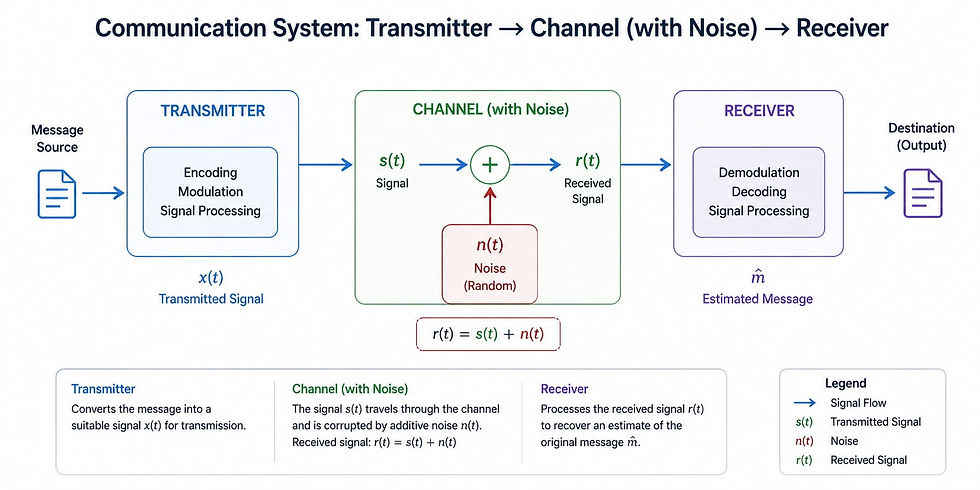
Any communication system, at the most basic level, has three components:
A transmitter. Something that converts information into a signal. Your phone's microphone converts sound waves into an electrical signal. Your phone's radio converts digital data into a radio wave.
A channel. The medium through which the signal travels. Air, copper, glass fiber. The channel doesn't care about your data - it just moves it, and along the way, it can distort it, weaken it, or add random noise to it.
A receiver. Something on the other end that takes whatever came through the channel and reconstructs the original information.
This three-part model, which engineers often call the Shannon model after Claude Shannon, the mathematician who formalized information theory in 1948, is the foundation of all telecommunications thinking. Every problem in the field traces back to it in some way.
The thing that makes real systems complicated is noise. In the real world, what arrives at the receiver is never exactly what the transmitter sent. Mathematically, the received signal y(t) is the transmitted signal x(t) plus some noise n(t):
y(t) = x(t) + n(t)
Noise is not a solvable problem in the way you might hope. You can't just make it go away. Thermal noise exists because electrons have temperature. Interference exists because other signals are present. The ground under your feet attenuates radio signals. The wall between your router and your laptop does too.
Engineering, in this context, is about designing systems that remain functional despite noise, not systems where noise doesn't exist.
Signals: The Medium of the Message
Telecommunications doesn't transmit "information" directly. It transmits signals. This distinction actually matters.
A signal is a physical quantity which is usually voltage, current, or electromagnetic field strength which varies over time and carries information in that variation. When you speak into a phone, the variations in air pressure from your voice become variations in electrical voltage. Those variations are the signal.
Analog vs. Digital
Signals can be analog or digital, and this is one of the most consequential design decisions in the history of communications.
An analog signal is continuous. It can take any value at any point in time. Your voice is analog. The voltage coming out of an old microphone is analog. It varies smoothly, and in principle captures infinite detail.
A digital signal is discrete. It takes values from a finite set, typically 0 and 1. Before transmission, analog information is sampled, quantized, and encoded into bits. The original continuous wave becomes a stream of numbers.

Modern telecommunication systems are almost entirely digital. This wasn't always obvious. Early systems, including the original telephone network, were analog. The shift to digital happened for several reasons that compound each other:
Noise immunity: When a digital signal degrades slightly, you can still tell a 1 from a 0. When an analog signal degrades, the degradation is embedded in the information itself and can't be removed.
Error correction: Once information is in binary, you can add redundancy in mathematically principled ways, detect errors, and correct them. You can't really do that with a continuous waveform.
Compression: Digital signals can be processed algorithmically. A phone call that would require 64 kilobits per second in raw form can be compressed to 8 or even 4 kilobits per second using modern codecs, without perceptible quality loss.
Scalability: Digital systems can be reproduced perfectly, switched without degradation, and processed by computers. The entire internet runs on digital signals. There was never going to be an "analog internet."
The decision to go digital wasn't just a technical preference. It was what made modern telecommunications possible.
Bandwidth: The Hardest Constraint in Telecom
If you've ever complained about slow internet speeds, you've encountered the consequences of bandwidth constraints, whether you knew it or not.
Bandwidth, in the technical sense, is the range of frequencies that a signal occupies or that a channel can carry. More bandwidth means more information can be transmitted per second. Less bandwidth means you're constrained.
The relationship between bandwidth and capacity was formalized by Claude Shannon in 1948, in what's now called the Shannon-Hartley theorem:
C = B × log₂(1 + SNR)
Where:
C is channel capacity in bits per second
B is bandwidth in hertz
SNR is the signal-to-noise ratio
This equation sets a theoretical ceiling on how much data you can send through a channel. You can't exceed it. You can approach it, with sophisticated enough encoding, but you can't beat it. This is one of the rare cases in engineering where a hard limit really means hard.

What the equation tells you practically is that you have two levers: bandwidth and signal quality. If you want more throughput, you either need more spectrum (which is finite and regulated) or you need to improve your SNR (which physics and geography constrain). This is why 5G base stations are placed on every other street corner in dense urban areas - the short distance dramatically improves SNR, which allows much higher data rates.
It also explains why telecommunications is inherently a resource management problem. Spectrum doesn't grow. The number of users does.
Modulation: How You Actually Put Information on a Wave
Raw digital data is a stream of 1s and 0s that can't just be blasted into the air. You need to encode it onto a physical wave that can propagate through your medium. That process is called modulation.
The basic idea: take a carrier signal, a continuous wave at a known frequency, and vary some property of it to encode information. The carrier signal itself carries nothing interesting. The variations in it carry your data.
The general form of a carrier wave looks like this:
s(t) = A × cos(2πf꜀t + φ)
The three things you can vary are A (amplitude), f꜀ (frequency), and φ (phase). Each variation gives you a different modulation scheme.
Amplitude Modulation (AM) varies the height of the wave. Used in AM radio. Simple, but sensitive to noise.
Frequency Modulation (FM) varies the frequency. Used in FM radio. Much better noise immunity than AM, which is why music on FM sounds cleaner than talk on AM.
Phase Modulation (PM) varies the phase - basically, the timing of the wave's peaks.
In modern digital communications, these are combined and extended into more sophisticated schemes:
QPSK (Quadrature Phase Shift Keying) uses four distinct phase states to encode two bits per symbol.
QAM (Quadrature Amplitude Modulation) combines amplitude and phase variation. 16-QAM encodes four bits per symbol. 64-QAM encodes six. 256-QAM encodes eight. Higher-order QAM gets you dramatically more bits per Hz of bandwidth.

The trade-off is straightforward but unforgiving: the higher the order of your modulation, the more bits you pack per symbol, but the closer together your symbol states are in signal space, and the harder it is for the receiver to tell them apart when noise is present. 256-QAM delivers great throughput when your signal is strong and clean. In a noisy environment, it falls apart. This is why your phone uses different modulation schemes depending on how close you are to a cell tower.
Multiplexing: Sharing One Medium Among Many Users
This is the part telecom engineers spend a lot of time thinking about, and it rarely gets explained well in popular writing.
You have one piece of physical medium, one stretch of air between a cell tower and thousands of phones. You have millions of users who all want to use it simultaneously. How do you divide it up fairly and efficiently?
The answer is multiplexing, and there are several ways to do it.
Frequency Division Multiplexing (FDM) gives each user their own frequency band. Your signal lives at 850 MHz; your neighbor's lives at 855 MHz. They don't interfere with each other because they occupy different parts of the spectrum. Old analog phone networks used this. AM and FM radio still do.
Time Division Multiplexing (TDM) gives each user the whole bandwidth, but only for a very short time slot. User A transmits in slot 1, user B in slot 2, and so on. The slots rotate fast enough that each user experiences what feels like continuous service.
Code Division Multiple Access (CDMA) is more clever. Every user transmits on the same frequency at the same time, but each user's signal is multiplied by a unique code. At the receiver, knowing the code, you can mathematically separate signals that overlap in both frequency and time. 3G networks used CDMA.
Orthogonal Frequency Division Multiplexing (OFDM) is what LTE and 5G use, and it's worth understanding why it became dominant.
OFDM takes a wideband channel and splits it into a large number of narrow subcarriers, each transmitting data at a low rate. Those subcarriers are mathematically orthogonal to each other. They can overlap in frequency without interfering. The big advantage is multipath resilience.

In the real world, a radio signal from a tower doesn't just travel in one straight line to your phone. It bounces off buildings, the ground, and other surfaces, arriving as many echoes with slightly different delays. In a single-carrier system, these echoes interfere with the main signal and destroy data. OFDM handles multipath much better because each narrow subcarrier has a long symbol duration relative to the multipath spread, making it resistant to delay-induced interference.
That's not the whole reason OFDM won, but it's a big one.
Transmission Media: What Signals Actually Travel Through
The physical medium matters enormously, and different media have wildly different properties.
Copper wire was the foundation of telecommunications for most of the 20th century. Voice telephone networks were built on it, and DSL internet still uses it in the "last mile" between telephone exchanges and homes. Copper is relatively cheap, easy to deploy, and works reasonably well for voice. Its limitations are significant: bandwidth is limited, signal attenuates quickly over distance, and it's sensitive to electromagnetic interference. DSL over copper can deliver useful speeds for a few kilometers, but beyond that, the signal simply runs out.
Wireless (radio frequency) transmission uses electromagnetic waves propagating through air and space. No cable required, which makes it essential for mobile devices. The physics are both enabling and limiting. Radio signals weaken with distance according to an inverse power law which states that roughly, doubling the distance reduces signal strength by a factor of four or more, depending on the environment. Obstacles absorb and reflect signals. Different frequencies behave differently: lower frequencies penetrate buildings and follow terrain, which is why emergency services use them. Higher frequencies carry more bandwidth but travel shorter distances and are blocked by walls.
Optical fiber is glass, very pure glass through which light pulses travel by total internal reflection. When light hits the boundary between the fiber core and the cladding at a shallow enough angle (above the critical angle), it bounces back into the core rather than escaping. This keeps the light traveling down the fiber with remarkably low loss. The bandwidth available through fiber is staggering - a single fiber strand can carry terabits per second using different wavelengths of light simultaneously, a technique called wavelength division multiplexing. Fiber forms the backbone of the internet: the undersea cables connecting continents, the long-haul routes between cities, the connections between data centers.

Most telecommunications systems today use a combination: fiber for long distances, wireless for the last hop to mobile devices, and some copper still clinging on in residential last-mile connections that haven't been upgraded yet.
Cellular Networks: The Architecture That Made Mobile Work
Before cellular architecture, mobile radio was simple but unscalable. A city had a few powerful transmitters on high towers. Everyone in the city shared the same frequencies. The number of simultaneous calls you could handle was directly limited by the number of frequency channels you had. In practice, that meant dozens of channels for an entire metropolitan area.
The cellular concept, developed at Bell Labs in the 1970s, solved this problem through frequency reuse.
The idea: divide the coverage area into many small cells, each served by a low-power base station. Assign each cell a subset of the available frequency channels. In cells far enough apart that they won't interfere with each other, reuse the same frequencies.
The immediate implication is dramatic. If you have 100 frequency channels and you divide your city into 100 cells, each cluster of seven or so cells reusing all frequencies, you can handle roughly 14 times as many simultaneous calls as the old high-tower approach. And if capacity fills up, you can split cells, make them smaller and reuse frequencies even more densely.
Mobility adds a complication: as a user moves from one cell to another, their call or data session needs to transfer to the new cell without interruption. This is a handover, and managing it gracefully, under real-world conditions where signals fade and overlap, is harder than it sounds.

The Architecture of a Cellular Network
A working cellular network has several distinct layers, each with its own function.
User Equipment (UE) - The phones, tablets, and modems that end users carry. These communicate wirelessly with the network.
The Radio Access Network (RAN) - The base stations distributed across the coverage area. In LTE terminology, these are called eNodeBs (evolved Node Bs). In 5G, gNodeBs. They manage the radio interface: scheduling which users transmit when, handling handovers, adapting modulation to channel conditions.
The Core Network - The intelligent center of the system, handling routing, authentication, billing, mobility management, and connections to external networks like the internet. In LTE, this is the Evolved Packet Core (EPC). In 5G, the 5G Core (5GC), which is redesigned around software-defined, cloud-native principles.

These layers are connected by standardized interfaces, which means a base station from one manufacturer can generally work with a core network from another at least in principle.
LTE: A Real Cellular System Worth Understanding
LTE (Long Term Evolution), the radio access technology we colloquially call "4G," was a significant departure from earlier generations. It was designed from the start as an all-IP system - every piece of data, including voice, travels as IP packets. There's no separate circuit-switched network for calls.
The radio interface uses OFDMA (Orthogonal Frequency Division Multiple Access) on the downlink from tower to phone and assigns different subsets of subcarriers to different users. On the uplink from phone to tower, it uses SC-FDMA (Single Carrier Frequency Division Multiple Access), a variant that has lower peak-to-average power ratio, which matters for battery life in mobile devices.
The basic unit of radio resource allocation in LTE is the Physical Resource Block (PRB), which is 12 subcarriers wide and one millisecond long. Every millisecond, the base station scheduler decides which users get which PRBs. That's a thousand scheduling decisions per second, per cell, taking into account channel quality feedback from every connected device, queue depths, quality-of-service requirements, and fairness constraints.

One thing that popular coverage of LTE often glosses over: the system is inherently unequal in throughput. A user close to the base station, with a strong signal and low interference, can use high-order modulation (256-QAM) and achieve peak rates of hundreds of megabits per second. A user at the cell edge, with a weak signal and interference from adjacent cells, might be limited to QPSK, achieving a fraction of that. LTE is engineered to maximize total cell throughput, which means edge users are disadvantaged. It's a consequence of the underlying physics which is worth knowing.
5G: What Actually Changed and Why It Matters
5G gets a lot of marketing language attached to it, so let me try to be specific about what it actually introduced.
New spectrum bands: 5G operates in two main frequency ranges. Sub-6 GHz (similar to LTE frequencies) provides decent coverage but relatively modest capacity gains. Millimeter wave (mmWave), above 24 GHz, offers massive bandwidth - potentially gigabits per second but with a catch: mmWave propagates poorly, is blocked by walls and foliage, and degrades quickly with distance. The mmWave deployments you see in dense urban areas cover small areas around specific hotspots. They're not cell towers in the traditional sense.
Massive MIMO: Traditional base station antennas have a few dozen elements at most. Massive MIMO puts hundreds of antenna elements in a single base station array. With that many elements, you can apply sophisticated beamforming: instead of broadcasting a signal in all directions, you form narrow beams directed precisely at individual users. Multiple beams can be active simultaneously, serving different users on the same time-frequency resources through spatial multiplexing. The theoretical gains from Massive MIMO are substantial, though achieving them in practice requires solving some hard signal processing problems.

Beamforming more broadly: Even below massive MIMO, 5G base stations use more sophisticated beamforming than LTE. The beam follows you as you move. This improves signal quality and reduces interference to other users.
Network slicing: This one is architectural rather than radio-level. 5G's core network is designed to support virtualized network slices which are logically separate networks sharing the same physical infrastructure but with different performance characteristics. A slice for autonomous vehicle communication might prioritize ultra-low latency. A slice for IoT sensors might prioritize connection density over throughput. A slice for video streaming might prioritize bandwidth. In principle, operators can tailor network behavior to application requirements without building separate physical networks.

Ultra-Reliable Low-Latency Communication (URLLC): One of 5G's stated use cases is latencies on the order of one millisecond with very high reliability. This is relevant for things like industrial automation, remote surgery (eventually), or vehicle-to-infrastructure communication. Achieving it requires small cell deployments close to users, and it's not available everywhere. It requires appropriate infrastructure investment.
Fiber Optics: The Part Nobody Talks About Enough
Wireless gets the headlines, but fiber optic cable carries the overwhelming majority of the world's telecommunications traffic. The undersea cables connecting continents, the backhaul links from cell towers to the core network, the connections between data centers, fiber does most of the heavy lifting.
The physics is total internal reflection. Light traveling through glass hits the boundary between the core (higher refractive index) and the cladding (lower refractive index) at a shallow angle. If the angle of incidence exceeds the critical angle which is determined by the refractive indices of the two materials, the light reflects back into the core rather than escaping. This keeps a light pulse propagating down the fiber, bouncing off the walls, over kilometers without significant loss.

Modern fiber optic systems use wavelength division multiplexing (WDM): multiple wavelengths of light, corresponding to different colors in the infrared range, are transmitted simultaneously down the same fiber. Each wavelength carries an independent data stream. A modern undersea cable system can carry on the order of 100 terabits per second across thousands of kilometers.
Fiber's limitation is the "last mile" i.e. the connection from the nearest exchange or cabinet to a home or business. Deploying fiber to every building is expensive and physically disruptive. Many countries still rely on copper for the last mile, with the fiber getting close but not all the way there. This is the bottleneck that limits consumer broadband speeds in much of the world.
Packet Switching: How the Internet Actually Routes Data
Early telephone networks were circuit switched: when you made a call, a dedicated physical connection was established between you and the other party for the duration of the call. The circuit was reserved whether you were talking or not. Efficient for continuous voice traffic, terrible for bursty data.
The internet uses packet switching, which works differently. Data is broken into packets which are chunks of fixed or variable maximum size and each of them independently routed through the network. A packet contains its destination address in a header, and each router it passes through makes its own forwarding decision based on that address.
Packets from the same data stream might take different routes through the network. They might arrive out of order. The receiving end reassembles them into the original sequence and requests retransmission of any that were lost. This is what TCP (Transmission Control Protocol) does.

The advantages of packet switching for data are significant. Resources are shared efficiently - a router only carries your packet for the few microseconds it takes to forward it, then moves on to the next user's packets. The network routes around failures: if one path goes down, packets find other routes. You don't need to reserve capacity in advance.
The disadvantage is that you can't guarantee latency or delivery timing. For real-time applications such as voice and video calls, online games, this creates engineering challenges. Various quality-of-service mechanisms exist to prioritize latency-sensitive traffic, but they all involve trade-offs with other traffic.
Latency, Throughput, and Reliability: The Three Things You Can't Have All at Once
Three metrics define user-level performance in any telecommunications system:
Latency is the time it takes for data to travel from one endpoint to another. Round-trip latency is what you feel as "lag" - the delay between sending a request and getting a response. Physical distance contributes a hard minimum: light travels about 200,000 km per second through fiber, so a round trip from New York to London adds at least 30 milliseconds just from propagation. Processing in routers, buffers, and data centers adds more. LTE typically delivers round-trip latencies of 20–50 ms. 5G aims for around 1 ms under ideal conditions, though typical user experience is higher.
Throughput is data rate - how many bits per second can be delivered to a user. Peak throughput gets the marketing focus ("5G delivers up to 10 Gbps!"), but average throughput under real load is what matters in practice.
Reliability is how often data gets through without errors. In modern cellular systems, the physical layer and protocol layers work hard to deliver very high reliability, but it's never perfect. Packet loss rates in congested cellular networks can affect quality noticeably.

The trade-offs between these three are real and pervasive. Techniques that improve reliability like adding forward error correction increase overhead, reducing throughput. Aggressive retransmission of lost packets improves reliability but increases latency. Filling buffers to maximize throughput during congestion increases latency. Networking has a version of these trade-offs so fundamental it has a name: the latency-throughput-reliability triangle.
Error Control: Making a Noisy System Act Reliable
Given that noise and interference are unavoidable, every serious telecommunications system has mechanisms to detect and correct errors.
Error detection uses techniques like Cyclic Redundancy Checks (CRC). The transmitter computes a mathematical function of the data and appends the result as a checksum. The receiver recomputes the same function on what it received. If the checksums don't match, the data was corrupted. The receiver can then request retransmission.
Forward Error Correction (FEC) is more sophisticated. The transmitter adds structured redundancy to the data in advance - enough redundancy that the receiver can detect and correct errors without needing retransmission. This is critical in systems where retransmission is expensive or impossible, like deep-space communication.
LTE used Turbo codes for FEC, which were state-of-the-art in the mid-2000s. 5G switched to LDPC (Low Density Parity Check) codes and Polar codes - both of which offer better performance closer to the Shannon limit, particularly at the high code rates and large block sizes used in high-throughput scenarios.
The amount of redundancy you add is a direct trade-off against throughput. If your channel is very noisy, you need to add lots of redundancy (a "low code rate"), which eats into your data rate. If the channel is clean, you can send more data and less redundancy. Modern systems adapt their error correction in real time based on measured channel conditions - the same adaptive modulation logic I mentioned earlier, extended to the error correction layer.
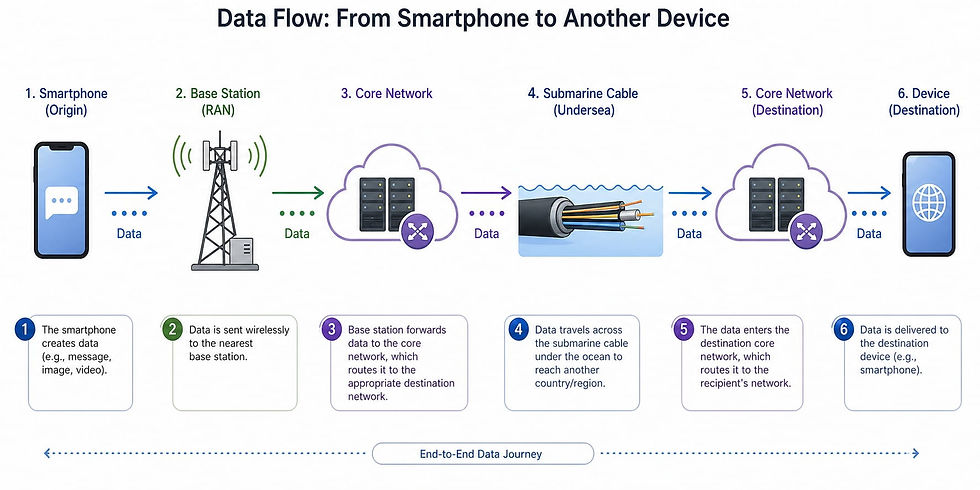
End-to-End: What Happens When You Hit Send
It's useful to trace a single data packet through the whole system.
Your phone generates data say, a chunk of a video you're uploading. The application layer hands it to the transport layer (TCP), which breaks it into segments, adds sequencing information, and sends it down to the IP layer, which adds source and destination addresses. This packet is then handed to the LTE or 5G protocol stack, which adds its own headers, performs channel-appropriate error coding, maps it to physical resource blocks, modulates it onto subcarriers using OFDM, and transmits it as a radio signal from your phone's antenna.
The base station receives your signal along with signals from hundreds of other devices. It decodes your transmission, strips the radio-layer overhead, and forwards the IP packet over a wired backhaul link which is almost certainly fiber - to the core network. The core network routes the packet toward its destination, which might be a server in a nearby data center or one on the other side of the world. Along the way, it passes through multiple routers, possibly traverses an undersea fiber cable, enters a data center, and gets processed by a server.
The response takes roughly the reverse path back to your phone. The whole round trip might take 50 milliseconds. In that time, the data has been encoded and decoded multiple times, modulated and demodulated, routed through perhaps a dozen network nodes, and traveled thousands of kilometers.

Every step involves engineering choices made by people who dealt with exactly the trade-offs described above.
The Real-World Constraints That Theory Doesn't Tell You
It's worth ending with some constraints that get less attention in textbooks but dominate real deployment decisions.
Spectrum is regulated: You cannot simply transmit on whatever frequency seems convenient. Every country has a regulatory body such as in the US, the FCC; in India, TRAI that allocates spectrum to different uses. Mobile operators pay billions of dollars for the right to use particular frequency bands. This creates hard limits on how much bandwidth any operator can deploy, regardless of how good their technology is.
Infrastructure is expensive: A single cell tower, including land rights, equipment, installation, power, and ongoing maintenance, can cost hundreds of thousands of dollars. A metro-area network has hundreds or thousands of towers. Backhaul fiber costs more. The data centers running the core network cost more still. Telecommunications is a capital-intensive business, and this shapes decisions about where coverage gets deployed and how quickly.
Interference is hard to predict: In a lab, you control the RF environment. In a city, you have thousands of transmitters, reflective surfaces of different materials, vehicles, weather, and users clustering in unpredictable ways. Network planning is as much art as science.
Users move: Handover i.e. transferring an active session from one base station to another as a user moves needs to work seamlessly, consistently, at vehicular speeds, even when the target cell is partially loaded and the source cell is degrading. Doing this well requires coordination between base stations and the core network in real time.
Battery life constrains everything on the device side: A phone that burns through its battery in two hours is not useful, regardless of what it can accomplish in that time. Power consumption shapes which modulation schemes are practical, how often devices transmit versus receive, and how many antennas a handset can support.

Where This Goes Next
The research and deployment roadmap in telecommunications is active.
6G research is underway in labs around the world, though standardization is still years away. It involves exploring spectrum above 100 GHz (terahertz bands), AI-native air interfaces where machine learning is built into the PHY layer rather than bolted on, and tighter integration between satellite and terrestrial networks.
Satellite internet has arrived in practical form. Starlink and similar systems demonstrate that low-Earth-orbit satellite constellations can deliver broadband latencies (30 - 60 ms) far better than older geostationary systems, though coverage in dense urban areas still can't match terrestrial cellular.
AI-driven network management is becoming real. The traditional approach to managing a mobile network involves human engineers configuring parameters based on experience and measurement. ML-based systems can optimize these parameters continuously, in real time, across millions of cells simultaneously.
Edge computing reduces latency for latency-sensitive applications by processing data at or near the base station rather than sending it to a distant data center. This is where URLLC applications actually become practical.
But through all of this, the fundamentals don't change. Shannon's capacity formula still applies. Noise is still unavoidable. Spectrum is still finite. The laws of physics that govern how radio waves propagate are the same laws they were in Hertz's lab in the 1880s.
What It All Means
Telecommunications is layered, and each layer is genuinely interesting once you stop treating it as a black box.
At the bottom, physics. Electromagnetic waves propagating through media, subject to noise, interference, and absorption. Signal processing that extracts meaning from ambiguous data.
In the middle, systems engineering. Multiplexing schemes that share limited spectrum among competing users. Modulation choices that trade robustness for throughput. Error correction codes that push performance toward theoretical limits. Network architectures that scale to hundreds of millions of simultaneous users.
At the top, the infrastructure reality. Spectrum auctions. Tower sites. Fiber routes. The political and economic decisions that determine whether your neighborhood gets fast broadband this year or five years from now.
When you send a message, none of this is visible. It just works, which is the goal and also something of an engineering miracle given everything it requires. But understanding what's happening underneath changes how you think about it. That wall your WiFi signal is struggling to penetrate? That's absorption at the material's resonant frequency. The difference in speed between a full bar and one bar? That's the Shannon limit at two different SNRs. The drop in quality on a video call when you walk behind a building? That's multipath and shadow fading colliding.
None of it is magic. It's physics and mathematics, deployed at scale, by engineers who spent a lot of time thinking about trade-offs you never have to know about unless you want to.
Which, now, you do.


Comments