Types of Communication Systems: Wired vs Wireless

If you strip telecom down to its bare bones, everything revolves around moving information from one place to another. That sounds deceptively simple until you sit down and think about the fact that the entire global internet, every cellular network, every satellite system, and even the Ethernet cable running to your desktop computer are all built on fundamentally different ways of doing exactly that one thing.
At a high level, all communication systems fall into two categories: wired communication systems (guided media) and wireless communication systems (unguided media). These two categories might seem like a textbook classification you memorize and forget, but this split is actually the lens through which you should be looking at every major decision in modern telecom engineering.
This isn't just a theoretical distinction. It determines network reliability, shapes capacity limits, drives latency characteristics, dictates deployment cost, and defines the security surface of any system you build. If you get this wrong or you treat it as a trivial classification, you end up making expensive, difficult-to-reverse mistakes.
Consider a few real examples. Your 5G smartphone connection is wireless, yes, but the data your phone sends almost certainly travels over fiber optic cables for the vast majority of its journey. A data center, by contrast, relies almost entirely on wired communication because predictable, stable performance isn't a nice-to-have there, it's an operational requirement. And in rural areas, wireless becomes the default option not because it's technically superior but because laying fiber across hundreds of kilometres of sparse terrain is genuinely not economically viable for most operators.

Understanding this split between wired and wireless is the foundation for understanding modern telecom architecture. Everything else builds on top of it.
First Principles: What Is a Communication System, really?
Before comparing wired and wireless in any depth, we need to be precise about what a communication system actually consists of. It's worth going back to basics here because a lot of engineers skip this step and then struggle to reason clearly about trade-offs later.
A generic communication system has five components. You have the source, which is where the information originates. Then a transmitter, which encodes and modulates the signal for transmission. Then the channel, which is the physical medium through which the signal travels. Then a receiver, which decodes the signal on the other end. And finally, a destination, which is the user or system that actually consumes the information.
The core mathematics behind this isn't complicated. A transmitted signal x(t) passes through a channel and arrives at the receiver as:

Where h(t) is the channel impulse response, n(t) is noise, and the asterisk represents convolution. This equation is universal. It applies whether you're dealing with fiber optics or radio waves, cable television or a 5G base station.
Here's the key insight that makes this equation so useful: the difference between wired and wireless systems lies entirely in the nature of h(t). In a fiber cable, h(t) is relatively clean, predictable, and controllable. In a wireless channel, h(t) is a shifting, messy function that changes depending on where you're standing, what buildings are nearby, how fast you're moving, and what the weather is doing. Everything that follows in this article is really just an elaboration of that one difference.

Wired Communication Systems
The Fundamental Concept
In wired systems, the signal is physically guided along a medium. This gives you three things that wireless engineers often envy: predictable propagation behavior, a controlled environment, and low interference. The signal goes where the wire goes. It doesn't bounce off buildings or get absorbed by rain. You know, within fairly tight margins, what you're going to get.
Types of Wired Media
Twisted Pair Cable
Twisted pair is probably the most familiar wired medium for most people, even if they don't think about it much. It's the technology behind Ethernet cables (Cat5e, Cat6) and traditional telephone lines.
The core idea is simple but clever. By twisting two conductors around each other along their length, you create a geometry that causes electromagnetic interference picked up by one twist to be cancelled out by the adjacent twist. Both wires pick up interference equally, and since signals travel as the difference between the two conductors, the noise cancels. This is why you can run Ethernet through a building full of fluorescent lights and motors without the signal degrading into noise.

Coaxial Cable
Coaxial cable takes the shielding concept further. You have an inner conductor, surrounded by a dielectric insulator, surrounded by a conductive shield, surrounded by an outer jacket. The shield confines the signal's electromagnetic field to the space between the inner conductor and the shield, which dramatically reduces both interference pickup and signal radiation.
The result is better shielding than twisted pair and significantly higher bandwidth. You'll find coaxial cable in cable TV infrastructure, DOCSIS broadband networks, and a lot of RF applications where you need to move high-frequency signals without losing them to radiation.
Optical Fiber
Optical fiber is where things get genuinely interesting, and it's arguably the most important physical medium in the world right now. Instead of moving electrons through a conductor, fiber moves photons through a glass or plastic core. The physics is different, the engineering is different, and the performance is in a different category entirely.
Light propagates through the fiber using a phenomenon called total internal reflection. When light hits the boundary between the glass core and the surrounding cladding at an angle greater than the critical angle θc, it reflects back into the core rather than passing through. It's basically a light pipe, bouncing photons along its length with remarkably low loss.
The formula for total internal reflection is:

Where θᵢ is the angle of incidence and θc is the critical angle determined by the refractive index difference between the core and cladding.
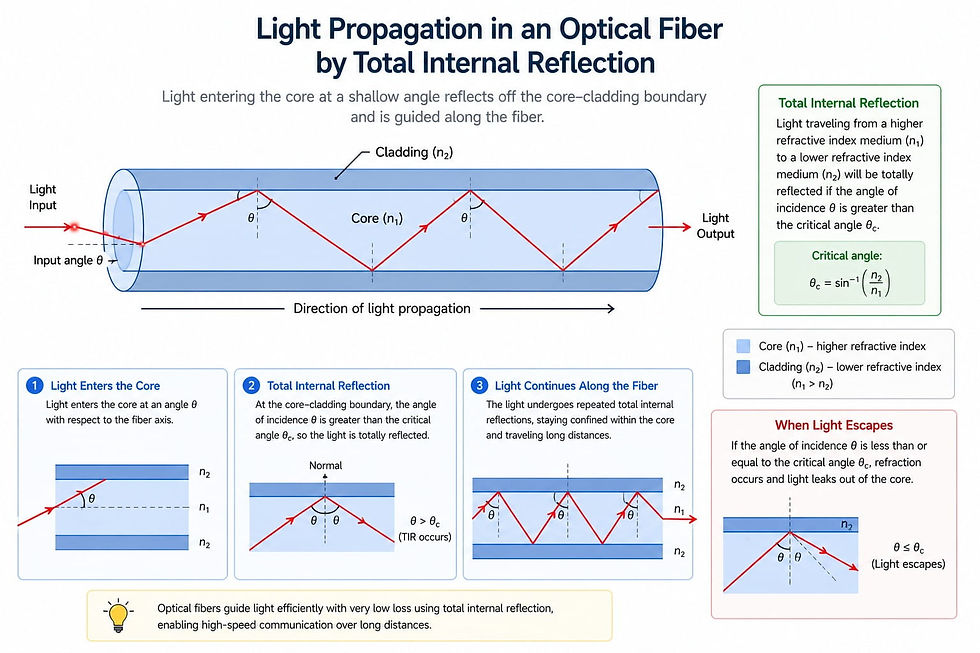
Fiber comes in two main types. Single-mode fiber has a very small core diameter, typically around 8 to 10 microns, which constrains light to travel in a single propagation path. This eliminates a source of signal degradation called modal dispersion and makes single-mode fiber the standard for long-distance, high-capacity links. Multi-mode fiber has a larger core, typically 50 or 62.5 microns, allowing light to travel via multiple paths simultaneously. This is cheaper to manufacture and easier to connect but introduces modal dispersion, making it suitable mainly for short runs like within a building.
Channel Characteristics in Wired Systems
Signal loss in a wired medium follows an exponential decay with distance:

Where α is the attenuation coefficient and d is the distance. The attenuation coefficient varies significantly by medium type. Copper cables have much higher attenuation than fiber, which is part of why fiber has displaced copper for nearly all long-distance transmission.
For bandwidth, optical fiber operates in a different league. Modern fiber systems routinely achieve terabits per second over a single fiber strand using wavelength division multiplexing (WDM), which is the technique of sending multiple wavelengths of light simultaneously through the same fiber. The theoretical bandwidth of a single fiber is measured in terahertz. This is why fiber powers the internet backbone because there's simply nothing else that comes close.
Advantages of Wired Systems
The capacity of fiber is the headline number, but it's not the only advantage. Wired systems offer low, predictable latency because you don't have the scheduling overhead, retransmission delays, and fading effects that plague wireless links. Physical security is real: someone wanting to intercept your traffic has to physically access the cable, which is a significant barrier compared to wireless signals that propagate through walls and into the street. And interference is essentially a non-issue once the cable is properly installed and shielded.
Limitations
Deployment cost is the main constraint. You need to dig trenches, run cable through conduit, manage physical connections at both ends, and maintain the infrastructure over time. In established urban areas with existing conduit, this is manageable. In greenfield deployments across difficult terrain, the economics can be brutal. And once the cable is in the ground, it's not going anywhere. The infrastructure doesn't follow users as they move around.
Fiber in the 5G World
One thing worth understanding clearly: fiber is not being replaced by 5G. It's being used more because of 5G. Every 5G base station needs a backhaul connection to the core network, and for high-capacity deployments, that backhaul is fiber.
The architecture looks like this: the user equipment connects to the gNodeB (the 5G base station) over the wireless interface. The gNodeB then connects to the core network over fiber. The "wireless" part is only the last hop. Everything behind the base station is wired.

This pattern repeats across all of cellular. The air interface is wireless by necessity (users are mobile), but the moment you hit the infrastructure side, you're almost always on fiber. Understanding this is important because it explains why telcos spend enormous amounts of money building dense fiber networks even in the midst of a major wireless technology cycle.
Wireless Communication Systems
The Fundamental Concept
Wireless systems transmit information via electromagnetic waves propagating through space. There's no physical medium guiding the signal as the channel is the air itself, or in some cases the vacuum of space. This creates both the freedom that makes wireless indispensable and the engineering challenges that make wireless hard.
An electromagnetic wave can be described mathematically as:

Where f is the frequency and φ is the phase. The frequency determines where the signal sits in the spectrum, which matters enormously for both the physical behavior of the wave and the regulatory and licensing environment.
The Frequency Spectrum
Different frequency bands behave very differently as propagation media.
Sub-1 GHz frequencies (like 700 MHz or 850 MHz) penetrate buildings well, diffract around obstacles, and can reach receivers tens of kilometres from the transmitter. The trade-off is bandwidth. At lower frequencies, you have less spectrum to work with, which means lower peak data rates. These bands are valuable for coverage, blanketing a wide area with a usable signal.
The 1 to 6 GHz range is where most modern cellular sits. LTE and 5G Sub-6 GHz deployments use these bands because they offer a reasonable balance between range and bandwidth. You don't get the propagation distances of 700 MHz, but you get more spectrum and higher data rates.
Millimeter wave (mmWave), above 24 GHz, is where things get interesting for 5G specifically. The available spectrum at these frequencies is enormous, which translates directly to potential data rates in the gigabits-per-second range. The problem is physics: at these frequencies, signals don't penetrate buildings, they barely go around corners, and rain can cause meaningful attenuation. mmWave 5G is essentially a technology for dense outdoor deployments or indoor coverage with dedicated access points. It's excellent in the right situations and nearly useless in others.

Propagation Mechanisms
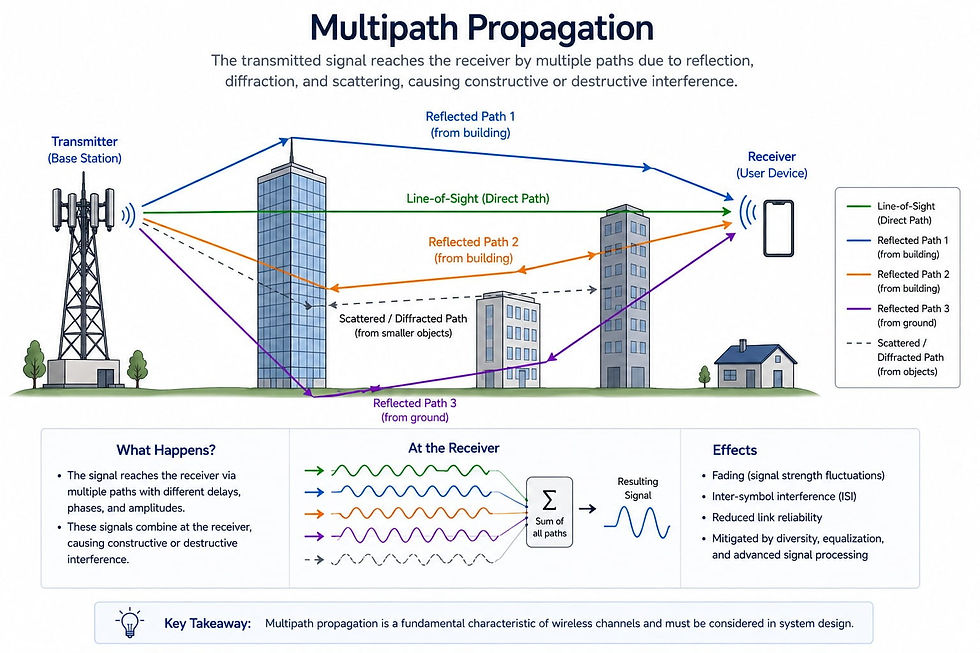
This is where wireless channels earn their reputation for complexity. When a signal leaves a transmitting antenna, it doesn't travel in a straight line to the receiver. It does all of the following simultaneously:
Reflection: the signal bounces off large flat surfaces like buildings, the ground, and water. Reflected paths can reach the receiver from multiple directions.
Diffraction: the signal bends around the edges of obstacles. This is why you can sometimes get a usable signal even without a line of sight to the base station because the signal diffracts around buildings or over hills.
Scattering: the signal scatters when it hits surfaces that are rough relative to the wavelength, like trees, foliage, or the surface texture of buildings.
The result of all this is that the receiver sees not one copy of the transmitted signal but many copies, each arriving from a different direction and with a different delay. This is called multipath propagation, and it's the fundamental reason wireless channels are hard.
Path Loss
The received power in a wireless link decrease with distance according to:

Where n is the path loss exponent, typically between 2 and 4 in real environments. In free space, n = 2 (following the inverse square law). In a dense urban environment with lots of obstructions and reflections, n can be 3.5 or 4 or higher.
Compare this to fiber, where attenuation follows the exponential e^(-αd). In fiber, very small values of α mean the signal travels enormous distances. In wireless, especially at higher frequencies, path loss is severe enough that cell radii of a few hundred metres are the norm for dense deployments.
Multipath Fading
The multiple copies of the signal arriving at the receiver add together, and depending on their relative phases, the result can be constructive (they add up and you get a strong signal) or destructive (they partially or fully cancel and you get a weak or absent signal). This is called fading.
What makes fading particularly challenging is that it's dynamic. As a user moves, even a small distance, the geometry of all the reflected paths changes, which changes the phase relationships, which changes whether you're in a constructive or destructive interference condition. A user walking across a room can experience signal variations of 20 or 30 dB. A car moving down a street experiences rapid, continuous fading. The receiver and the system as a whole need to deal with this constantly.
Wireless Technologies
Wi-Fi occupies the short-range end of the spectrum. It operates in unlicensed bands (primarily 2.4 GHz and 5 GHz, with 6 GHz added in Wi-Fi 6E), requires no licensing fees, and delivers high throughput over distances of tens to a hundred or so metres. The trade-off for unlicensed operation is that you share the band with everyone else, your neighbours' Wi-Fi networks, Bluetooth devices, microwave ovens, and anything else operating in those bands. Interference management in unlicensed bands is a real engineering problem.
LTE (4G) operates in licensed spectrum, which means the operator pays significant fees for the right to use those frequencies exclusively within a geographic area. LTE is based on OFDMA (Orthogonal Frequency Division Multiple Access) on the downlink, which divides the available bandwidth into many small subcarriers and allocates them to users dynamically. The scheduler at the base station decides, every millisecond or so, which users get which resource blocks, and it tries to do this in a way that exploits the channel variability by giving users resources when their channel is relatively good.
5G NR adds several important capabilities to LTE. Massive MIMO uses antenna arrays with dozens or hundreds of antenna elements to create narrow, steerable beams. Instead of broadcasting the signal in all directions and hoping the right user receives it, the base station can focus energy precisely toward specific users. This improves signal quality for each user and allows the system to serve more users simultaneously with less interference between them. Network slicing allows the same physical infrastructure to be partitioned into multiple virtual networks, each with different performance characteristics. You can have an ultra-low-latency slice for industrial automation and a high-throughput slice for video streaming on the same physical infrastructure.

Key Wireless Techniques
Modulation is the process of encoding information onto a carrier wave. Higher-order modulation schemes pack more bits into each transmitted symbol. QPSK (Quadrature Phase Shift Keying) encodes 2 bits per symbol. 16-QAM encodes 4 bits per symbol. 64-QAM encodes 6 bits per symbol. 256-QAM encodes 8. The catch is that higher-order schemes require higher SNR to work reliably - each constellation point is closer to its neighbours, so more noise is needed to cause an error. In practice, the modulation order is selected adaptively based on the channel quality: use 256-QAM when the channel is good, fall back to QPSK when the channel is bad.

OFDM (Orthogonal Frequency Division Multiplexing) splits the available channel bandwidth into many narrow subcarriers, each of which carries a portion of the data.
Mathematically:

The orthogonality between subcarriers means they can overlap in frequency without interfering with each other, which makes very efficient use of the available spectrum. More importantly for wireless, OFDM is robust against multipath because the symbol duration on each narrow subcarrier is long compared to the delay spread of the channel. OFDM is the basis for Wi-Fi, LTE, and 5G.

MIMO (Multiple Input Multiple Output) uses multiple antennas at both the transmitter and receiver. This can improve the system in two ways. Spatial multiplexing uses the multiple antennas to send independent data streams simultaneously in the same frequency band, multiplying the data rate by the number of streams. Diversity coding sends the same data via multiple paths, improving reliability. The massive MIMO used in 5G base stations takes this further, using large antenna arrays to form multiple beams that can serve different users in the same time-frequency resource.
Advantages of Wireless Systems
Mobility is the fundamental one. A fiber cable cannot follow a person as they walk down the street. Wireless can. This isn't a minor feature; it's the reason smartphones exist as products and it's why mobile data traffic has been growing at double-digit percentages for decades.
Rapid deployment is another real advantage. You can put up a cellular base station or point-to-point microwave link far faster than you can trench and lay fiber. In disaster response or emergency connectivity scenarios, this matters enormously. In markets where the economics of fiber deployment don't work, wireless provides connectivity that would otherwise not exist at all.
Limitations
Limited spectrum is the binding constraint for wireless. The radio spectrum is a finite resource, and every wireless system has to share it with every other wireless system operating in the same band in the same geographic area. This is why spectrum auctions can generate tens or hundreds of billions of dollars. Exclusive access to a useful frequency band is genuinely valuable and genuinely scarce.
Security is a persistent concern. Unlike a fiber cable, wireless signals propagate through walls and into public spaces where anyone with the right equipment can receive them. This doesn't make wireless inherently insecure. Modern encryption is strong but it means the security considerations are fundamentally different from physical-access-controlled wired infrastructure.
Performance variability is the third major limitation. A fiber link is going to deliver essentially the same performance hour after hour. A wireless link's performance depends on how many users are connected, where they're standing, what interference environment they're in, and whether it's raining. You can engineer and optimize this variability, but you can't eliminate it.
Wired vs Wireless: Engineering Comparison in Depth
Capacity
Fiber operates in a fundamentally different capacity regime than wireless. A single fiber strand carrying dense WDM can sustain terabits per second of throughput. Wireless systems are constrained by spectrum availability and path loss.
The Shannon-Hartley theorem gives the theoretical upper bound on channel capacity:

Wireless systems suffer on both sides of this equation. B is limited by available spectrum. SNR is limited by path loss, interference, and fading. Fiber has enormous B and excellent SNR. This is not a gap that wireless technology can close, it's a fundamental physics limit.
Latency
Wired latency is predictable. You know the propagation speed of light through fiber (roughly 2 × 10⁸ m/s in glass), you know the cable length, and your latency is the sum of propagation delay and deterministic processing delays. In wireless, you add scheduling latency (the scheduler runs every millisecond or so in LTE), potential retransmissions when packets are lost due to channel errors, and variable queueing delays depending on network load. 5G NR has reduced the scheduling interval to improve latency, but wireless will never match fiber for predictable, consistent latency.


Reliability
Wired links fail in relatively well-understood ways: fiber cuts, connector degradation, equipment failures. These are discrete events, and the network can route around them. Wireless reliability degrades continuously and dynamically in response to environmental factors that are completely outside the operator's control. Heavy rain, unexpected interference from a new source, or even a user walking from an open area into a basement can all degrade wireless performance in ways that are hard to predict and impossible to prevent.
Deployment Cost
Wired has high upfront costs and low ongoing costs once installed properly. Wireless has lower infrastructure costs but licensing fees for spectrum can be enormous, and operating costs for base stations (power, maintenance, backhaul connectivity) add up. Which is cheaper in total depends heavily on the specific deployment scenario.
Security
Wired systems require physical access to intercept traffic, which is a strong baseline security property. Wireless systems broadcast into shared space and require cryptographic security to protect privacy. Both approaches can be secure in practice, but the threat model and the engineering of security are different.
Hybrid Systems: How the Real World Actually Works
If you take one thing away from this article, let it be this: modern telecom systems are not purely wired or wireless. They're deliberately engineered combinations of both, designed to use each where it makes sense.
Consider how data flows when you open a website on your phone. Your device connects to the network wirelessly over 5G or LTE. The base station connects back to the operator's core network over fiber. The core network connects to the internet over fiber backbone links. The web server you're reaching connects to its data center network over wired Ethernet. Somewhere in there might be a CDN edge node connected over fiber. The only wireless hop in this entire chain is the very first one, from your phone to the base station.
This isn't an accident. Wireless solves the mobility problem at the edge, where users are physically moving and where you physically cannot run a wire to every handset. Wired solves the capacity and reliability problem in the core, where the traffic volumes are too high for wireless to handle and where the infrastructure is fixed.
Every real-world deployment involves trade-offs between these properties. ISPs building FTTH (Fiber to the Home) networks are moving the fiber/wireless boundary closer to the user, reducing the wireless portion of the last mile. 5G small cell deployments are pushing wireless deeper into buildings and denser into urban areas. LEO satellite constellations like Starlink are adding a wireless hop from space, but they still connect to ground stations that are on the fiber internet backbone.

Trade-offs Engineers Actually Think About
Spectrum vs Infrastructure
Wireless engineers are constantly constrained by spectrum scarcity. You can't just deploy more wireless capacity by throwing money at infrastructure - you eventually hit the hard limit of available spectrum. Wired engineers have the opposite constraint: spectrum isn't a concern, but the cost of physical infrastructure is. These lead to very different design philosophies.
Energy Efficiency
Wireless systems require power amplifiers to transmit with enough power to cover useful distances, and digital signal processing for modulation, equalization, MIMO, and everything else. Fiber, once installed, moves bits using light and requires very little energy per bit transmitted. As data traffic has scaled dramatically, the energy efficiency of the transmission medium has become an increasingly important factor in network design.
Scalability
Fiber scales via DWDM (Dense Wavelength Division Multiplexing), which adds capacity by adding wavelengths to existing fiber without replacing any physical infrastructure. The glass in the ground already installed in the 1990s is carrying far more capacity today because the technology at the ends has improved. Wireless scales through a combination of spectrum reuse (deploying more cells to reuse the same frequencies over smaller geographic areas) and adding spectrum where available. Small cell densification - the deployment of many small base stations covering limited areas is the main technique for increasing wireless capacity in urban areas.
Interference Management
Interference is a wireless-only problem. Wired systems don't have to worry about their signals interfering with adjacent cables (assuming basic shielding) or dealing with signals from other systems in the same medium. Wireless engineers spend enormous amounts of effort on interference management: frequency planning, fractional frequency reuse, inter-cell coordination, beamforming to reduce interference between users, and receiver algorithms that can extract a signal from an interference-heavy environment.
The Last Mile Problem
The hardest problem in access network engineering is getting connectivity to the end user. In dense urban areas, fiber to individual buildings and apartments is becoming economically viable. In suburban areas, the economics are harder. In rural areas, running fiber to every home is often completely uneconomical, which is why fixed wireless access (FWA) in which a wireless link to a home or business substitutes for the fiber connection has become a significant product category. The last mile problem is fundamentally about the trade-off between wired capacity and wireless deployment flexibility, and different operators have landed at very different points on that spectrum depending on their geography, customer density, and capital resources.

Why Fiber Will Always Win the Backbone
Even in the era of 5G, massive MIMO, and increasingly capable satellite internet, global traffic runs on submarine fiber cables. The capacity of wireless systems, even at their theoretical best, is nowhere near what fiber can deliver.
The reason comes back to the Shannon capacity equation. Fiber has enormous bandwidth (terahertz-scale), excellent SNR (low noise, controlled environment), and no spectrum sharing. The capacity of the global fiber network is not close to being exhausted, it's increasing as WDM technology improves and as more fiber is installed. Wireless cannot approach these numbers not because of insufficient engineering effort but because of fundamental physical constraints on spectrum availability and path loss.
This doesn't mean wireless is losing. It means wireless and wired are solving different problems and conflating them is a mistake.
Why Wireless Will Always Be Necessary
Humans move. Devices are mobile. The smartphone you carry everywhere is fundamentally incompatible with a physical tether to the network infrastructure. Wireless exists because mobility is non-negotiable in a way that copper or fiber cables can never accommodate.
Beyond mobility, wireless provides connectivity in environments where installing physical cable is genuinely impossible or impractical - think ships at sea, aircraft, remote monitoring of oil pipelines, agricultural sensors scattered across thousands of acres of farmland. The emerging Internet of Things (IoT) ecosystem is full of use cases where deploying wired infrastructure to each device would be absurd.
Where Things Are Heading
5G and the next generation are pushing the performance envelope of wireless in several directions simultaneously. Massive MIMO and beamforming are improving spectral efficiency. Ultra-dense small cell networks are increasing capacity through frequency reuse. Network slicing is making wireless networks more flexible and configurable. The 3GPP standards process is already working on what comes after 5G, with targets for latency, capacity, and device density that will require new approaches to antenna design, spectrum utilization, and network architecture.
Fiber deep networks represent operators pushing the fiber endpoint closer to users. FTTH takes fiber all the way to the home, essentially eliminating the last-mile wireless hop for fixed broadband. FTTx architectures - fiber to the cabinet, fiber to the curb, fiber to the distribution point all represent different trade-offs in the fiber/wireless boundary, with the wireless hop getting shorter as fiber gets cheaper to deploy.
LEO satellite internet is a genuinely new development in this space. Traditional geostationary satellites sit at about 35,000 km altitude, which creates roughly 600 ms of round-trip latency which is too high for many applications. Low Earth Orbit constellations operating at 500 to 1200 km reduce this to 40 to 80 ms, making satellite internet competitive for more use cases. But these satellites still need ground stations connected to the fiber internet backbone. They're adding a wireless hop to the mix, not replacing fiber.
The Real Conclusion
The question "wired or wireless?" is the wrong question. It's not a competition. They coexist in every large-scale network because they're good at different things.
Wired systems (optical fiber specifically) dominate where capacity, stability, and predictability are the primary requirements. The internet backbone, data center interconnects, cellular backhaul, and enterprise campus networks all lean heavily on wired infrastructure for exactly these reasons.
Wireless systems dominate where mobility matters, where deployment speed matters, and where physical infrastructure is impractical. The access edge of cellular networks, fixed wireless access, IoT, and satellite links are all wireless by necessity.
Modern telecom engineering is the discipline of designing carefully composed combinations of both. Every architectural decision involves placing the wired/wireless boundary in the right place for the constraints of that specific deployment - balancing capacity against deployment cost, stability against mobility, fiber infrastructure investment against spectrum licensing fees.
If you understand why fiber powers the backbone and why wireless serves the edge, you understand the structural logic of how global communication networks are built. Not just at a conceptual level, but at the level of physics and information theory that actually drives the decisions.
That's the difference between knowing what the diagram shows and understanding why it's drawn that way.


Comments