Airtel 5G SA vs NSA: What Really Changes Behind the 5G Icon?

Airtel 5G SA vs NSA is not just about which network shows a “5G” logo on your phone. In real telecom systems, the important question is: what part of the network is actually 5G? Is only the radio layer upgraded, or has the entire control plane, user plane, mobility system, authentication path and core network moved to a 5G-native design?
That distinction matters because many users judge 5G only by speed tests. But an engineer looks at something deeper: radio spectrum, carrier aggregation, LTE anchoring, core latency, scheduling, handover behavior, fiber backhaul, packet routing and congestion. Airtel originally used 5G NSA for Airtel 5G Plus, meaning the 5G radio was added on top of existing 4G LTE infrastructure to accelerate rollout, while SA requires a 5G Core. Airtel itself explained that Airtel 5G Plus was using NSA mode to deploy 5G quickly across the country.
The Simple Difference: NSA Uses 4G as the Anchor, SA Does Not
In 5G NSA, the phone connects to LTE and 5G NR together. LTE acts as the control anchor, while 5G NR provides extra data capacity. In 3GPP terms, NSA can use EN-DC, where an LTE eNB and 5G en-gNB work together through the X2 interface. 3GPP describes NSA as a temporary step toward full 5G, with the 5G access network connected to the 4G core.
In 5G SA, the device connects to 5G NR and a 5G Core directly. There is no LTE anchor required for the 5G session. That means the network can use 5G-native control functions such as AMF, SMF, UPF, UDM and PCF instead of depending on the LTE EPC design.
A simplified way to compare them:
NSA:
Phone → LTE anchor + 5G NR → 4G EPC → Internet
SA:
Phone → 5G NR → 5G Core → Internet / edge / enterprise slice

Why Airtel Chose NSA First
From a deployment perspective, NSA is the practical first step. Airtel already had a nationwide LTE network, towers, fiber routes, EPC systems, IMS voice infrastructure and mature mobility procedures. By adding 5G NR radios to existing sites, Airtel could deliver higher data speeds without replacing the full core network at once.
This is why NSA often gives excellent download speeds but does not always feel like a completely new network. The radio pipe is wider, but parts of the signaling and packet-control architecture still behave like an evolved 4G system. Airtel has continued expanding 5G sites aggressively, including thousands of new 5G sites in circles such as UP East and Gujarat in 2026.
The engineering trade-off is simple: NSA gives faster coverage expansion; SA gives better 5G architecture.
The Engineering View: Throughput Is Not Only About SA or NSA
A common mistake is assuming SA is automatically faster than NSA. Peak throughput depends more on radio bandwidth, modulation, MIMO layers, scheduler load, backhaul capacity and signal quality.
A rough downlink capacity model is:
C = B log₂ (1 + SINR)
Where:
C is channel capacity in bits per second,
B is channel bandwidth in Hz,
SINR is signal-to-interference-plus-noise ratio.
This equation explains why a user with “full 5G signal” can still get poor speed. If the cell is congested or interference is high, SINR drops and the scheduler cannot assign high-order modulation efficiently. NSA versus SA changes the architecture, but the radio still obeys Shannon’s limit.
In NSA, Airtel can combine LTE and NR resources, which may help throughput in some scenarios. In SA, the network can become more efficient for 5G-native sessions, but if spectrum, backhaul or cell loading are weak, SA will not magically fix the radio layer.

Latency: Where SA Actually Starts to Matter
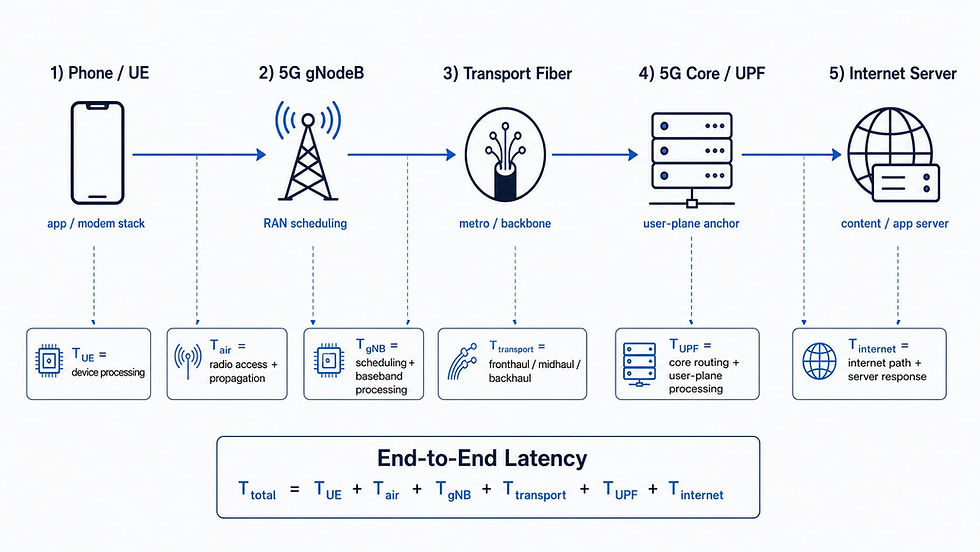
Latency is where SA becomes more interesting. In NSA, control signaling often depends on LTE anchoring and EPC paths. In SA, the 5G Core can place the User Plane Function closer to the user, especially for edge computing, enterprise networks and fixed wireless access.
End-to-end latency can be simplified as:
Tₜₒₜ = Tᵣ + Tₜ + T꜀+ Tₛ
Where:
Tᵣ is air-interface scheduling and retransmission delay,
Tₜ is fiber or microwave backhaul delay,
T꜀ is packet-core processing and routing delay,
Tₛ is application/server response time.
SA mainly improves the core and service architecture part of this equation. It can reduce unnecessary anchoring, support local breakout through UPF placement, and enable cleaner network slicing. But for normal web browsing, the server and transport path may still dominate. That is why SA is more meaningful for gaming, industrial IoT, private 5G, AR/VR, FWA and enterprise traffic engineering than for simply opening Instagram faster.
Airtel SA vs NSA in Real User Experience
For an average Airtel user, NSA feels good with high peak speeds when coverage is good, quick rollout, wide compatibility and reliance on the existing LTE ecosystem. It is good for YouTube, downloads, social apps, browsing and general mobile data.
SA should feel different when the operator enables enough of the 5G-native stack such as lower control-plane dependency on LTE, better latency consistency, support for VoNR, more efficient FWA, and future slicing. Ericsson describes SA as using a cloud-native 5G Core with service-based architecture, enabling more agile service orchestration and advanced 5G capabilities.
However, the user-facing improvement may be uneven. Your phone must support SA bands and carrier policy. The local site must support SA. The SIM profile, firmware, IMS/VoNR settings and core routing must also be ready. A 5G SA icon alone does not guarantee better performance if the cell is overloaded or backhaul is constrained.

Why FWA Benefits Strongly from SA
Fixed Wireless Access is one of the most natural early use cases for SA. A home 5G router is stationary, easier to optimize, and can be mapped to specific QoS policies. The operator can engineer capacity sector by sector, unlike mobile users moving unpredictably across cells.
For FWA, the important equation is not just peak radio speed but shared sector capacity:
Rᵤ ≈ ηB/N
Where:
Rᵤ is approximate per-user throughput,
η is spectral efficiency in bits/s/Hz,
B is usable bandwidth,
N is the number of active users sharing resources.
SA helps because the operator can apply cleaner QoS, session management and traffic steering through the 5G Core. But if too many FWA users are placed on the same sector, speeds will still fall. The radio resource block is finite.

The Limitations Most Miss
Airtel 5G SA vs NSA comparison should not reduce the issue to “SA good, NSA bad.” NSA was the right rollout architecture when speed and coverage mattered first. SA is the better long-term architecture when the network must support low-latency services, slicing, private 5G, VoNR and edge routing.
The real limitation is that 5G performance is a chain. The weakest link may be radio spectrum, tower density, fiber backhaul, core routing, DNS, CDN peering, handset modem, thermal throttling or cell congestion. Airtel has also been expanding 4G and 5G infrastructure through vendor deals and site additions, showing that radio and transport capacity remain just as important as the SA transition. Reuters reported Airtel’s major 4G/5G equipment agreement with Ericsson to improve network speed, reliability and coverage.

Airtel 5G SA Is the Future, but NSA Was the Necessary Bridge
Airtel’s NSA network made sense because India needed fast 5G coverage at massive scale. It reused LTE infrastructure, reduced rollout complexity and delivered visible speed improvements quickly. But NSA is still an evolutionary architecture. It gives users 5G radio capacity without fully exposing the 5G system design.
SA is where 5G becomes a complete architecture: 5G NR, 5G Core, cloud-native control, UPF placement, slicing, VoNR, FWA optimization and enterprise-grade traffic engineering. The real verdict is this: Airtel 5G NSA is excellent for broad consumer coverage and speed-led rollout; Airtel 5G SA is the more important long-term platform for latency-sensitive, enterprise, FWA and 5G-native services.
For users, the best Airtel 5G experience will not come from SA alone. It will come when SA is combined with clean spectrum, dense sites, strong fiber backhaul, low congestion, good peering and mature device support. That is the real engineering story behind Airtel 5G SA vs NSA.


Comments