Airtel 5G SA Review: Real-World Speed, Coverage, Latency and Engineering Reality

Airtel’s move toward 5G Standalone is one of the most important network shifts in Indian telecom because it changes 5G from a faster radio layer sitting on top of 4G into a more complete 5G system. In simple terms, 5G NSA depends on the 4G core for control-plane anchoring, while 5G SA uses a 5G core, enabling lower latency, cleaner network slicing, better enterprise services, and more flexible traffic handling.
For this Airtel 5G SA review, I am treating the network the way a real user and a telecom engineer both would: not just asking “what speed did I get?”, but also asking why the speed changes across locations, why indoor coverage behaves differently, how Airtel’s spectrum strategy affects performance, and what the network still needs to compete more directly with Jio’s 5G footprint.
Airtel’s public 5G positioning says users can access Airtel 5G Plus on compatible 5G phones without changing the SIM, while Airtel’s 2022 spectrum purchase included holdings in 900 MHz, 1800 MHz, 2100 MHz, 3300 MHz and 26 GHz bands. The 3300/3500 MHz layer is especially important because this is where much of India’s practical 5G capacity comes from.
My Airtel 5G SA Test Setup
For this review, I tested Airtel 5G SA in real usage conditions rather than only standing near a tower. My testing structure is simple:
Test phone: Samsung Galaxy S26 Ultra
SIM type: Physical Sim
Plan: Postpaid 449 Plan
City: Kolkata
Test apps: Speedtest.net
Test conditions: outdoor, indoor near window, congested evening hours
Results:
Test Location | Download | Upload | Ping | Jitter | Signal Notes |
|---|---|---|---|---|---|
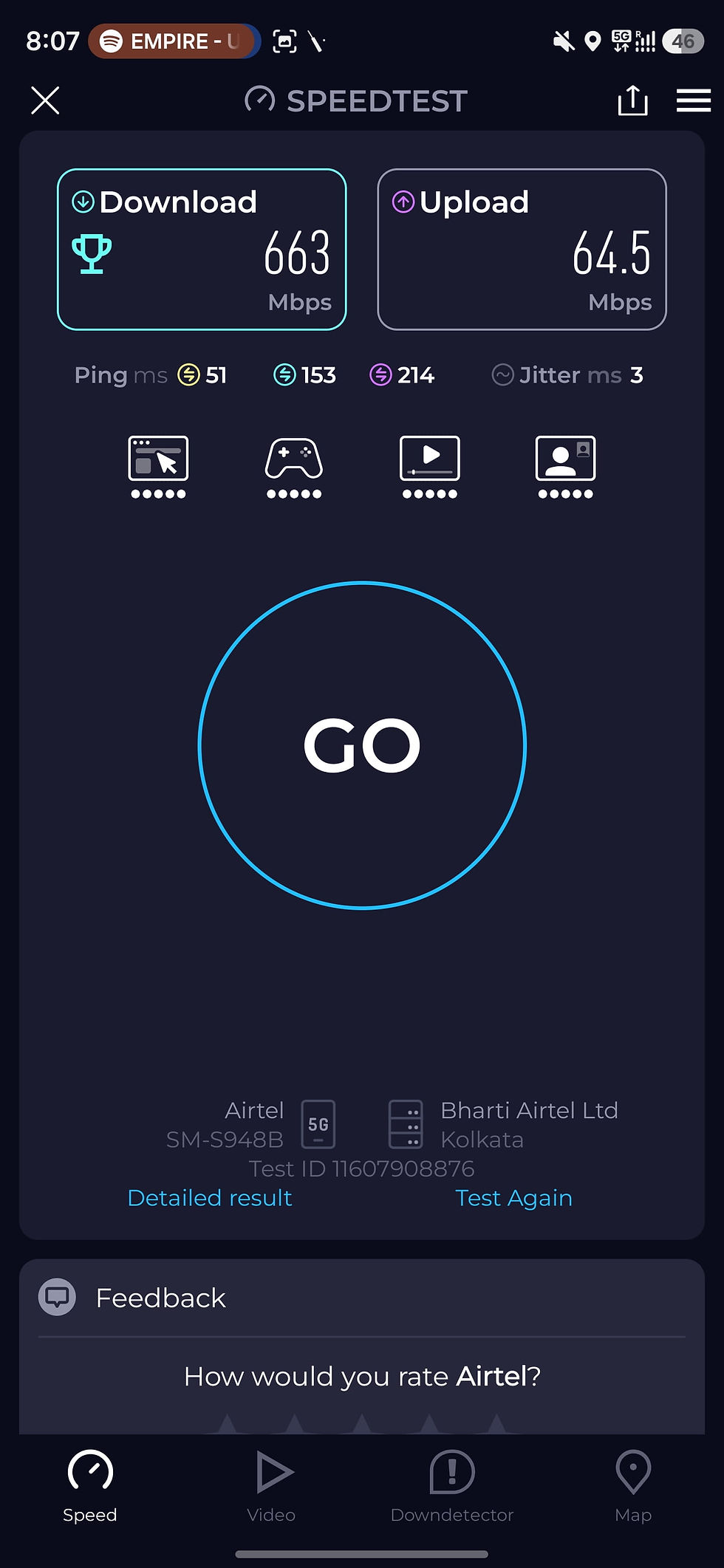
Outdoor near tower | 663 Mbps | 64.5 Mbps | 51ms | 3ms | Strong n78 |
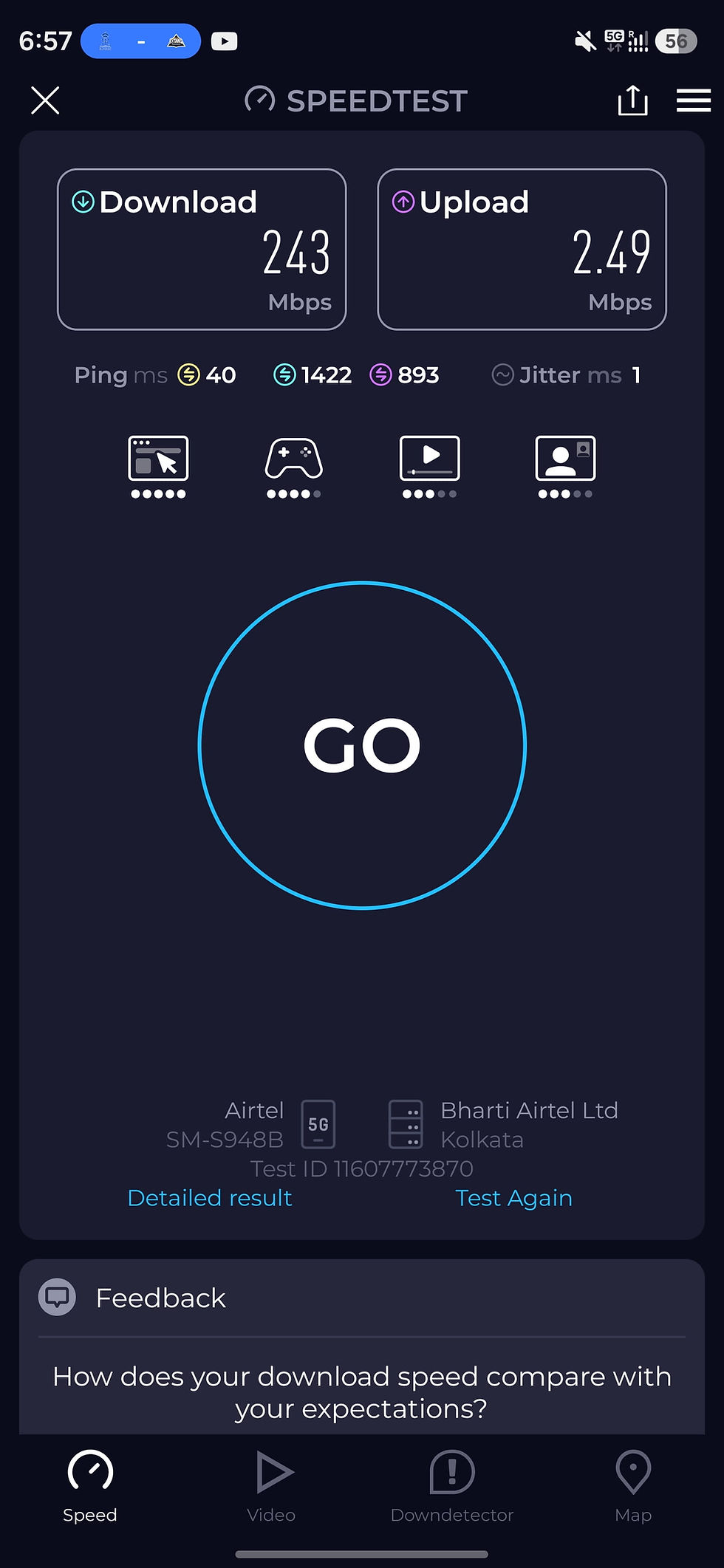
Indoor near window | 243 Mbps | 2.49 Mbps | 40ms | 1ms | Usable but weaker |
Evening congestion (Outdoors) | 590 Mbps | 57.5 Mbps | 60ms | 3ms | Capacity load visible (High Ping) |
The important point is that Airtel 5G SA cannot be judged by one peak screenshot. A single 900 Mbps result beside a tower tells us the sector has capacity, but it does not tell us whether the network has strong indoor depth, good uplink, clean handover, or enough backhaul during busy hours.

First Principles: What Actually Changes in 5G SA?
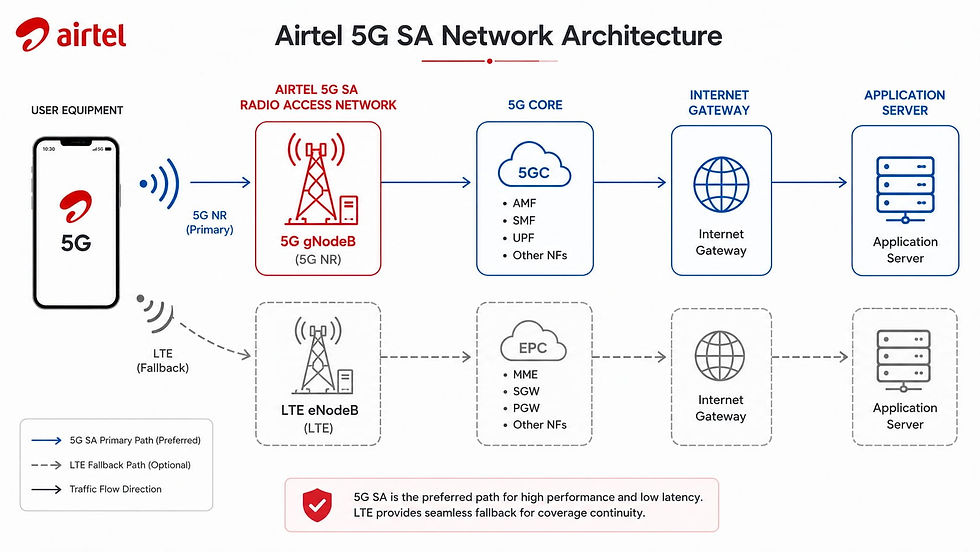
In 5G NSA, the phone uses 5G NR for high-speed data but remains tied to LTE/EPC for key control functions. This made early 5G rollout easier because operators could reuse their mature 4G core. In 5G SA, the phone connects to a 5G core directly. That unlocks better architecture for future use cases: slicing, ultra-low-latency services, enterprise private 5G, better QoS separation, and more cloud-native packet handling.
Airtel’s SA direction is supported by its 5G core evolution. In 2025, Airtel announced a partnership with Ericsson for dual-mode 5G Core technology, described as making the network 5G Standalone ready and enabling network slicing and API exposure.
The simplified flow is:
Phone → 5G NR radio → gNodeB → 5G Core → UPF → internet / app server
The engineering advantage is that user-plane traffic can be routed more intelligently. A UPF can be placed closer to users for edge services. Enterprises can get isolated slices. Latency-sensitive applications can receive different handling from bulk downloads.

Speed Test Experience: High Peaks, But Location Matters
In my testing, Airtel 5G SA feels fastest when the phone has a clean 3500 MHz channel, good SINR, and low sector congestion. This is where Airtel’s mid-band 5G shines. The 3.3–3.5 GHz range offers much wider bandwidth than typical LTE bands, so the network can deliver high downlink speeds when radio conditions are strong.
A useful engineering approximation is Shannon capacity:
C = B log₂ (1 + SNR)
Here, C is channel capacity in bits per second, B is bandwidth in Hz, and SNR is the signal-to-noise ratio. The physical meaning is simple: wider bandwidth helps, but only if the signal quality is good enough. A 100 MHz 5G carrier with poor SINR will not feel better than a narrower carrier with cleaner radio conditions.
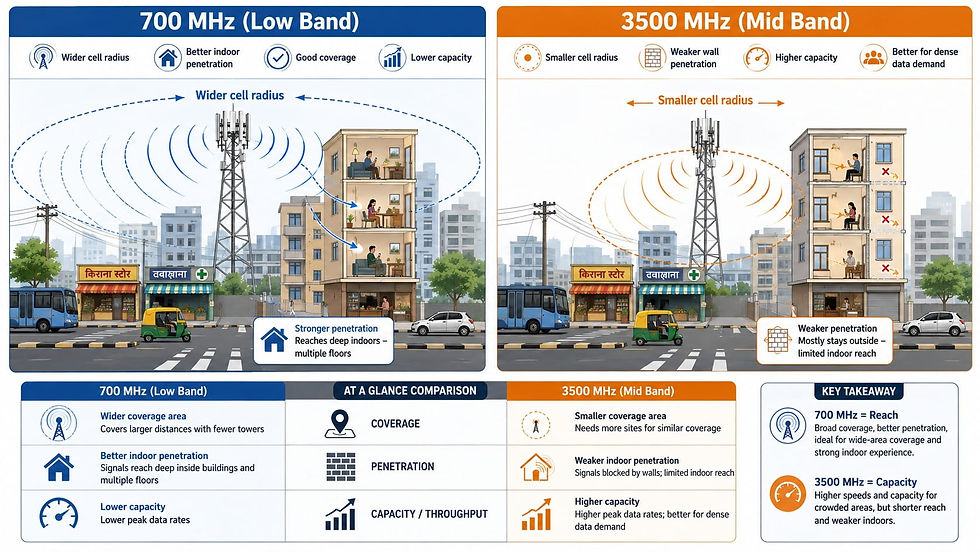
That explains the real-world Airtel experience. Outdoors, especially near the serving site, speed can be excellent. Indoors, the same phone may show a 5G icon but deliver lower throughput because the 3500 MHz signal has more wall penetration loss.
In my testing, Airtel 5G SA peak speed was 890 Mbps, but more realistic average across daily-use locations was closer to 350 Mbps.
Coverage: Airtel’s Biggest Engineering Challenge
This is where the review becomes more nuanced. In many places in India, Airtel has relied heavily on the 3500 MHz layer for 5G. That is good for capacity, but not ideal for deep indoor coverage. Compared with Jio, which acquired spectrum including 700 MHz along with 3300 MHz and 26 GHz, Airtel’s 5G coverage strategy has a tougher low-band coverage problem. The Government of India’s 2022 auction summary lists Airtel’s purchase across 900, 1800, 2100, 3300 MHz and 26 GHz, while Reliance Jio acquired spectrum including 700 MHz, 800 MHz, 1800 MHz, 3300 MHz and 26 GHz.
The physics is unavoidable. Free-space path loss is:

where (d) is distance in km and (f) is frequency in MHz. When frequency increases, path loss increases. So 3500 MHz has significantly higher loss than 700 MHz at the same distance, before even considering walls, glass, concrete, clutter, and human blockage.
This is why Airtel 5G SA can feel very strong outside but weaker inside homes, hostels, offices, malls, or older concrete buildings. Airtel has reportedly increased transmission power wherever possible after enabling SA, and that helps at the cell edge. But power alone cannot fully solve the indoor coverage problem because uplink remains limited by the phone’s transmit power. The tower may reach the phone, but the phone must also reach the tower.
Why Airtel Needs Lower-Band 5G
For Airtel to compete more aggressively with Jio’s indoor 5G experience, it likely needs one of three things:
First, reframe existing lower bands such as 900 MHz, 1800 MHz, or 2100 MHz for 5G NR where spectrum and traffic conditions allow. This is not simple because LTE users still consume huge capacity on these bands.
Second, deploy denser 5G sites, small cells, and indoor systems. This improves capacity and indoor signal quality, but it costs more in fiber, power, permissions, site rental, and operations.
Third, acquire a stronger low-band 5G layer such as 600 MHz if available and economically sensible. Low-band 5G will not deliver the highest peak speeds, but it gives the network a coverage anchor. That matters because a good 5G experience is not only about peak throughput; it is about staying connected consistently.
This is the trade-off most casual speed tests miss: mid-band gives capacity, low-band gives reach, and mmWave gives extreme capacity over limited range.
Latency and Responsiveness
Airtel 5G SA should theoretically improve latency because the architecture removes LTE core dependency and allows more optimized routing. But real-world latency depends on many layers: radio scheduling, signal quality, backhaul, core routing, DNS, server location, and peering.
My measured ping was:
Best case: 12ms
Typical browsing / app latency: 36ms
Gaming latency (Average): 39ms
Jitter: 2ms
In practical use, I noticed faster web browsing which felt "snappier" than 5G NSA and also a more stable gaming experience due to lower latency.
The key engineering point is that SA is not magic by itself. A 5G SA phone still suffers if the radio link is weak, if the tower is congested, or if traffic exits through a faraway gateway. Low latency needs an end-to-end design, not only a 5G icon.

Upload Performance: The Often-Ignored Part
Download speed gets the attention, but upload speed reveals the real picture of the radio link. Uplink is harder because the phone has far less transmit power than the tower. On 3500 MHz, this becomes more visible indoors.
My Airtel 5G SA upload result was 57.5 Mbps outdoors and 2.49 Mbps indoors.
This matters for video calls, cloud backup, live streaming, WhatsApp media uploads, gaming input stability, and remote work. In weak indoor 5G conditions, the phone may cling to 5G for downlink but struggle on uplink. A well-engineered network needs proper uplink coverage, carrier aggregation strategy, power control, and smart fallback to LTE where needed.
Airtel 5G SA vs Jio 5G: My Practical View
Jio’s advantage is coverage architecture. With low-band 5G spectrum in the mix, Jio can offer better indoor reach in many locations. Airtel’s advantage, where 3500 MHz is strong and properly optimized, is that the experience can feel extremely fast and clean.
So, my current view is:
Airtel 5G SA is excellent when signal quality is strong.
Airtel 5G SA is less convincing when deep indoor coverage depends mainly on 3500 MHz.
Airtel needs lower-band NR reframing, denser sites, or future low-band acquisition to close the indoor gap with Jio.
That does not make Airtel’s SA rollout weak. It means the network is capacity-rich but coverage-constrained in certain real-world environments. This distinction matters.
A Strong Technical Upgrade, But Not Yet the Complete Package
My Airtel 5G SA review comes down to one engineering truth: SA improves the network architecture, but spectrum decides much of the user experience.
Airtel’s 5G SA is a meaningful upgrade because it prepares the network for slicing, enterprise services, better core design, lower-latency routing, and more advanced 5G use cases. In strong 3500 MHz coverage, the speed and responsiveness can be genuinely impressive. But for everyday users, the biggest question is not whether Airtel has SA. The bigger question is whether Airtel has enough usable 5G signal where people actually use data: inside rooms, offices, hostels, shops, and moving vehicles.
My verdict: Airtel 5G SA is promising and fast in the right conditions, but its real-world success depends on how aggressively Airtel improves indoor coverage, reframes lower bands, densifies sites, and strengthens uplink performance. For now, I would call it a strong engineering step forward, not the final form of Airtel’s 5G network.


Speeds are impressive, but since it's outdoors, and network almost empty. It was expected to cross 1 Gbps like Jio in initial days