What Is 5G and How It Works? The Complete Technical Guide to Fifth Generation Cellular Networks
Updated: Apr 25
The fifth generation of mobile networks, commonly known as 5G, represents one of the most significant advancements in telecommunications since the introduction of the internet. Unlike previous generations of mobile technology, 5G is not merely an incremental improvement in speed. It is a complete redesign of mobile network architecture, enabling ultra-fast data speeds, extremely low latency, and the ability to connect billions of devices simultaneously.
5G is expected to power everything from smart cities and autonomous vehicles to industrial automation and immersive virtual reality applications. Understanding how 5G works requires exploring multiple layers of modern telecommunications engineering, including radio spectrum allocation, advanced antenna systems, new network architectures, and sophisticated signal processing techniques.
This article provides a comprehensive and technical explanation of 5G technology, beginning with the evolution of cellular networks and progressing toward the core engineering principles that make 5G possible.
The Evolution of Cellular Networks
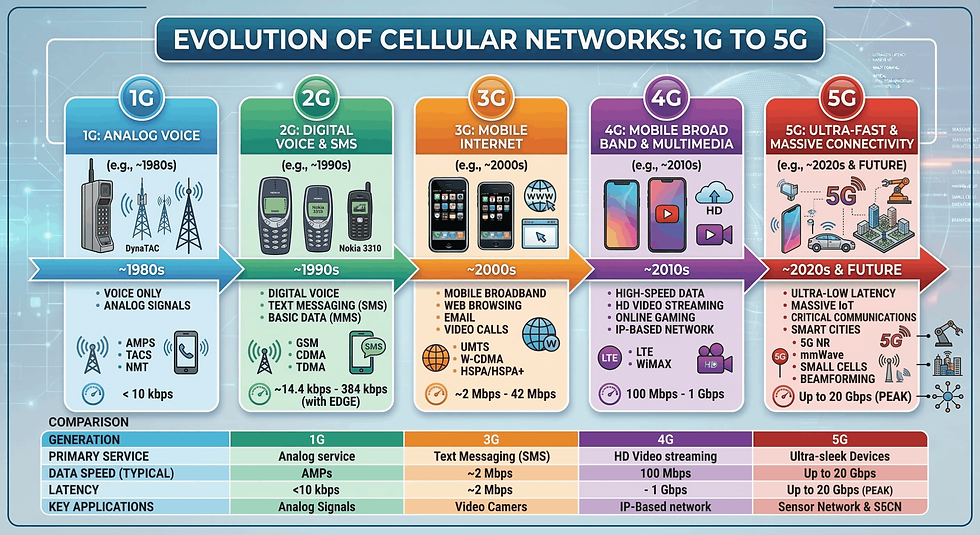
Before understanding 5G, it is important to examine how mobile communication has evolved through previous generations.
The earliest mobile networks were designed primarily for voice communication.
1G – Analog Cellular Systems
First generation networks introduced in the 1980s used analog transmission technologies. These systems allowed voice calls but lacked encryption and suffered from poor spectral efficiency.
2G – Digital Communication
Second generation networks introduced digital modulation techniques such as GSM and CDMA, enabling improved voice quality, encryption, and basic data services like SMS.
3G – Mobile Internet
Third generation networks introduced higher data speeds using technologies such as UMTS and CDMA2000, enabling mobile internet access and multimedia messaging.
4G – Broadband Mobile Data
Fourth generation networks, particularly LTE, introduced packet-switched architecture and significantly improved data speeds using technologies such as Orthogonal Frequency Division Multiple Access (OFDMA) and Multiple Input Multiple Output (MIMO).
Despite the success of 4G LTE, growing demand for bandwidth and emerging applications required an entirely new network architecture.
5G was developed to address these challenges.
What Is 5G?
5G refers to the fifth generation of cellular communication technology defined by the 3rd Generation Partnership Project (3GPP) under the 5G New Radio (NR) standard.
Unlike previous generations, 5G was designed with three primary performance goals:
1. Enhanced Mobile Broadband (eMBB)
Provides significantly higher data speeds for applications such as high-resolution video streaming, augmented reality, and cloud gaming.
2. Ultra-Reliable Low Latency Communication (URLLC)
Enables mission-critical applications requiring extremely low latency and high reliability, including remote surgery and autonomous vehicles.
3. Massive Machine Type Communication (mMTC)
Supports the connection of billions of Internet of Things devices such as sensors, smart meters, and industrial equipment.
These three pillars represent the core design philosophy behind 5G networks.

The 5G Spectrum
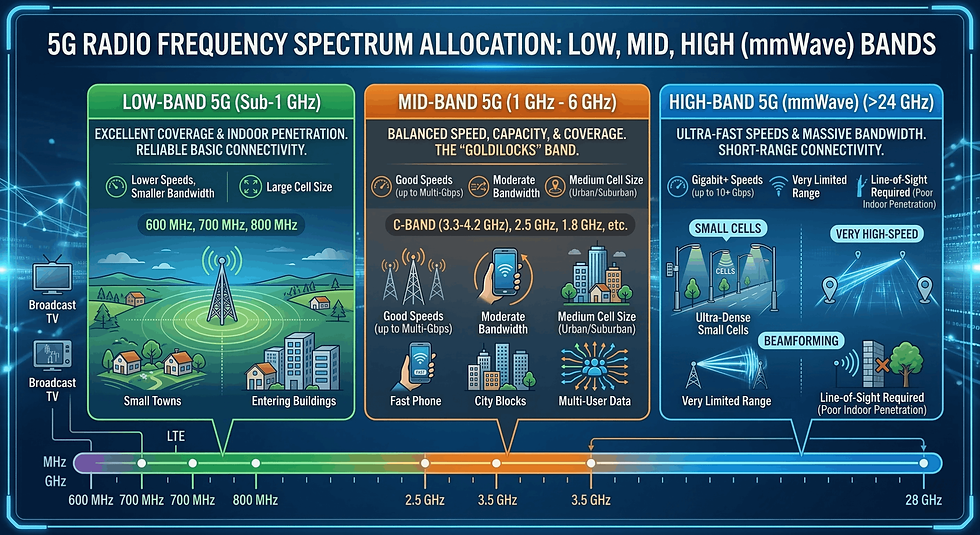
Wireless communication relies on radio frequencies within the electromagnetic spectrum. One of the defining features of 5G is its ability to operate across a wide range of frequency bands.
5G spectrum is typically categorized into three groups.
Low-Band Spectrum
Low-band frequencies below 1 GHz provide wide coverage areas and strong signal penetration through buildings. However, they offer limited bandwidth and lower data speeds.
Typical frequencies include:
600 MHz
700 MHz
850 MHz
These frequencies are often used for nationwide coverage.
Mid-Band Spectrum
Mid-band frequencies between 1 GHz and 6 GHz provide a balance between coverage and
capacity.
Examples include:
2.3 GHz
2.5 GHz
3.5 GHz
Mid-band spectrum forms the backbone of most current 5G deployments worldwide.
High-Band Spectrum (Millimeter Wave)
Millimeter wave frequencies operate above 24 GHz and offer extremely high bandwidth.
Examples include:
26 GHz
28 GHz
39 GHz
These frequencies enable extremely fast data speeds but have shorter transmission distances and limited penetration through obstacles.
The Architecture of a 5G Network
A 5G network consists of multiple interconnected components that work together to deliver wireless communication services.
The architecture can be divided into three primary layers.
1. User Equipment (UE)
User equipment refers to devices such as smartphones, IoT devices, and connected vehicles that communicate with the network.
2. Radio Access Network (RAN)
The radio access network connects devices to the cellular infrastructure through base stations.
3. Core Network
The core network manages data routing, authentication, mobility management, and connectivity to external networks such as the internet.

5G Radio Access Network (RAN)
The 5G Radio Access Network provides the wireless interface between user devices and the telecommunications infrastructure.
The main components of the 5G RAN include:
gNodeB
The gNodeB is the 5G equivalent of the LTE eNodeB. It acts as the base station responsible for managing radio communication with connected devices.
Functions of the gNodeB include:
Radio signal transmission and reception
Resource allocation
Mobility management
Scheduling and interference control
Modern gNodeBs support advanced antenna systems and distributed architectures.
Massive MIMO
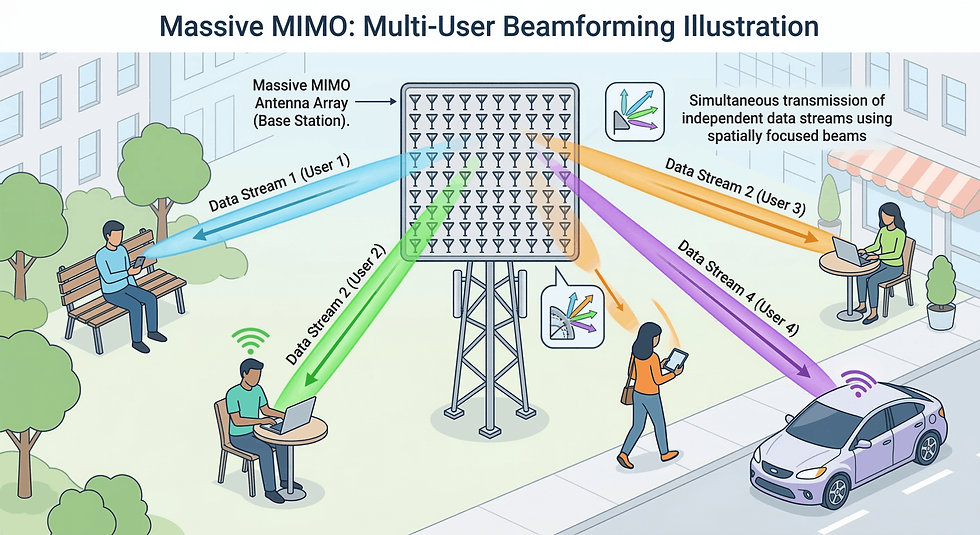
One of the most important technologies enabling 5G performance improvements is Massive Multiple Input Multiple Output (Massive MIMO).
Traditional cellular networks used antennas with only a few transmitting elements. Massive MIMO dramatically increases the number of antennas deployed at base stations.
A typical massive MIMO system may use 64, 128, or even more antenna elements.
These antenna arrays enable:
Simultaneous transmission of multiple data streams
Improved spectral efficiency
Enhanced signal reliability
Massive MIMO uses spatial multiplexing to increase network capacity without requiring additional spectrum.
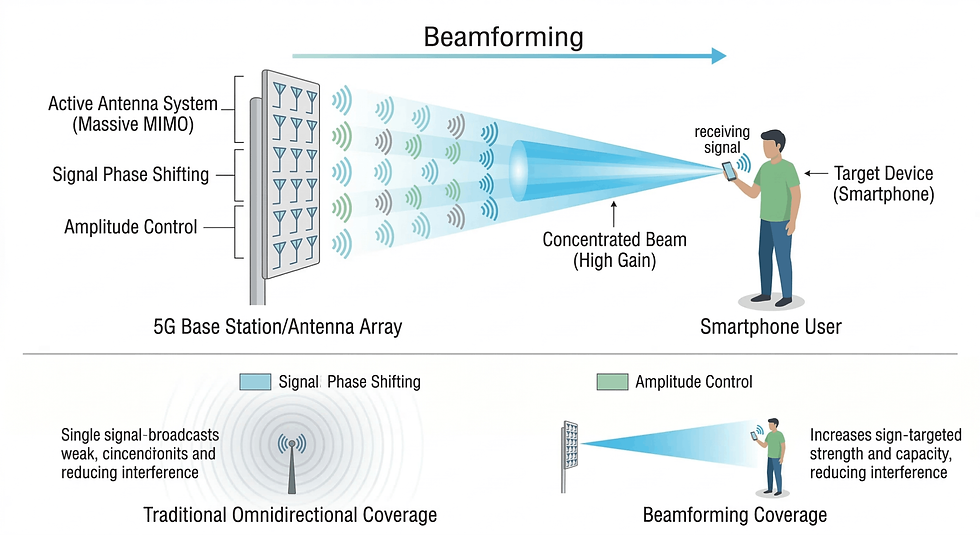
Beamforming Technology
Beamforming is another key innovation in 5G radio systems. Traditional antennas broadcast signals in all directions, which wastes energy and increases interference.
Beamforming focuses radio energy toward specific users by adjusting the phase and amplitude of signals transmitted from multiple antennas.
This process creates a directional beam that improves signal strength and reduces interference.
Beamforming is particularly important for millimeter wave communications, where signals are more susceptible to attenuation.
Small Cells and Network Densification
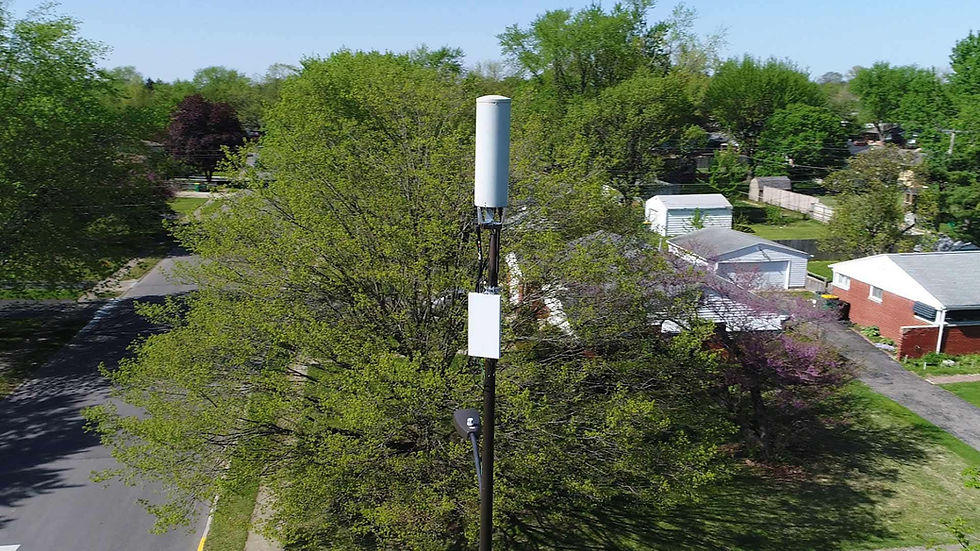
To achieve higher network capacity, 5G networks rely on network densification. Instead of relying solely on large macro towers, 5G deployments include numerous small cells placed in urban environments.
Small cells are compact base stations installed on structures such as:
Streetlights
Buildings
Utility poles
These cells provide localized coverage and increase overall network capacity.
5G Core Network
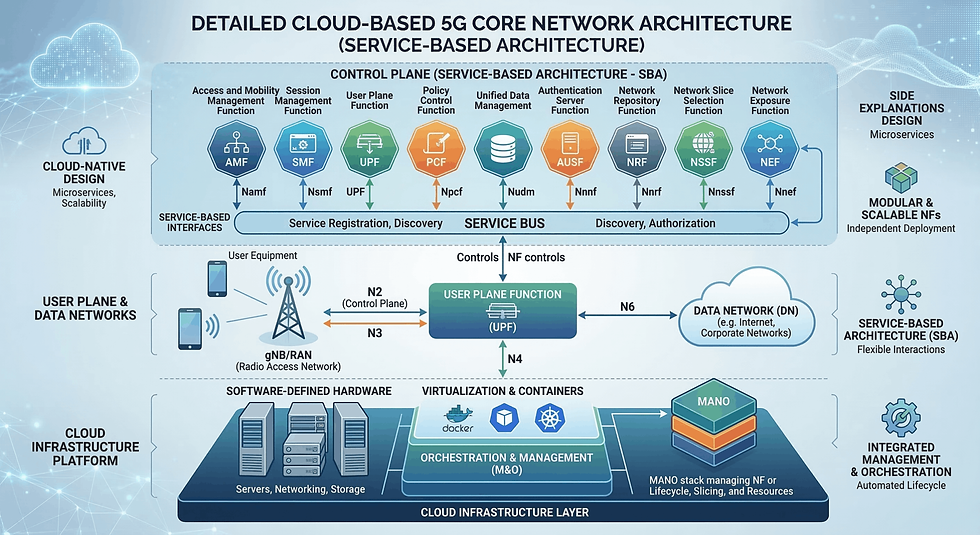
The 5G core network represents a major shift from previous cellular architectures. Unlike earlier generations, which relied heavily on dedicated hardware appliances, the 5G core is designed to be cloud-native and software-defined.
Key components include:
1. Access and Mobility Management Function (AMF)
Handles device authentication and mobility management.
2. Session Management Function (SMF)
Responsible for establishing and managing network sessions.
3. User Plane Function (UPF)
Handles the routing and forwarding of user data packets.
4. Network Repository Function (NRF)
Maintains information about network services.
This modular architecture enables flexible deployment and easier scalability.
Network Slicing
One of the most transformative features of 5G is network slicing. Network slicing allows a single physical network to be divided into multiple virtual networks optimized for different applications.
Examples include:
A slice optimized for high bandwidth video streaming.
A slice designed for ultra-low latency industrial automation.
A slice dedicated to massive IoT device connectivity.
Each slice operates independently with customized performance parameters.

Latency Improvements in 5G
Latency refers to the delay between sending and receiving data.
4G LTE networks typically have latency between 30 and 50 milliseconds. 5G aims to reduce latency to as low as 1 millisecond in optimal conditions.
Latency improvements are achieved through several mechanisms:
Edge computing
Shorter transmission intervals
Optimized scheduling algorithms
Distributed network architecture
These improvements enable real-time applications such as remote robotics and augmented reality.
Edge Computing in 5G Networks
Edge computing moves data processing closer to end users by deploying computing resources near base stations. Instead of sending all data to centralized data centers, edge computing allows applications to run locally within the network.
This reduces latency and improves performance for applications such as:
Autonomous driving
Cloud gaming
Real-time analytics

Security Enhancements in 5G
Security is a critical component of modern telecommunications systems. 5G introduces several improvements over previous generations.
These include:
Stronger encryption algorithms
Improved authentication protocols
Protection against signaling attacks
Enhanced subscriber privacy
The use of Subscription Concealed Identifiers (SUCI) protects the permanent subscriber identity from interception.
Real-World Applications of 5G
The capabilities of 5G networks enable a wide range of applications across multiple industries.
Smart Cities
Sensors and connected infrastructure can optimize traffic management, energy usage, and public safety.
Autonomous Vehicles
Ultra-low latency communication enables real-time vehicle coordination and navigation.
Industrial Automation
Factories can deploy wireless robotics and real-time monitoring systems.
Healthcare
Remote surgery and telemedicine applications become possible with high reliability and low latency communication.
Augmented and Virtual Reality
Immersive experiences require extremely high bandwidth and low latency connections.
The Global Deployment of 5G
Since the first commercial launches in 2019, 5G networks have rapidly expanded worldwide. Major telecom operators across Asia, Europe, and North America have deployed 5G infrastructure in urban and suburban areas. As network deployments continue, the technology is expected to support billions of connected devices.
The Future Beyond 5G
Although 5G is still being deployed, research into sixth generation (6G) networks has already begun.
Future wireless systems may explore technologies such as:
Terahertz communication
AI-driven network management
Integrated satellite networks
Holographic communication systems
These innovations will further transform global connectivity.
Conclusion
5G represents a fundamental transformation in telecommunications technology. By combining advanced radio technologies such as massive MIMO and beamforming with cloud-native network architectures and edge computing, 5G networks provide unprecedented levels of performance, scalability, and flexibility.
The technology enables faster mobile broadband, ultra-low latency communication, and massive device connectivity. These capabilities are expected to power the next generation of digital services across industries ranging from transportation and healthcare to manufacturing and entertainment.
Understanding how 5G works reveals the complex engineering innovations that underpin modern wireless communication and highlights the immense potential of next-generation networks.


Log in to the 10.0.0.1 admin panel to manage your router’s network settings, check connected devices, adjust Wi-Fi options, and update security preferences. If you’re unsure how to reach the login page or which credentials to enter, follow the basic steps to access the router’s administration interface.