How Cell Towers Work: The Complete Technical Guide to Cellular Base Stations
Updated: Apr 25
Mobile phones feel like magic. You tap a screen, make a call, stream a video, or send a message, and the data travels instantly across cities, countries, or even continents.
Behind this seamless experience lies one of the most complex and carefully engineered infrastructures ever built: the cellular network.
At the heart of this infrastructure are cell towers, also called base stations. These towers form the wireless bridge between your smartphone and the broader telecommunications network.
This article will take you from first principles of cellular communication to advanced engineering concepts, explaining exactly how cell towers work.
The Fundamental Problem: Wireless Communication Over Large Areas
Wireless communication relies on radio waves, which are electromagnetic waves capable of traveling through air.
However, radio signals face several challenges:
Signal strength decreases with distance
Obstacles such as buildings block signals
Interference from other devices can degrade communication
Limited radio spectrum must be shared among millions of users
If one transmitter tried to cover an entire country, the signal would quickly become unusable.
The solution to this problem is the cellular architecture.
The Cellular Network Concept
Instead of one powerful transmitter covering a massive region, the coverage area is divided into small geographic regions called cells.
Each cell is served by a cell tower (base station).
This architecture allows:
efficient reuse of radio frequencies
increased network capacity
better signal quality
scalable infrastructure
The term “cellular network” comes from this design.

Each tower serves a specific area, typically ranging from:
200 meters (dense urban small cells)
2–5 km (urban macro cells)
10–30 km (rural macro cells)
When you move from one area to another, your phone simply connects to a different tower.
The Main Components of a Cell Tower System
A cell tower is not just a tall structure with antennas. It is an integrated system consisting of multiple subsystems.
The major components include:
Antennas: Transmit and receive radio signals.
Base Station Radio Equipment: Processes wireless signals.
Baseband Processing Unit: Handles signal processing and communication protocols.
Backhaul Network: Connects the tower to the telecom operator’s core network.
Power Systems: Provide electricity and backup power.
Tower Structure: Physical structure supporting antennas and equipment.
Each of these components performs a critical function in delivering mobile connectivity.

Cell Tower Antennas
The antennas mounted on cell towers are responsible for transmitting and receiving radio signals.
These antennas operate in specific frequency bands, depending on the cellular technology.
Examples include:
Technology | Typical Frequency |
|---|---|
2G GSM | 900 MHz / 1800 MHz |
3G UMTS | 2100 MHz |
4G LTE | 700 MHz – 2600 MHz |
5G NR | Sub-6 GHz and mmWave |
Lower frequencies provide longer range, while higher frequencies allow greater data capacity.
Most modern cell towers use sector antennas. Instead of broadcasting signals in all directions, the tower divides coverage into three
sectors. Each antenna typically covers 120 degrees. This design improves capacity and reduces interference.

Radio Units and Signal Transmission
Modern cellular networks use Remote Radio Units (RRUs) or Remote Radio Heads (RRH).
These units are usually mounted near the antennas.
Their purpose is to:
convert digital signals into radio signals
amplify transmission power
receive and filter incoming signals
The radio unit communicates with the Baseband Unit (BBU) via fiber optic cables. This separation reduces signal loss and improves performance.

Baseband Processing
The Baseband Unit (BBU) is the computational brain of the cell tower.
It performs complex signal processing tasks such as:
modulation and demodulation
channel encoding and decoding
scheduling radio resources
error correction
encryption
Cellular communication relies on sophisticated modulation schemes such as:
QPSK
16-QAM
64-QAM
256-QAM
These schemes allow large amounts of data to be transmitted efficiently over limited spectrum.
In modern networks, baseband processing is often centralized using Cloud RAN (C-RAN) architecture.

Frequency Reuse and Network Capacity
One of the most important concepts in cellular networks is frequency reuse.
The radio spectrum is extremely limited.
Telecom operators cannot assign a unique frequency to every tower. Instead, the same frequencies are reused in different cells separated by sufficient distance. This allows millions of users to share limited spectrum efficiently.
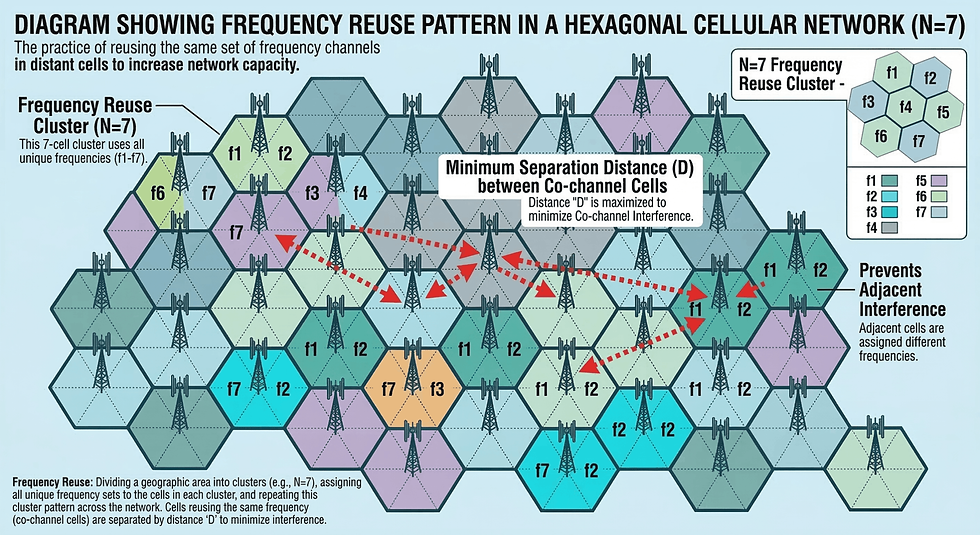
The reuse factor determines how often the same frequency appears in nearby cells.
Advanced technologies such as LTE and 5G further improve efficiency using:
Orthogonal Frequency Division Multiple Access (OFDMA)
Dynamic spectrum allocation
interference management techniques
How Your Phone Connects to a Cell Tower
When your phone is powered on, it immediately begins scanning for available cellular signals.
The connection process includes several steps:
Step 1: Cell Search
Your phone scans nearby frequencies for broadcast signals from towers.
These signals contain information such as:
network identity
cell ID
supported technologies
Step 2: Synchronization
The phone synchronizes with the tower’s timing and frequency.
Step 3: Authentication
The SIM card contains a secret key used to authenticate with the network.
This ensures that only authorized users can access the network.
Step 4: Radio Resource Allocation
The base station assigns radio resources to the device.
Once connected, the phone can send and receive data.
Mobile Data Transmission
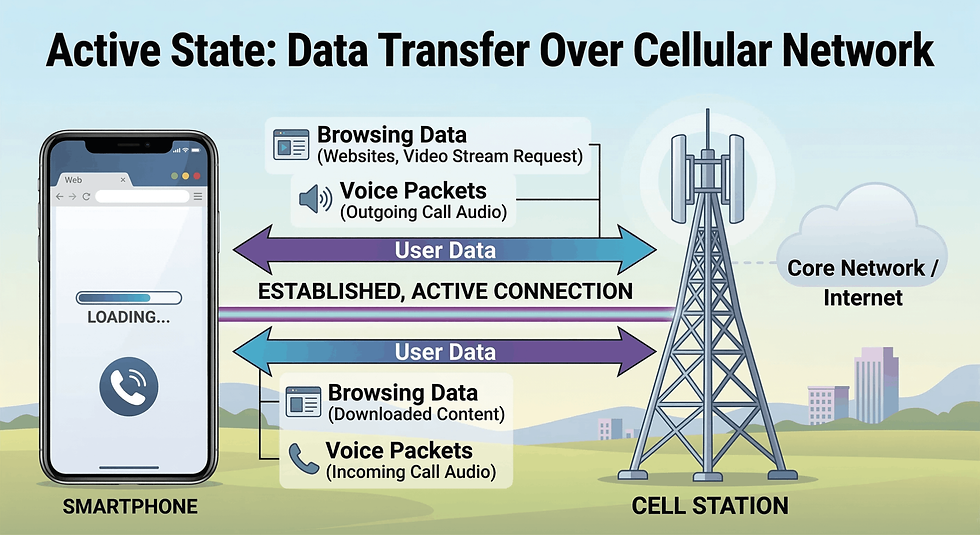
When you use mobile data, your phone converts digital information into radio signals.
These signals travel to the nearest cell tower.
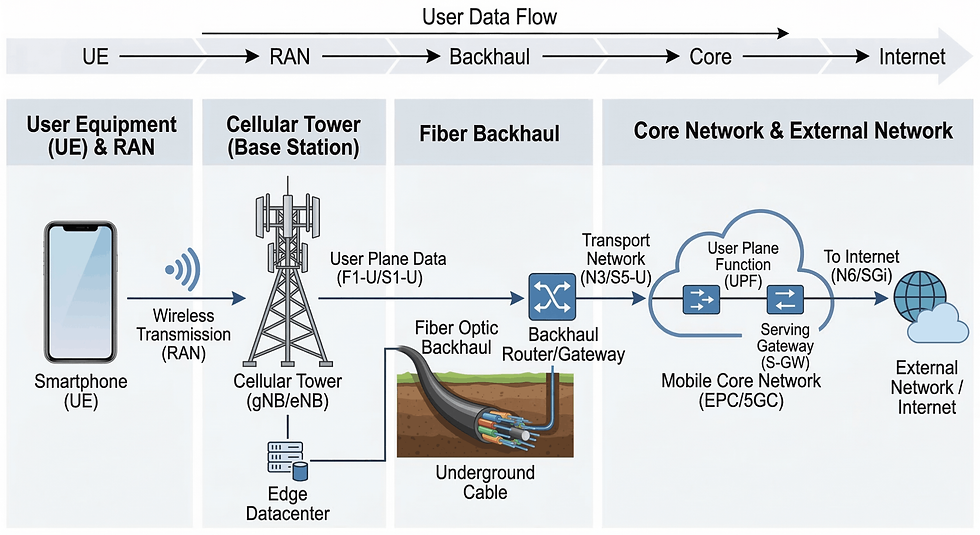
The tower then forwards the data through the backhaul network.
Backhaul connections typically use:
fiber optic links
microwave links
millimeter wave wireless links
From there, data reaches the mobile core network, which routes it to the internet.
The Mobile Core Network
The core network manages:
user authentication
mobility management
internet connectivity
billing and policy enforcement
In 4G LTE networks, major core components include:
MME (Mobility Management Entity)
SGW (Serving Gateway)
PGW (Packet Gateway)
In 5G networks, the architecture becomes more software-defined, including:
AMF
SMF
UPF
These components manage network sessions and data routing.
Handover Between Cell Towers
One of the most critical functions of a cellular network is handover, also known as handoff.
As you move, your phone constantly measures signal strength from nearby towers. When the signal from another tower becomes stronger, the network initiates a handover.
This process must occur within milliseconds to avoid dropped calls.
There are several types of handover:
Hard handover – connection switches instantly
Soft handover – device communicates with multiple towers simultaneously
Make-before-break handover – used in LTE and 5G

Interference Management
Cellular networks face significant interference challenges.
Sources of interference include:
neighboring cells
overlapping frequency bands
electronic noise
To manage interference, networks use techniques such as:
power control
dynamic frequency allocation
beamforming
coordinated multipoint transmission
These techniques allow networks to maintain high data rates even in dense urban environments.
Massive MIMO and Beamforming
Modern LTE-Advanced and 5G networks use Massive MIMO. MIMO stands for Multiple Input Multiple Output.
Instead of a single antenna, towers use dozens or even hundreds of antenna elements.
These antennas can transmit multiple data streams simultaneously.
Beamforming further improves efficiency by focusing radio energy directly toward a specific user. This increases signal strength while reducing interference.

Types of Cell Towers
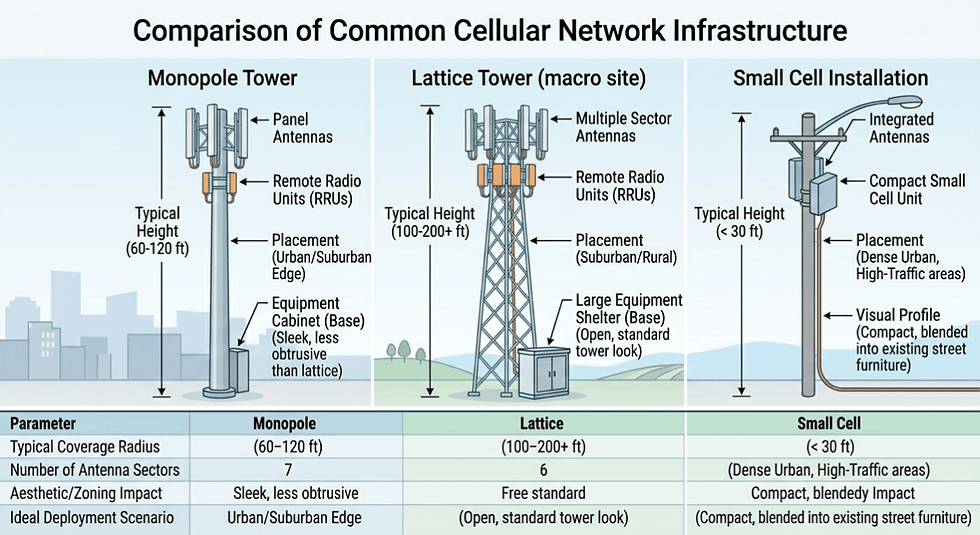
Cell towers come in several structural designs depending on location and coverage needs.
Monopole Towers: Single cylindrical poles commonly used in urban areas.
Lattice Towers: Steel frameworks used for high-capacity installations.
Guyed Towers: Tall towers supported by tensioned cables.
Small Cells: Compact base stations installed on streetlights or buildings. Small cells are especially important for 5G networks, where coverage areas are smaller.
Power Systems and Backup Infrastructure
Cell towers require reliable power to operate continuously.
Typical power infrastructure includes:
grid electricity connection
battery backup systems
diesel generators
Battery systems can keep towers operational for several hours during outages. This ensures network availability during emergencies.
The Evolution Toward 5G Infrastructure
5G introduces several changes to traditional tower architecture.
Key innovations include:
Network Virtualization: Network functions are implemented in software rather than dedicated hardware.
Network Slicing: Multiple virtual networks can operate on the same physical infrastructure.
Edge Computing: Data processing moves closer to users to reduce latency.
Dense Small Cell Deployments: Urban environments require many smaller base stations.
These advancements dramatically increase network capacity and performance.
Real-World Scale of Cellular Infrastructure
Modern cellular networks are massive.
A large telecom operator may deploy:
hundreds of thousands of towers
millions of antennas
petabytes of daily data traffic
In India alone, the telecom infrastructure includes over 700,000 cell towers supporting billions of mobile connections.
This infrastructure forms one of the most critical components of modern digital society.
Conclusion
Cell towers are far more than simple metal structures.
They are highly sophisticated systems combining:
radio frequency engineering
digital signal processing
network architecture
large-scale infrastructure design
Through technologies such as frequency reuse, advanced modulation, massive MIMO, and beamforming, cellular networks can deliver reliable connectivity to billions of devices.
Every time you make a call, stream a video, or send a message, an intricate chain of wireless communication begins at the nearest cell tower.
Understanding how these towers work reveals the incredible engineering that powers modern mobile communication.


Comments