Airtel Priority Postpaid 5G Review: Network Slicing, 5G SA, Real-World Performance, and What It Actually Means

Airtel launched Priority Postpaid on May 19, 2026, and it immediately triggered two very different conversations. One is a technical discussion about 5G architecture, specifically network slicing and standalone core deployment. The other is a regulatory debate about whether this crosses India's net neutrality rules.
Both conversations matter. But before getting into either, there's a basic thing most reviews gloss over: Airtel Priority Postpaid is not just "faster 5G." It's specifically a 5G SA feature. If your phone isn't on standalone 5G, the whole thing doesn't work the way Airtel advertises it. That single detail changes how you should evaluate everything else.
What Is Airtel Priority Postpaid?
Airtel Priority Postpaid is designed to offer faster and more stable connectivity during periods of heavy network congestion using 5G network slicing. All existing Airtel postpaid plans have been upgraded to Priority Postpaid, so existing customers don't need to switch anything. New users can take a postpaid connection through the Airtel app or at any Airtel store. Existing prepaid users can do the same.
Airtel confirmed that the rollout was built on upgraded 5G core infrastructure from Ericsson and Nokia.
The most visible sign that Priority Postpaid is active is the network name on your status bar changing from "Airtel" to Airtel PRIORITY. That's not cosmetic. It means the device has been recognized by the 5G SA core and is being handled under a priority slice. But and this is important - the name showing up doesn't tell you whether you're actually on 5G SA or whether the phone has quietly fallen back to NSA. More on that later.

While 5G slicing has been deployed internationally over the past year in markets such as the United States, the United Kingdom, Singapore, and Malaysia, Airtel's rollout marks the first commercial application of this technology for retail mobile subscribers in India.
Plans and Pricing
Airtel Priority Postpaid plans start at ₹449 for a single user and go up to ₹1,749 for five users or a family, with unlimited data and calling. The individual plan includes free access to Airtel Xstream Play, Adobe Express Premium, and 100 GB of cloud storage. Higher-priced plans add Amazon Prime, Jio Hotstar, Apple TV, and Apple Music, and the highest tier also bundles Netflix.
Monthly Rental | Data / Calls / SMS | OTT & Extra Benefits |
|---|---|---|
₹449 + GST | Unlimited 4G/5G data, unlimited calling, 100 SMS/day | Airtel Xstream Premium for 3 months, Adobe Express Premium for 12 months, Google One (100 GB) for 6 months |
₹549 + GST | Unlimited 4G/5G data, unlimited calling, 100 SMS/day | Airtel Xstream Premium for 3 months, JioHotstar for 12 months, Amazon Prime for 6 months, Adobe Express Premium for 12 months, Google One (100 GB) for 6 months |
₹699 + GST | 2 Sims, Unlimited 4G/5G data, unlimited calling, 100 SMS/day | Airtel Xstream Premium for 3 months, JioHotstar for 12 months, Amazon Prime for 6 months, Adobe Express Premium for 12 months, Google One (100 GB) for 6 months |
₹999 + GST | 3 Sims, Unlimited 4G/5G data, unlimited calling, 100 SMS/day | Airtel Xstream Premium, JioHotstar for 12 months, Amazon Prime for 6 months, Apple TV and Apple Music, Adobe Express Premium for 12 months, Google One (100 GB) for 6 months |
₹1199 + GST | 4 Sims, Unlimited 4G/5G data, unlimited calling, 100 SMS/day | Airtel Xstream Premium, JioHotstar for 12 months, Amazon Prime for 6 months, Apple TV and Apple Music, Adobe Express Premium for 12 months, Google One (100 GB) for 6 months |
₹1399 + GST | 4 Sims, Unlimited 4G/5G data, unlimited calling, 100 SMS/day | Airtel Xstream Premium, JioHotstar for 12 months, Amazon Prime for 6 months, Netflix Basic, Apple TV and Apple Music, Adobe Express Premium for 12 months, Google One (100 GB) for 6 months |
₹1749 + GST | 4 Sims, Unlimited 4G/5G data, unlimited calling, 100 SMS/day | Airtel Xstream Premium, JioHotstar for 12 months, Amazon Prime for 6 months, Netflix Standard, Apple TV and Apple Music, Adobe Express Premium for 12 months, Google One (100 GB) for 6 months |
The service is enabled automatically from the backend for all existing postpaid customers on compatible 5G SA-enabled smartphones. No add-on purchase is needed.
Airtel Priority Postpaid starts at ₹449 versus Jio postpaid's entry price of ₹349. The core difference is that Airtel offers 5G network slicing for retail mobile subscribers while Jio's network slicing is currently limited to Fixed Wireless Access deployments only. Users who spend significant time in crowded areas or depend on uninterrupted connectivity for work get more value from Airtel's Priority network feature than from Jio's lower entry price.
That ₹100 gap matters less than it sounds once you factor in what Jio doesn't yet offer at the individual phone level. That said, if you're mostly at home or on stable Wi-Fi, the slicing advantage becomes less relevant to your daily experience.
The Technical Foundation: 5G NSA vs 5G SA
This is where most people get lost, and where Airtel's marketing doesn't exactly help.
5G NSA (Non-Standalone) is the architecture that most Indian users have been on since 5G launched. The phone uses a 5G radio for data throughput, but the control plane still runs through the existing 4G core. Put simply: 5G radio, 4G brain. It rolled out fast because operators didn't have to rebuild the entire core. Speeds can be excellent, especially in areas with good mid-band spectrum. But it can't support features that require 5G-native core functions like proper network slicing.
5G SA (Standalone) runs both the radio and the core natively on 5G. This is where more advanced capabilities become practical: network slicing, lower latency potential, better quality-of-service control, and more granular traffic steering per user or per application.
Airtel Priority Postpaid requires 5G SA because network slicing is a core function, not a radio-layer feature. You can't bolt it onto NSA. The 5G core has to recognize your SIM, your plan, and your device, then assign your traffic to a priority slice with its own capacity allocation and QoS treatment.

This is why the "5G" icon on your phone doesn't tell the whole story. You could be seeing 5G and still be on NSA, which means Priority Postpaid isn't doing anything special for you in that moment.
Airtel's 5G SA Rollout: Where Things Actually Stand
Most Airtel 5G users were still running on Non-Standalone architecture until recently which is essentially 5G radios riding on top of a 4G core. In early February 2026, Airtel confirmed it's actively rolling out 5G Standalone, starting with home broadband services and now phasing it in for mobile users nationwide.
Airtel noted it is currently upgrading its networks to 5G Standalone technology, adding that it won't have to incur significant incremental capital expenditures to run 5G SA services, because its radio and core network is already SA-ready. The company is in a great position to offer 5G SA using its 3.5 GHz spectrum along with a large pool of mid-band spectrum through carrier aggregation.
Airtel has also been aggressively expanding its 5G site count. Over the last 12 months alone, Airtel deployed more than 3,400 new 5G sites across Maharashtra and Goa, bringing coverage to over 22 million customers in cities, towns, and remote rural villages across 36 districts, including underserved areas like Gadchiroli, Nandurbar, and Sindhudurg. Similarly, in UP East, Airtel added more than 4,300 new 5G sites at an average of 12 new sites every day, benefiting customers in Lucknow, Kanpur, Varanasi, Prayagraj, Gorakhpur, and Ayodhya.
The scale of expansion sounds impressive, but there's a critical distinction between 5G coverage (NSA) and 5G SA coverage. Not every new site immediately runs standalone. SA deployment is concentrated in metro cities and major urban centres for now. If you're in a smaller city or a newer coverage area, your phone is likely still seeing NSA even if Airtel's signal is strong.
Device Compatibility: Not Every 5G Phone Qualifies
This is a section most casual reviews skip, and it catches a lot of users off guard.
Compatible devices include iPhones from the iPhone 15 Pro series onward and flagship Android devices from Samsung, OnePlus, Xiaomi, and others. Budget 5G phones often support only NSA 5G and do not activate the Priority Fastlane slice.
To check whether your handset supports Airtel Priority Postpaid, the Airtel app will show device compatibility. Priority Postpaid is auto-enabled from the backend and there's nothing to manually activate. It works if you have a 5G-ready SIM, a 5G SA-compatible device with the latest software version, and you're in an area with 5G SA coverage.
Customers for whom a software upgrade is pending will see a pending action in the Settings section of their phones.


So, the full checklist before you even get Priority Postpaid working is:
Airtel postpaid SIM
5G SA-capable device (not all 5G phones qualify)
Latest software update installed
Active 5G SA coverage in your area
Miss any one of those and you're on regular 5G or 4G, with no slicing benefit whatsoever. If you have a budget 5G phone from 2022 or 2023, chances are it supports NSA only. Worth verifying before assuming the feature is live on your device.
What Network Slicing Actually Does
The highway analogy is overused but accurate enough to be worth keeping. On a normal network, everyone - prepaid, postpaid, high-traffic, low-traffic competes for the same lanes. When the road fills up, everyone slows down.
With slicing, the operator creates separate logical lanes on the same physical infrastructure. A priority slice for postpaid users can have its own resource pool, separate QoS handling, and dedicated capacity allocation. If the shared lanes get congested, your slice doesn't necessarily feel it.
By intelligently and dynamically segmenting network capacity, Airtel offers a stable and dependable experience for postpaid customers, even when traffic demand is high.
The word "dynamically" matters here. The slice isn't a fixed reserved block sitting idle. The network allocates capacity in real time based on actual demand, which means the benefit scales with congestion. It's most noticeable when things are busy, and nearly invisible when the network is empty.
What network slicing does not do:
It doesn't create more physical towers
It doesn't unlock extra spectrum
It doesn't bypass radio signal limitations
It doesn't guarantee higher peak speeds than NSA
The value is in quality management under pressure, not raw capacity addition.

How the Global Industry Has Been Doing This
India isn't inventing network slicing. The technology has been in commercial deployment abroad for a few years, and the international examples are worth understanding because they show what the feature can realistically deliver.
Deutsche Telekom has utilized network slicing to support gaming, a use case that appeals to millions, while US subsidiary T-Mobile has deployed slices for broadcast crews and photojournalists. More recently, T-Mobile showcased its network slicing capabilities during the wildfires that swept through Los Angeles in January 2025, where the company activated priority slicing for the Los Angeles Fire Department at no additional cost.
Singtel has expanded from launching the world's first commercial network slice in 2022 to supporting event-based slicing for concerts, Singapore's National Day Parade, and its annual Formula One race. The technology allows operators to allocate dedicated network resources to prioritize specific applications and guarantee service quality.
In China, consumer slicing is showing traction, with multiple different options including a consumer package based on network slicing that provides priority access and increases uplink peak to 100 Mbps. Asia-Pacific currently leads the network slicing market with 91% of global revenue in 2025, driven almost entirely by China's aggressive SA rollout.
Analyst firm ABI Research forecasts the global network slicing market will grow from $6.1 billion in 2025 to $67.52 billion by 2030, a compound annual growth rate of 70%. Trends influencing this forecast include the concerted effort by telcos like China Mobile, Deutsche Telekom, and T-Mobile US to monetize slicing services and the growing maturity of 5G SA-capable smartphones.
What this global picture tells us is that network slicing works when deployed properly, but the consumer-facing value case has most often been proven in specific, high-congestion events or in markets where SA infrastructure is genuinely mature. India is earlier in that journey.
My Real-World Experience
Here's where I'll be direct about something the launch coverage mostly glossed over. In my area, Airtel 5G SA coverage exists but isn't consistently strong. The phone does show "Airtel PRIORITY", that part works. But the SA signal quality isn't always stable enough to hold. When it drops to NSA, Priority Postpaid's slicing benefit becomes inactive, and you're back on normal 5G like everyone else.
The more interesting part: in my location, Airtel's 5G NSA speeds are often higher than 5G SA speeds, even with Priority Postpaid active. That's counterintuitive if you assume SA = more advanced = faster. It isn't that simple. NSA may have more mature radio configuration, stronger carrier aggregation, and better backhaul provisioning in certain areas, especially early in SA rollout. SA being architecturally superior doesn't automatically mean it's faster everywhere today.
So, what does Priority Postpaid actually give me right now? Mostly, a better experience during congestion on SA-covered sites due to more stable ping, less jitter, more consistent upload throughput. During a speed test on an uncongested network at 2 AM, I wouldn't necessarily notice it over regular 5G. During a packed commute or at a crowded event, it could matter more.
The honest conclusion is that Priority Postpaid is a congestion-handling feature, not a raw speed upgrade. If you're benchmarking it purely through speed tests on an empty network, you're testing the wrong thing.



Speed Test Methodology: Do It Right
A single Speedtest at home tells you almost nothing about this service. Here's what to actually track:
1. Confirm your network mode. Use an engineering menu or network signal app to verify whether the phone is on 5G SA or NSA. On SA, there should be no LTE anchor band visible in the connection parameters.
2. Track metrics beyond download speed. Ping consistency, jitter, upload speed, and packet loss matter more for Priority Postpaid than peak download. A video call on 35 Mbps with stable 20ms ping beats 120 Mbps with 80ms jitter every time.
3. Test at congested times and places. Evening peak hours, busy markets, railway stations, college campuses. That's when the slice is supposed to earn its keep.
4. Separate your SA and NSA results. Don't average them. If NSA consistently beats SA in raw throughput in your area, say that clearly. It doesn't mean the service is broken, it means SA deployment maturity there is still catching up.
5. Test upload specifically. Upload is where mobile networks degrade faster under congestion. If Priority Postpaid improves uplink consistency, that's a real-world win for video calls and content sharing.
6. Run identical tests at different hours. The same location at 11 PM versus 8 PM can produce very different results. If Priority Postpaid is working as intended, the 8 PM performance gap between SA and NSA should be smaller than you'd expect.
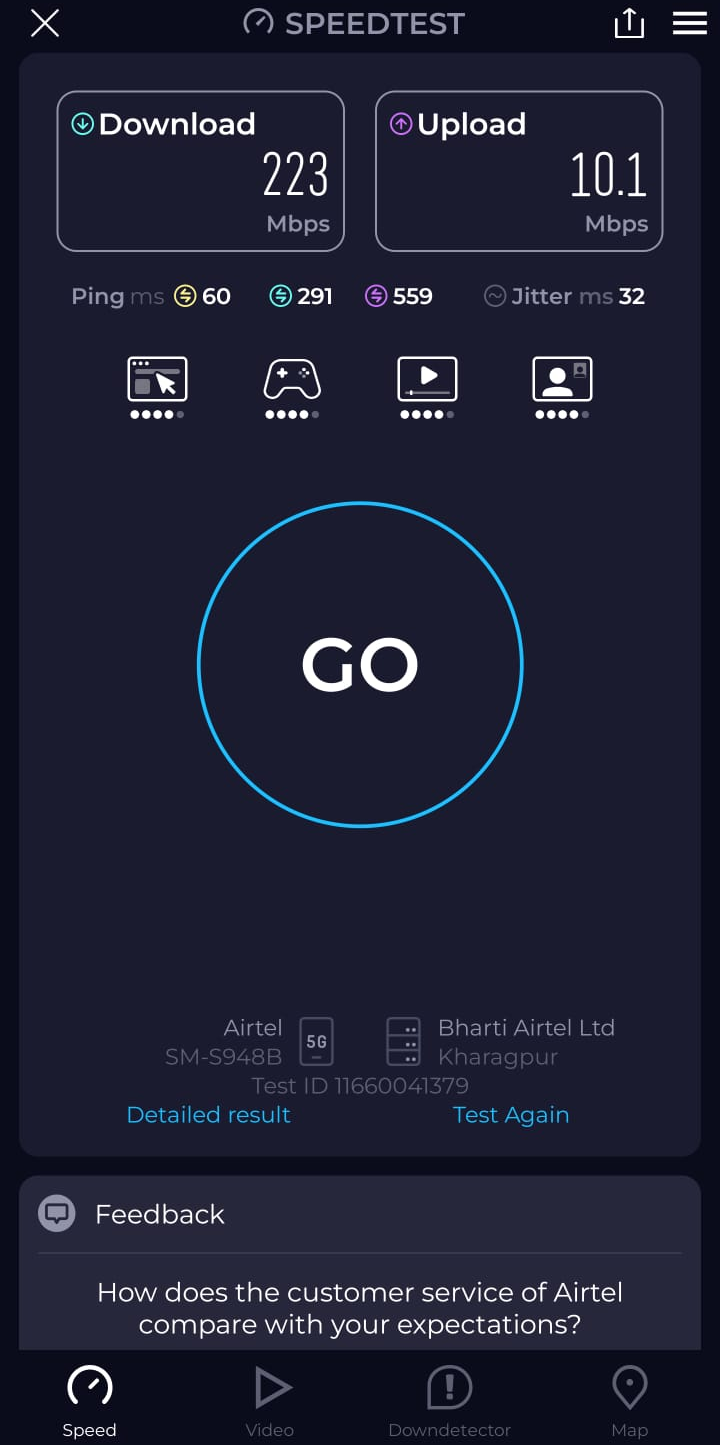
In my testing, I got the following results:
Condition | Download | Upload | Ping | Jitter |
|---|---|---|---|---|
Afternoon, indoor area (SA) | 145 Mbps | 5.7 Mbps | 40 ms | 1 ms |
Afternoon, indoor area (NSA) | 223 Mbps | 10.1 Mbps | 60 ms | 32 ms |
Evening peak, busy area outdoors (SA) | 398 Mbps | 39.8 Mbps | 15 ms | 1 ms |
Evening peak, busy area outdoors (NSA) | 577 Mbps | 37.3 Mbps | 19 ms | 4 ms |
When Priority Postpaid Should Actually Help
Crowded events and public places. Concert venues, railway stations, busy markets - anywhere a single tower is serving hundreds of simultaneous users. Congestion is where the slice's reserved capacity makes a visible difference. The Singtel example at the Singapore Grand Prix is exactly this use case at scale.
Peak evening hours in residential areas. Mobile networks in dense residential zones see heavy evening traffic as people stream and run hotspots. Priority handling may keep your connection more stable when the tower is loaded.
Video calls and remote work. Raw speed doesn't determine call quality. Latency and jitter do. A priority slice that maintains low jitter during busy hours has real value for anyone on calls regularly while commuting or traveling.
UPI payments and essential apps. Lightweight but critical tasks that fail at the worst moments in crowded areas. A stable low-latency slice keeps these working when the shared network gets overloaded. This is one of the most underrated practical benefits, because network congestion at a busy festival ground or railway station doesn't just slow YouTube, it kills UPI transactions, cab apps, and OTP delivery entirely.
Upload-heavy tasks. Sending files, uploading video, using a mobile hotspot for your laptop during travel, upload throughput typically suffers more than download under congestion, and this is where a priority slice can make the sharpest difference.
Streaming in congested locations. If you've ever had video buffer on loop at a packed stadium or a trade fair while the person next to you seems to be streaming fine, that's the problem network slicing is designed to solve. With a reserved slice, your stream doesn't compete with the same pool of bandwidth that everyone else's Netflix and Instagram Reels are pulling from.
When It Won't Make Much Difference
Low-congestion locations. If your local tower has plenty of headroom, there's nothing for priority to fix. Regular 5G already works fine.
Weak 5G SA coverage. If the phone keeps falling back to NSA because SA signal is patchy, you're not getting the priority experience most of the time anyway. This is currently the most common real-world limitation as SA coverage outside the top metro areas is genuinely thin.
Areas where NSA is better tuned. As I found firsthand, NSA can outperform SA on raw throughput in some locations. Priority Postpaid doesn't change that. The radio conditions and spectrum configuration matter more than the network architecture label in many real-world situations right now.
Budget 5G phones. If your device only supports NSA, the feature is entirely irrelevant to you regardless of plan. The line between "5G phone" and "5G SA phone" isn't well understood by most consumers, and Airtel's marketing hasn't been particularly clear about this.
Indoor coverage issues. No amount of slicing compensates for weak physical signal inside buildings. If you get poor signal indoors, Priority Postpaid isn't going to solve that. Slicing operates above the physical layer. It can't create signal where there isn't any.
Times when the network is genuinely idle. Late-night speed tests, rural locations with low user density, or quiet office zones on weekends. The feature has nothing to address in these conditions because there's no congestion causing problems in the first place.
The Net Neutrality Question - More Complicated Than Either Side Admits
This is the part of the story that matters beyond the tech review, especially for anyone thinking about the long-term direction of Indian mobile connectivity.
In 2020, following a complaint from Reliance Jio, TRAI asked Airtel to withhold its Platinum plan and Vodafone Idea to withhold its RedX plan, both of which offered faster speeds and priority access to postpaid users. At the time, TRAI said the plans could harm service quality for other users. While TRAI moved to block priority plans then, it has so far taken a softer preliminary view of Airtel's network-slicing-based offering.
Six years later, Airtel is attempting the same idea with better technology underneath it. The question is whether 5G network slicing genuinely changes the regulatory calculus, or whether it's the same concept with more sophisticated plumbing.
Airtel has defended its Priority Postpaid service before a Department of Telecommunications panel, asserting that the offering neither violates net neutrality norms nor degrades service quality for prepaid users. The company said prepaid and other non-priority traffic continues to have additional headroom to roughly 60 per cent of total capacity.
Airtel has also noted there is a clear commercial incentive to ensure prepaid customers - who make up 92 per cent of its 368 million subscriber base and contribute 88 per cent of revenue receive excellent service. Any degradation of their experience would be counterproductive to the company's core business.
That's actually a more honest argument than most of the regulatory submissions. If Airtel lets prepaid quality degrade, it alienates the vast majority of its own customers. The business logic holds. But "we won't degrade prepaid because it hurts us commercially" is different from "we have structural safeguards preventing it" and this exact difference matters for regulation.
TRAI's examination found that the plans being offered to postpaid users through 5G slicing did not potentially degrade the quality of service to or the experience of prepaid users. "The issue was whether the plan was adversely affecting the quality of the remaining 5G customers, and, principally, that does not seem to be the case," a person close to the deliberations said. India's telecom regulator is veering towards the view that Airtel's priority postpaid plans do not constitute a violation of net neutrality norms.
So, at the time of writing, TRAI's preliminary position leans toward approval, though the regulator is continuing to monitor the implementation and hasn't formally closed the review.
Rival Vi jumped into the controversy and launched a digital campaign mocking Airtel with slogans like "No more, no less but equal network to all" and "Strong Network. Sabka Haq." However, Reliance Jio lent its support to Airtel, submitting to a parliamentary standing committee that 5G network slicing is compatible with India's net neutrality framework provided there's no degradation of regular internet services.
The broader industry position is taking shape: service-tier differentiation (postpaid vs. prepaid) seems acceptable, content-based discrimination (this app gets priority over that app) does not. Airtel is firmly on the service-tier side of that line. Where the line itself gets drawn and whether regulators adjust it as slicing becomes more widespread is a question for the next few years.
Airtel's average revenue per user stood at ₹257 in FY26, ahead of Jio's ₹214, but the company has consistently said it needs to cross ₹300 for adequate capital returns. Priority Postpaid targets that gap by nudging higher-value prepaid users toward postpaid plans.
That's the commercial reality sitting underneath the technical story. Airtel is using network slicing partly because it's genuinely useful technology, and partly because it creates a convincing reason for high-usage prepaid users to convert to postpaid. There's nothing wrong with that. It's how telecom economics works, but it's worth keeping in view when evaluating the "we're doing this for you, the customer" framing.
Airtel vs Jio vs Vi: Where Each Operator Stands
Airtel has moved first and committed fully. Priority Postpaid is live, built on Ericsson and Nokia's 5G SA core, and includes all postpaid customers automatically. The bet is that network quality differentiation, rather than just data limits or OTT bundling becomes a real competitive lever.
Jio has been more cautious in its public position, supporting the regulatory concept of 5G slicing while being careful not to endorse Airtel's specific implementation. Jio's network slicing is currently limited to Fixed Wireless Access deployments only, so it hasn't brought slicing to individual postpaid subscribers yet. Given Jio's fully SA-native architecture from the start, it could theoretically move quickly if it decides to. The competitive pressure from Airtel's launch will likely force the conversation.
Vodafone Idea (Vi) has taken the most skeptical public position, opposing preferential speeds on fairness grounds while simultaneously running a social media campaign against Airtel. Given Vi's current network investment constraints, this position is partly principled and partly practical. Vi is in no position to offer a competitive slicing service right now.
How This Compares to the 2020 Platinum Plan Episode
This isn't the first time Airtel has tried to sell premium postpaid network access. The 2020 Platinum plan offered faster 4G speeds to postpaid customers paying ₹499 and above. TRAI shut it down quickly, primarily because the technology at the time, basic QoS prioritization on a 4G NSA core was difficult to implement without directly degrading service for other users.
5G SA changes the technical picture. Slicing is designed from the ground up to create separate logical networks, not just preferential treatment within a shared pool. Whether that architectural difference is sufficient to satisfy regulators is what's being worked out right now.
The regulatory history is relevant because it shows how Airtel has been building toward this for at least six years. Priority Postpaid isn't a sudden idea but the 5G-era version of something Airtel has wanted to offer for a long time, now with the technical foundation that actually supports it.
Who Should Actually Consider Switching or Upgrading
It makes sense if you:
Already use Airtel postpaid and have a 5G SA-compatible device
Work in a city where Airtel's SA network is reasonably deployed
Regularly deal with congested mobile networks during commutes, travel, events
Depend on video calls or mobile hotspot during busy hours
Want to be on Airtel's most current 5G feature tier without paying a premium above the base plan
It probably won't move the needle if you:
Mostly use Wi-Fi at home and work
Are in an area where Airtel's 5G SA footprint is still thin
Only care about peak speed test numbers
Currently get better NSA throughput in your area than SA
Use a budget 5G phone that doesn't support SA
If you're a heavy prepaid user thinking about switching to postpaid purely for this feature: check your 5G SA coverage first. The Airtel app can show device compatibility. If your phone qualifies and your area has SA coverage, the ₹449 entry plan is a reasonable deal with the OTT and storage benefits included, regardless of what the slicing delivers. If SA coverage in your area is weak, you're essentially paying for a feature that won't activate reliably.
Honest Verdict
Airtel Priority Postpaid is technically the most interesting consumer 5G launch in India so far. Not because it promises higher peak speeds - it doesn't always deliver that. Because it's the first time a mainstream operator in India has brought real 5G SA network slicing to retail postpaid users. The same architecture that's been discussed almost exclusively in enterprise and industrial 5G contexts is now available, at least in principle, to anyone on a ₹449 postpaid plan.
That's a genuine step forward in how Indian mobile networks are structured. But the real-world experience is uneven right now, and the reasons are straightforward. 5G SA coverage is still expanding. In some areas, NSA is more mature and delivers better raw throughput. The priority benefit is most relevant under congestion, which means users in low-traffic areas or those who primarily benchmark with speed tests may not notice much.
My personal take: the "Airtel PRIORITY" label does show up and the service does feel more stable during busier periods. But the phone falling back to NSA when SA signal weakens collapses the slicing benefit until it reconnects, and that happens more than I'd like. NSA speeds in my area often beat SA speeds on a straight download test. I don't think that makes Priority Postpaid pointless. It makes it a feature whose value depends heavily on where you are and what you're doing.
The TRAI picture is clarifying. Preliminary signals suggest the regulator isn't going to shut this down the way it did the 2020 Platinum plan. The 5G SA architecture gives Airtel a technically defensible argument that it couldn't make with 4G QoS prioritization. If that regulatory clearance holds, other operators will follow, and consumer-facing 5G slicing will become a standard part of Indian telecom's competitive landscape.
For now, Airtel Priority Postpaid is worth having if you're already a postpaid user on a compatible phone, it costs nothing extra. Whether it justifies switching from prepaid depends entirely on your device, your location's SA coverage, and how often you're actually in congested network situations. Don't decide based on the marketing video. Check your coverage, check which mode your phone connects on, and test it during peak hours in a busy area rather than at midnight when the network is empty. The architecture is right. The coverage just needs to catch up to the promise.


Comments