Airtel AirFiber: An In-Depth Investigation into a Broken Promise
Updated: Apr 25
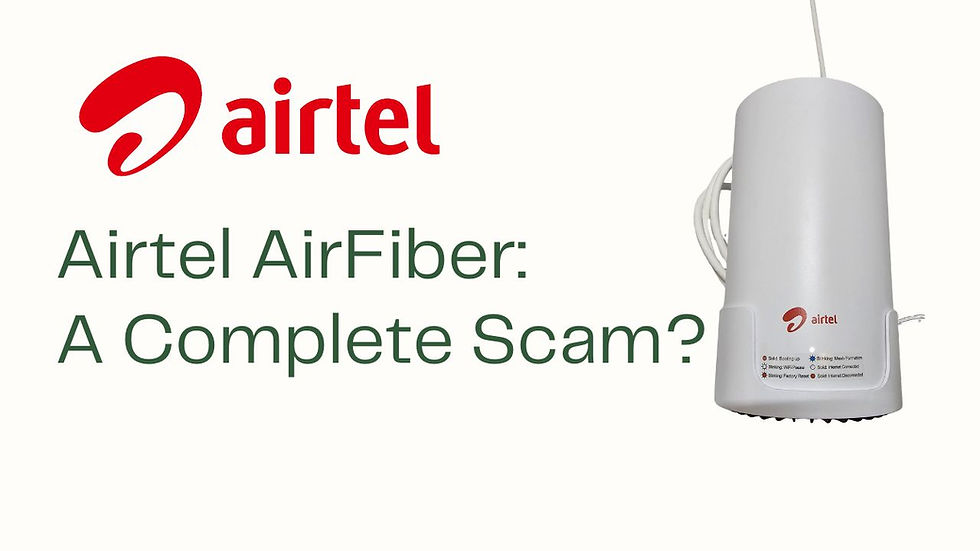
In the relentless pursuit of high-speed internet, consumers are often presented with what appear to be groundbreaking solutions. Airtel AirFiber entered the market with a flourish, promising fiber-like speeds without the complexities of wiring, a beacon of hope for those in areas with underdeveloped optical fiber infrastructure. The marketing painted a picture of seamless connectivity, ultra-fast downloads, and a revolution in home broadband. However, for a rapidly growing number of customers, this picture has warped into a caricature of everything that can go wrong with an internet service. The dream of 100Mbps speeds has dissolved into a daily nightmare of buffering, the promise of robust customer support has been replaced by a wall of silence, and the entire service feels less like a technological marvel and more like a carefully constructed corporate stratagem. This isn’t just a story of a product failing to meet expectations; it is a deep dive into what many are now calling a huge scam, a deliberate corporate pivot that prioritizes profit over performance and leaves a trail of frustrated, unheard, and out-of-pocket customers.
This is not a balanced review. This is an exposé, a detailed chronicle of broken promises and systemic failures. We will dissect every aspect of the Airtel AirFiber experience, from the choked bandwidth during peak hours to the labyrinthine and ultimately futile customer support system. We will explore the technical inferiority of the service compared to true Optical Fiber Cable (OFC) and question the corporate ethics behind promoting a demonstrably compromised technology. This is the review you need to read before you even consider letting an Airtel AirFiber installation team near your home. This is the unfiltered truth, a warning siren for prospective buyers, and a voice for the countless customers whose complaints have been ignored, dismissed, or outright blocked. If you are considering Airtel AirFiber, stop. Read this first. It might be the most important consumer decision you make this year.
The Grand Illusion: Deconstructing the 100Mbps Speed Promise
The cornerstone of Airtel AirFiber’s marketing campaign is the bold promise of high speeds, often touted as reaching up to 100Mbps. For the average consumer, this number represents a gateway to a world of seamless 4K streaming, lag-free online gaming, and instantaneous downloads. It’s a powerful and alluring figure, designed to compete directly with the offerings of established fiber optic providers. The sales pitch is slick, the advertisements are convincing, and the initial setup process often feels professional and efficient. The technicians arrive, install a sleek outdoor unit with a clear line of sight to a nearby tower, and run a speed test that, more often than not, displays a number impressively close to the advertised speed. For a fleeting moment, it seems the promise is real. You are connected. You are fast.
However, this initial euphoria is often short-lived, a carefully staged first act in a play that descends into a tragedy of technological limitations and corporate over-promising. The number on that first speed test is a snapshot taken under ideal conditions, a best-case scenario that rarely reflects the reality of day-to-day usage. The grand illusion begins to crumble not in days, but often within hours, as the network is subjected to the real-world stresses of concurrent users, environmental factors, and, most critically, the crushing weight of peak-hour traffic. What was sold as a dedicated superhighway of internet connectivity quickly reveals itself to be a congested single-lane road during rush hour.
The discrepancy between the advertised speed and the delivered speed is not a minor variance; for many users, it is a chasm. The 100Mbps dream becomes a 10Mbps, 5Mbps, or sometimes even a sub-1Mbps reality. Videos that once loaded in an instant now buffer incessantly. Online games become unplayable due to crippling latency spikes. Even simple web browsing can feel sluggish, a throwback to the dial-up era. The problem is not necessarily that the technology can’t achieve 100Mbps. The issue is that it cannot sustain it. Fixed Wireless Access (FWA), the technology underpinning AirFiber, is fundamentally a shared resource. Unlike a dedicated fiber optic line that runs directly to your home, AirFiber users in a specific geographic area are all connecting to the same cellular tower. This is a critical distinction that is often glossed over during the sales process.
Imagine a water pipe. A true fiber optic connection is like having a dedicated, large-diameter pipe running directly from the reservoir to your house. You get consistent pressure and flow, regardless of how many of your neighbors are taking a shower. Airtel AirFiber, on the other hand, is like sharing a single, smaller pipe with everyone on your street. When everyone turns on their taps at the same time, the pressure drops for everyone. The flow becomes a trickle. This is precisely what happens to the AirFiber network. The tower has a finite amount of bandwidth to allocate. When a few users are online, performance is great. But when hundreds of users in the vicinity—including mobile phone users on the same 5G network—are all streaming, gaming, and working from home simultaneously, the tower becomes overwhelmed. The available bandwidth is spread thin, and every user’s speed plummets.
This is not a technical glitch; it is an inherent characteristic of the technology being deployed. The promise of 100Mbps is, therefore, conditional at best and deceptive at worst. It’s a promise of a “potential” speed, not a “guaranteed” or “consistent” speed. This crucial nuance is the foundation of the widespread customer dissatisfaction. Users feel they have been sold a premium sports car, only to discover it has the engine of a scooter. The frustration is compounded by the fact that many have signed up for long-term plans, lured by discounts, trapping them in a service that fails to deliver on its most fundamental promise. The illusion shatters, leaving behind a bitter reality of a service that is, for all intents and purposes, broken. The 100Mbps figure remains on the bill, a constant, mocking reminder of the performance that was paid for but never truly received.


The Peak Hour Nightmare: 7 PM to 10 PM, The Dead Zone
For most households, the hours between 7 PM and 10 PM are prime time. It’s when families gather to stream movies, when gamers log on for multiplayer battles, and when many individuals catch up on work or browse the web after a long day. This is the period when a reliable, high-speed internet connection is not just a luxury, but a necessity. It is also, ironically, the exact window of time when Airtel AirFiber consistently and catastrophically fails. This daily, predictable collapse in service is perhaps the single most infuriating and illustrative issue plaguing the platform, transforming the promise of high-speed internet into a nightly ritual of frustration.
Users from across the country report the same phenomenon with uncanny similarity. As the clock strikes 7 PM, the once-usable internet connection begins to degrade rapidly. Speeds that may have been acceptable during the day, perhaps in the 40-50Mbps range, nosedive into the single digits. Latency, the measure of network responsiveness crucial for gaming and video calls, skyrockets from a reasonable 20-30ms to an unplayable 300-500ms or even higher. Web pages take ages to load. 4K streams on Netflix or YouTube buffer every few seconds before defaulting to a pixelated 480p resolution. Online gaming is an exercise in futility, with constant lag, rubber-banding, and disconnections. The service becomes, in essence, unusable for anything beyond sending a simple text-based email.
This isn’t a random outage. It’s a systemic, recurring failure rooted in the very architecture of the service. As explained earlier, AirFiber operates on a shared bandwidth model, piggybacking on Airtel’s 5G cellular network. The cell tower that provides your home broadband is the same tower that serves hundreds, if not thousands, of mobile phone users in your vicinity. During the day, usage is distributed. People are at work, at school, or on the move. But in the evening, everyone comes home. They connect their smartphones, smart TVs, laptops, and tablets to the network. This massive, concentrated surge in demand creates a digital traffic jam of epic proportions. The tower simply does not have the capacity—the backhaul—to handle the load.
Complaining to customer support about this specific issue is a journey into a void of scripted responses and feigned ignorance. They will guide you through the motions: restart your router, check your device, move the receiver. They might even schedule a technician visit, who will inevitably arrive during the day when the network is less congested, run a speed test that shows acceptable performance, and declare the issue resolved. They systematically ignore the core complaint: the problem is time-dependent. It is a capacity issue, not a hardware fault. Customers who are technically savvy and point-blank state that the local tower’s capacity is insufficient are met with silence or empty promises of “escalating the issue to the network team.” These escalations rarely, if ever, result in tangible improvements.
One user, living with a clear, unobstructed line of sight to a tower less than 100 meters away, perfectly encapsulates the problem. Proximity and a strong signal mean nothing when the tower itself is the bottleneck. It’s like having a perfect, clear path to a grocery store, only to find the store has empty shelves every evening. The problem isn’t your access to the store; it’s the store’s inability to keep its shelves stocked during periods of high demand. Airtel, it seems, is fully aware of this limitation. The cost of significantly upgrading tower capacity and backhaul infrastructure across thousands of locations is astronomical. It is far cheaper to acquire new customers with promises of high speeds and then manage the fallout of their complaints with a deflective customer support system than it is to build a network that can actually deliver on those promises consistently.
The 7 PM to 10 PM dead zone is the most glaring evidence of AirFiber being a compromised product. It’s a service sold for evening entertainment and work-from-home reliability that systematically fails during the precise hours it’s most needed. This daily, predictable failure is not just an inconvenience; it’s a breach of the fundamental agreement between the service provider and the customer. Users are paying a premium for a service that is, for three of the most crucial hours of the day, fundamentally broken. This nightly nightmare is the starkest reality of the AirFiber experience.

A Masterclass in Misdirection: The Futile Quest for Customer Support
A company’s true character is often revealed not when things are going well, but when they go wrong. It is in the moments of failure and frustration that the quality of its customer support system is truly tested. In this regard, Airtel AirFiber’s support system is not just a failure; it appears to be a deliberately constructed labyrinth of frustration, designed to deter, deflect, and ultimately exhaust the customer into submission. The experience is a masterclass in misdirection, where the goal is not to resolve problems but to manage and eventually close complaint tickets, regardless of the actual outcome.
The journey begins with the initial contact. Whether you use the Airtel Thanks app, the website, or the customer care hotline, you are first funneled into a system of automated responses and chatbots. These bots are programmed with a limited flowchart of troubleshooting steps: “Have you tried restarting your router?” “Is the device light green?” “Please run a speed test.” They are incapable of understanding context-specific issues like the peak hour speed drops. Pleading with a chatbot that the problem only occurs between 7 PM and 10 PM is futile. You are trapped in a loop of irrelevant suggestions.
Should you manage to navigate the digital gauntlet and reach a human agent, the experience barely improves. The agents appear to be working from the same limited script. They are polite, empathetic in tone, but ultimately powerless. They will log your complaint, assign you a service request number, and promise a resolution within 24 to 48 hours. This promise is the first of many that will be broken. The “resolution” often comes in the form of an automated SMS message stating that the issue has been fixed, even when nothing has changed. The speed is still abysmal, the connection still drops, but in Airtel’s system, the ticket is closed. The onus is then on you, the customer, to start the entire frustrating process all over again.
For persistent customers, the cycle repeats. You complain, you get a ticket number, the ticket is closed without resolution, you complain again. Each time, you have to re-explain the entire history of the issue to a new agent who has no context of your previous interactions. It is a system designed to wear you down. The technical support visits, if they happen at all, follow a similar pattern of futility. The technician arrives during off-peak hours, finds the connection working acceptably, and closes the case. They are not equipped or empowered to diagnose or report systemic issues like tower congestion. Their mandate is to fix immediate, on-site hardware problems, which are rarely the root cause of the AirFiber’s failures.
The most shocking and egregious tactic reported by numerous users is the practice of being blocked by customer support for being too persistent. Customers who raise multiple complaints about the same unresolved issue have found their numbers suddenly unable to connect to the support hotline. Their requests for callbacks go unanswered. They are, in effect, ghosted by their own service provider. This is not just poor customer service; it is an actively hostile act against a paying customer seeking a resolution for a deficient service. It is a clear message from the company: “We have your money. We are not going to fix your problem. Please stop bothering us.” This practice is ethically bankrupt and speaks volumes about the company’s contempt for its own user base. It transforms the customer relationship from one of service into one of adversity.
The entire support structure seems to be a carefully engineered facade. It exists to create the illusion of a support system while actively preventing genuine problem resolution. There is no clear path for escalation. Asking to speak to a supervisor often leads to being put on indefinite hold or a promise of a callback that never materializes. The system is designed to contain and neutralize complaints, not to solve them. For the user, it’s a maddening, isolating experience. You are paying for a service that doesn’t work, and the very people you are paying are actively working to silence your complaints. This isn’t a bug in the system; it is the system.


The Technology Deception: Why AirFiber is Not “Fiber”
The very name “AirFiber” is a masterpiece of marketing sleight of hand. It cleverly co-opts the word “Fiber,” a term that consumers have come to associate with the gold standard of internet connectivity: reliability, speed, and low latency. By placing “Air” in front of it, Airtel creates the impression of a futuristic, wireless version of fiber optic technology, offering all the benefits without the need for physical cables. This is a profound and deliberate deception. Airtel AirFiber is not fiber internet. It is Fixed Wireless Access (FWA), a technology that is fundamentally different from, and in most residential scenarios, technically inferior to, true Optical Fiber Cable (OFC).
Understanding this difference is key to understanding why the AirFiber service is so fraught with problems. Let’s break it down.
Optical Fiber Cable (OFC): The Gold Standard True fiber internet works by transmitting data as pulses of light through incredibly thin strands of glass. This connection is a physical, dedicated line that runs from the provider’s central hub directly to a user’s home or building. This architecture has several immense advantages.
Immense Bandwidth and Speed: Light traveling through a glass fiber can carry an astonishing amount of data. This allows for symmetrical speeds (equal download and upload) that can easily reach 1Gbps and beyond.
Unmatched Reliability: Because it’s a closed, physical line, it is almost completely immune to radio frequency interference, atmospheric conditions like rain or fog, and network congestion from other users. The bandwidth is dedicated to you.
Extremely Low Latency: Data travels at the speed of light in a direct path. This results in incredibly low ping times (latency), which is critical for real-time applications like online gaming, stock trading, and video conferencing. Your connection is responsive and immediate.
Fixed Wireless Access (FWA): The Compromise Airtel AirFiber, or FWA, operates on a completely different principle. It uses the same 5G cellular network as your smartphone. An outdoor receiver on your roof captures the radio waves from a nearby cell tower, which are then converted into an internet signal for your home Wi-Fi. This system has one primary advantage: ease of deployment. Airtel does not need to dig trenches and lay expensive fiber cables to every home. They can leverage their existing mobile network infrastructure. However, this cost-saving measure for the company comes with a litany of technical compromises for the consumer.
Shared, Limited Bandwidth: As we’ve established, you are sharing the bandwidth of a cell tower with potentially thousands of other mobile and AirFiber users. This is the primary cause of the peak-hour slowdowns. The network is easily congested.
Higher and Unstable Latency: Radio waves are inherently more prone to latency than light in a fiber cable. The signal has to travel through the air, be processed by the tower, and then routed to the internet backbone. This results in higher average ping times and, more importantly, “jitter”—wild fluctuations in latency that make online gaming a nightmare.
Susceptibility to Interference: The signal can be affected by a host of environmental factors. While a clear line of sight (LoS) is required, even this can be compromised. Heavy rain, dense fog, or even growing foliage on trees can degrade signal quality. Other radio signals in the same frequency band can also cause interference.
Line of Sight (LoS) Dependency: The performance is critically dependent on a perfect, unobstructed view of the cell tower. Any new construction, a neighbor’s tree growing taller, or even a large truck parking in the wrong spot can potentially impact the signal. This makes the connection fragile and unpredictable over the long term.
Airtel’s decision to brand this technology as “AirFiber” is a deliberate attempt to mislead consumers by associating their product with the quality of a superior technology. They are selling a wireless service that is subject to all the traditional limitations of wireless communication while marketing it as a competitor to the stability and performance of a wired fiber optic line. It’s akin to selling a high-quality electric bicycle and calling it a “Wheeled Motorcycle” to imply it has the power and range of a gas-powered vehicle.
This technological deception is the root cause of the entire AirFiber fiasco. The company is pushing a solution that is ill-suited for dense residential areas where demand is high and consistent performance is expected. It is a cost-cutting measure for Airtel, allowing them to rapidly expand their “broadband” footprint without the massive capital investment required for a true fiber rollout. The consumer, unfortunately, is the one who pays the price for this compromise, both literally on their monthly bill and figuratively in their daily frustration with a service that was never designed to be a true replacement for fiber.

The Cancellation Quagmire and the Vanishing Refund
After weeks or months of enduring abysmal speeds, nonexistent support, and the nightly dead zone, many Airtel AirFiber customers reach a breaking point. They decide that enough is enough and make the perfectly reasonable decision to cancel the service and get their money back, especially if they paid a hefty upfront amount for a 6-month or 12-month plan. This is where they discover the final, and perhaps most insulting, layer of Airtel’s anti-consumer labyrinth: the cancellation and refund process. If the customer support system was designed to exhaust you, the cancellation system seems designed to hold your money hostage indefinitely.
The process of simply requesting a disconnection is an ordeal in itself. It cannot be done with a simple click of a button. It requires navigating the same frustrating support channels that failed to resolve the initial problems. When a customer finally declares their intention to cancel, they are not met with a straightforward process but with the dreaded “retention team.” This team’s sole purpose is to prevent you from leaving. They will make a slew of new, hollow promises. They will offer a one-month discount, a free upgrade to a (nonexistent) better plan, or a guarantee that your issues will finally be escalated to a “senior network engineer.”
These are the same promises that were made and broken countless times before. For the customer who has already lost all faith in the company, this is an infuriating waste of time. They are forced to repeatedly and forcefully state their demand to cancel, often over multiple calls, as the retention team employs every psychological trick in the book to keep them on the hook. It is a process designed to be as difficult and unpleasant as possible, in the hopes that the customer will simply give up and resign themselves to the terrible service.
For those who persevere and finally get a cancellation request officially logged, the battle is far from over. The next stage is the return of the equipment. A technician must be scheduled to come and collect the outdoor and indoor units. This process can be subject to the same delays and no-shows that plagued the initial service requests. But the real nightmare begins after the equipment is gone: the wait for the refund.
The timelines given for refunds are vague and inconsistent, ranging from 7 business days to 45 working days. In reality, for a huge number of customers, the refund never arrives automatically. The promised date comes and goes with no credit to their bank account. Once again, the customer is forced to re-engage with the black hole of Airtel’s support system. They call, they email, they plead. They are given new ticket numbers, new promises of escalation, and new, extended timelines. Each support agent gives a different story. “The refund has been processed, sir, it will reflect in 3-5 days.” “There was an issue with the accounts department, we are re-initiating it.” “We need to verify the equipment return, even though it was collected a month ago.”
It is a bureaucratic nightmare. Many users report waiting for months, making dozens of follow-up calls, and still not receiving their money. Some give up in sheer exhaustion. Others find that the only way to get a response is to resort to public shaming on social media platforms like Twitter, tagging senior Airtel executives. Only when faced with public embarrassment does the company sometimes, grudgingly, process the refund that the customer was legally and ethically entitled to all along. In many other cases, the money simply vanishes. The company stonewalls, and the customer is left with no choice but to absorb the loss or attempt the arduous process of filing a complaint with a consumer court.
This is not an accidental administrative delay. It is a systemic, widespread problem that points to a deliberate strategy. By making the cancellation and refund process so incredibly difficult, the company accomplishes two things. Firstly, it deters customers from canceling in the first place. Secondly, it holds onto customer funds for as long as possible, benefiting from the cash flow. For a certain percentage of customers who give up, it becomes pure profit. This is a predatory business practice, an unethical and potentially illegal exploitation of consumer trust. Customers who paid in good faith for a service that was not delivered are being victimized a second time when they try to reclaim their own money. The cancellation quagmire is the final, bitter confirmation that for Airtel AirFiber, the customer is not a valued partner but a mark to be exploited.


The Economic Motive: A Deliberate Pivot from Quality
Why would a telecommunications giant like Airtel, with a reputation to uphold, knowingly push a product that is so fundamentally flawed? Why would they risk the torrent of customer outrage and the damage to their brand? The answer, as is so often the case, lies in simple, cold economics. The rollout and promotion of Airtel AirFiber over the expansion of a true Optical Fiber Cable (OFC) network is not a technological misstep; it is a calculated and deliberate business strategy designed to maximize profit and market share at the direct expense of service quality and customer satisfaction.
Building a true fiber-to-the-home (FTTH) network is an incredibly expensive and time-consuming endeavor. It involves immense capital expenditure on materials (thousands of kilometers of optical fiber), labor-intensive civil work (digging trenches, laying conduits), and navigating a complex web of municipal permits and right-of-way permissions. To wire up a single city with comprehensive fiber coverage can take years and cost hundreds of crores. While the end result is a vastly superior and future-proof network, the upfront investment is a significant deterrent for a publicly traded company focused on short-term quarterly results.
Airtel AirFiber, using Fixed Wireless Access (FWA), presents a seductive financial alternative. The company has already invested billions in building its 5G mobile network. The towers, the spectrum, and the core infrastructure are already in place. By offering AirFiber, Airtel can leverage this existing investment to offer a “home broadband” product with minimal additional cost. There is no need for last-mile trenching or wiring. The only significant cost is the subsidized customer premises equipment (CPE)—the receiver and router. This allows Airtel to enter new markets and declare an area “broadband-ready” in a fraction of the time and at a fraction of the cost of a traditional fiber rollout.
This strategy is particularly appealing for expanding into semi-urban and tier-2 cities, where laying fiber might be deemed less profitable. It allows Airtel to quickly capture market share from local providers and competitors like Jio, which is also aggressively pushing its own AirFiber product. The corporate goal is subscriber acquisition. The marketing team is given a simple mandate: sign up as many customers as possible, as quickly as possible. The technical limitations of the service are a secondary concern, a problem to be “managed” by the customer support and retention teams later.
The company is essentially placing a bet. They are betting that a large percentage of customers will not be heavy users and may not notice the performance degradation. They are betting that many of the customers who do notice will not have the time, energy, or knowledge to navigate the deliberately obtuse complaint system. They are betting that even if a certain percentage of customers cancel, the low cost of acquiring them in the first place makes it financially worthwhile. It is a numbers game, where individual customer experience is a disposable metric in the larger equation of market penetration and revenue growth.
The claim that they are deliberately promoting AirFiber instead of expanding their OFC network holds significant weight. In many areas where AirFiber is being heavily pushed, there has been no parallel effort to lay down new optical fiber. Customers who inquire about a traditional fiber connection are often told it is “not feasible” in their area and are aggressively upsold on the AirFiber “solution.” The company is actively guiding customers towards the cheaper, lower-quality option because it serves their bottom line. This is not about bridging the digital divide with the best possible technology; it is about plugging the gap with the most profitable technology for the company.
This economic motive explains everything. It explains the over-promising on speeds. It explains the under-investment in tower capacity. It explains the frustrating, deflective customer support. And it explains the impossible refund process. Every single point of failure in the Airtel AirFiber experience can be traced back to a corporate decision to prioritize cost-cutting and rapid expansion over building a robust, reliable service. The customer is not the beneficiary of a new technology; they are the unwitting financier of a corporate shortcut.

Your Voice Matters: A Guide to Fighting Back
Feeling trapped, ignored, and ripped off by a massive corporation can be an incredibly disempowering experience. The deliberately frustrating systems are designed to make you feel helpless and encourage you to give up. But your voice matters, and there are established channels through which you can and should fight back. If you are a victim of Airtel AirFiber’s broken promises, do not suffer in silence. It is crucial to hold the company accountable, not just for your own sake, but for all the other consumers who are being misled. Here is a step-by-step guide to escalating your complaint and making your voice heard.
Step 1: Document Everything Meticulously From the moment your problems start, become a diligent record-keeper. Your documentation is your most powerful weapon.
Speed Tests: Run speed tests regularly, especially during the 7 PM to 10 PM peak hours. Take screenshots of the results, ensuring the date and time are visible. Use multiple speed test websites (Ookla, Fast.com, etc.) for a comprehensive picture.
Communication Records: Keep a log of every interaction with customer support. Note the date, time, the name of the agent you spoke with (if they give one), the service request (SR) number they provide, and a summary of the conversation. Save all emails and chat transcripts.
Photos and Videos: If possible, take videos of buffering streams or lagging games to visually demonstrate the impact of the poor service. Take photos of your equipment setup and the line of sight to the tower.
Bill Payments: Keep copies of all your bills and payment receipts as proof of your financial commitment.
Step 2: Utilize Social Media for Public Accountability The customer support hotline may ignore you, but the social media team is often more responsive because their interactions are public.
Twitter (X) is Key: This is the most effective platform. Craft a clear, concise, but firm tweet detailing your issue. Include your city, the core problem (e.g., “pathetic speeds every night from 7-10 PM”), and how long you’ve been complaining.
Tag the Right Accounts: Always tag the official Airtel accounts (@Airtel_Presence, @airtelindia) and, if you can find them, the accounts of senior executives or the CEO. Public visibility often prompts a quicker, more senior-level response.
Use Hashtags: Use relevant hashtags like #Airtel #AirtelAirFiber #BadService #ConsumerRights to increase the visibility of your complaint.
Be Persistent: Don’t just tweet once. Post regular updates, especially if you get a ticket number and it’s closed without resolution. Create a thread detailing your entire ordeal with screenshots as evidence.
Step 3: Escalate Through the Official Grievance Redressal Mechanism Every telecom company in India is required by law to have a formal three-tier grievance redressal mechanism.
Tier 1: Complaint Centre (Customer Care): This is the initial step you’ve already taken. When they fail to resolve your issue satisfactorily within a reasonable timeframe (usually 7 days), you can escalate.
Tier 2: Nodal Officer: Each service area (telecom circle) has a Nodal Officer. You can find their contact details (email and phone number) on the Airtel website. Draft a formal email to the Nodal Officer. In the email, clearly state your problem, mention your original SR numbers, and state that the customer care team failed to resolve it. Attach your evidence (speed test screenshots, etc.). The Nodal Officer is obligated to respond and resolve the issue within 10 days.
Tier 3: Appellate Authority: If the Nodal Officer also fails to provide a satisfactory resolution, you can appeal to the Appellate Authority. Again, their contact information is available on the Airtel website. Your appeal should be filed within 90 days of your original complaint. This is the highest level of internal escalation within the company.
Step 4: Take the Fight to External Forums If Airtel’s internal mechanisms fail, it’s time to go external.
National Consumer Helpline (NCH): This is a government-run portal for consumer grievances. You can register a complaint by calling the toll-free number 1915 or through their mobile app. They will act as a mediator between you and the company.
Consumer Court (Consumer Dispute Redressal Commission): This is your final and most powerful option. For disputes involving amounts up to Rs 5 lakh, you can file a case in the District Consumer Forum online through the e-Daakhil portal. The process has been simplified, and you often do not need a lawyer for smaller claims. You can claim a full refund, compensation for mental agony, and litigation costs. Your meticulous documentation from Step 1 will be critical here.
By following these steps, you transform from a passive, frustrated user into an empowered consumer actively seeking justice. It requires time and effort, but it is the only way to force a corporation to listen. Every complaint filed, every negative review posted, and every case won in consumer court adds to the pressure on Airtel to either fix their broken service or face the financial and reputational consequences of their deceptive practices. Do not let them silence you. Fight back.
The Verdict: A Resounding and Unequivocal Warning
We have journeyed through the labyrinth of the Airtel AirFiber experience, from the glittering mirage of its 100Mbps promise to the desolate reality of its nightly network collapse. We have dissected the technology and exposed the cynical marketing that equates a compromised wireless service with the gold standard of true fiber. We have navigated the soul-crushing futility of a customer support system designed to deflect, not to help, and uncovered the predatory nature of a cancellation and refund process that holds customer money hostage. We have laid bare the cold, hard economic motive that drives a corporate giant to knowingly sell a deficient product to an unsuspecting public.
There is no room for ambiguity here. There are no “minor issues” or “teething problems” to excuse. The problems with Airtel AirFiber are not glitches in the system; they are fundamental, systemic failures baked into the very DNA of the service and the business strategy behind it. The service is built on a technological compromise, sold through deceptive marketing, and supported by a structure of consumer hostility.
The promise of fiber-like speed is a lie. The advertised 100Mbps is a theoretical maximum that is rarely, if ever, sustained during the hours you need it most. The service is fundamentally unreliable, prone to congestion, and cannot handle the demands of a modern connected household during peak hours.
The promise of customer support is a sham. The support system is a firewall designed to protect the company from its customers. It is a maze of automated dead-ends, powerless agents, and broken promises, culminating in the egregious practice of blocking customers who dare to complain too persistently.
The promise of a fair deal is a fantasy. The company makes it excruciatingly difficult to cancel a service that does not work and even harder to get your money back. It is a strategy that disrespects the consumer and abuses their trust.
This is not a viable alternative to fiber optic broadband. It is a stop-gap measure, a cost-cutting shortcut for Airtel that offloads all the risk and frustration onto you, the paying customer. It is a product born not of innovation for the consumer’s benefit, but of a desire to gain market share on the cheap. The decision to aggressively promote this inferior technology over the expansion of their true fiber network is a betrayal of the trust that consumers place in a national brand.
Therefore, the conclusion of this exhaustive investigation can be nothing but a stark, unequivocal warning. Do not be swayed by the slick advertising. Do not be tempted by the promise of a quick and easy installation. Do not fall for the illusion of “AirFiber.”
⚠️ DO NOT BUY AIRTEL AIRFIBER ⚠️
You will be paying a premium price for a sub-standard service. You will be trading reliability for constant frustration. You will be investing your hard-earned money into a product that fails on every significant promise it makes. Save yourself the headache, the anger, and the inevitable, exhausting battle for refunds and resolution. If true fiber optic is available in your area from any provider, choose it without a second thought. If it is not, wait. A bad internet connection is better than a service that is actively hostile to its users. Let the empty promises of Airtel AirFiber dissipate into the air from which they came. Your money, your time, and your sanity are worth more.


Comments