My Airtel AirFiber Nightmare: A Confession on Why I’m Calling It a National Deception
Updated: Apr 25

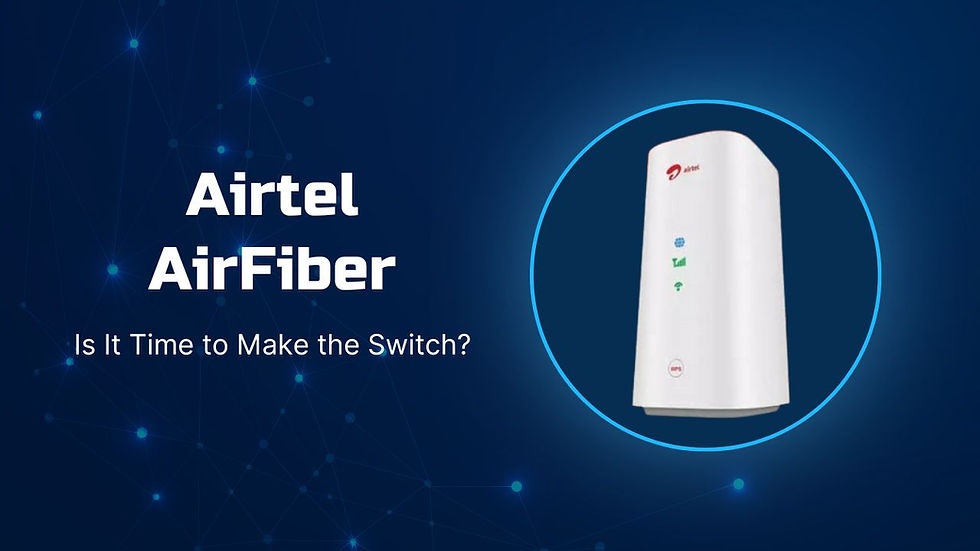
Airtel AirFiber. The name sounded like the future. It promised to free me from the tyranny of slow internet, beaming fiber-optic speeds into my home through the air. As a resident of Kolkata, West Bengal, tired of unreliable connections, I bought into the dream. I signed up, paid my dues, and awaited the revolution. What I got instead was a masterclass in corporate negligence, a fundamentally broken product, and a journey into a customer support abyss so profound it’s designed to break you. This is not a review. This is my story.
My name is not important, because my experience is the experience of countless others. I am the customer Airtel doesn’t want you to hear from. For months, I have meticulously documented every broken promise, every failed speed test, and every soul-crushing interaction with a support system designed not to help, but to silence. This is my personal testimony, and a warning to every single person in India considering this service.
I will lay bare the irrefutable evidence of Airtel’s blatant violations of TRAI regulations. I will dissect the technical lie they are selling and expose the corporate strategy that prioritizes their bottom line over the service you pay for. Most importantly, I will give you the playbook I was forced to write—a step-by-step guide to fighting back when they leave you with a useless connection and no one to turn to.
If you are thinking about subscribing to Airtel AirFiber, I implore you: stop. Read this first. If you are already a customer, trapped in the same cycle of frustration, know that you are not alone. This is the unfiltered truth.

The Glimmering Promise vs. My Crushing Reality: Deconstructing the AirFiber Myth
Airtel’s marketing is brilliant; I’ll give them that. They painted a picture I desperately wanted to believe. A sleek, elegant box in my home, effortlessly pulling in a consistent 100 Mbps from a 5G tower just down the street. No more ugly wires, no more waiting for technicians to dig up the road. Just pure, unadulterated speed for buffer-free 4K streaming, seamless work-from-home video calls, and lag-free gaming.
I signed up for the 100 Mbps Airtel Airfiber service, bundled into the Airtel Black 899 IPTV Plan. I was sold. The installation was quick, and for a fleeting moment, everything seemed perfect. During the day, the speeds were fantastic, often hitting the advertised 100 Mbps. This, I now realize, is the cruelest part of the deception. It gives you a taste of what you paid for, a sliver of hope that the system works. It’s the hook.
Then, every single evening, like clockwork, the dream collapses into a nightmare. Around 6 PM, as my community settles in after a day’s work, my futuristic internet service grinds to a halt. The promised 100 Mbps superhighway vanishes, replaced by a congested, pot-holed dirt track. Speeds don’t just dip; they freefall. This isn’t a minor fluctuation; it’s a catastrophic, predictable failure. Every night, between 7 PM and 10 PM, my connection plummets below 30 Mbps, frequently hitting a pathetic 10-15 Mbps.
At these speeds, my “high-speed” internet is a joke. It’s a systemic failure that has fundamentally disrupted my life:
Family Movie Night? Impossible. The “Ultra HD” 4K streaming I was promised becomes a buffering symbol’s personal playground. Even 1080p on a single TV is a struggle.
Urgent Work Video Call? A professional disaster. I’m reduced to a pixelated, frozen face with choppy audio, constantly apologizing for my “bad connection.” It’s embarrassing and damaging to my work.
Relaxing with Online Gaming? It’s an exercise in pure rage. The latency is so high that the games are unplayable.
A Modern Family Online? Forget it. If my child needs to do online research for school while I’m trying to send an email and my spouse is on a WhatsApp call, the entire network simply gives up.
This isn’t an occasional problem. It’s my daily reality. I have become obsessed with documenting this failure, running dozens of Ookla Speedtests and logging every single result. I have a mountain of timestamped evidence that proves this is not a glitch, but the way the service is designed to fail. I paid for a superhighway; Airtel delivered a daily traffic jam and has no intention of clearing it.


The Technical Lie: My Tower, My Congestion, My Corporate Negligence
When I first started complaining, Airtel’s support agents treated me like I was an idiot. They followed a script, a playbook of denial. “Sir, have you restarted your device?” “Sir, it could be the weather.” “Sir, maybe there’s interference.” Anything to avoid admitting the truth: the network is severely, negligently congested.
Here’s the infuriating part: my setup is perfect. The Airtel 5G tower is a mere 60-70 meters from my home. I have a perfect, unobstructed Line of Sight (LoS). I can literally see it from my window. No trees, no buildings, nothing. My AirFiber device reports “Excellent” signal strength 24/7. The problem isn’t the signal getting to my house; it’s the tower itself.
Think of the tower as a water pipe. Airtel promised me a high-pressure flow. But they’ve connected hundreds of users to that same pipe—5G mobile users, and now data-hungry AirFiber homes like mine—without increasing the pipe’s capacity. So every evening, when everyone turns on their taps, the pressure drops for all of us. I’m standing right next to the pipe with a perfect connection, but only a trickle of water comes out.
This is a direct result of Airtel’s greed. They are aggressively overselling their network capacity, signing up new customers to towers that cannot handle the load. They are doing this without making the necessary, costly upgrades to the tower’s backend infrastructure (the “backhaul”). My 5G mobile data also becomes useless during these hours, confirming the tower itself is the bottleneck.
In my repeated, exhaustive escalations to their technical teams, nodal officers, and appellate authorities, I have explicitly stated this. I have demanded that they investigate the tower’s capacity and provide a plan for its decongestion. Their response? Utter silence. Canned emails about “network optimization” that do nothing. They know the tower is overloaded. They know they are flagrantly violating TRAI’s Quality of Service (QoS) mandates, which state I should receive at least 80% of my subscribed speed. They simply do not care. Upgrading their network costs money. Collecting my monthly fee costs them nothing. This isn’t a technical glitch; it’s their business model.

Into the Abyss: My Soul-Crushing Journey Through Airtel’s Customer Support
If the service is a failure, the customer support is a form of psychological warfare. It’s a multi-layered fortress of corporate indifference designed to make you give up.
Level 1: The Scripted Robots (Helpline 121 & The App) My journey always began here. I’d call 121 or use the Airtel Thanks app. I’d be met with a polite agent who had no power and less knowledge, reading from a script. “Restart the device.” “We are registering your concern.” I’d get a Service Request (SR) number, a meaningless token. Hours later, a text message: “Your issue has been resolved.” A blatant lie. Nothing had changed.
Level 2: The Escalation Black Hole After weeks of this, I’d demand an escalation. They’d promise a callback from a “senior technical team.” The call never came. My complaint was simply tossed into a black hole, but not before wasting more of my time and energy.
Level 3: The Wall of Silence (Nodal & Appellate Authorities) This is where the true nature of their system revealed itself. I followed their own grievance redressal policy to the letter. I composed detailed, formal complaints, attaching my speed test logs and call records. I emailed the Nodal Officer. No resolution. I then escalated to the Appellate Authority for my region, sending formal emails on September 14th and 22nd, 2025. The response was a deafening, arrogant silence. The very people meant to be the final arbiters of justice within the company are just another brick in the wall.
The Final Insult: I Was Blocked This is the part that still makes my blood boil. After weeks of persistent, polite, but firm complaints about my unresolved issue, I discovered that one of the support execs. had blocked my number from everywhere. I couldn’t get through to him. They didn’t fix the problem; they silenced the person reporting it. This is not poor customer service. This is an unethical, deliberate act to shut down a legitimate complaint. It is a practice that TRAI must investigate and punish severely.

A Deliberate Strategy: Why I Believe This is a Scam
Why is Airtel doing this? After months of fighting them, the answer is painfully clear: money.
AirFiber (Fixed Wireless Access – FWA) is cheap. It uses their existing 5G towers. It saves them the enormous cost and effort of laying thousands of kilometers of Optical Fiber Cable (OFC). It’s a shortcut to grab market share.
True Fiber (OFC) is superior but expensive. A physical fiber line to my home would give me a dedicated, stable connection immune to this wireless congestion. It’s the gold standard for a reason.
Airtel is marketing AirFiber as a true fiber alternative, which is a lie. They are deliberately pushing a technologically inferior product to save money. They are gambling that people like me won’t understand the technical reasons for the failure or will simply give up fighting their labyrinthine support system. This isn’t just a bad product; it’s a strategic deception that is harming Indian consumers and undermining our national digital infrastructure.
My Battle Plan: How I’m Fighting Back (And You Can Too)
I refuse to be a victim. I am fighting back, and I want to arm you with the knowledge to do the same. You have rights protected by TRAI. Here is my personal battle plan.
Step 1: Become a meticulous record-keeper This is your most crucial weapon.
Speed Tests are Your Proof: I run tests on Ookla and TRAI’s MySpeed app daily, especially between 6 PM and 11 PM. I screenshot every single one.
Keep a Detailed Log: I have a spreadsheet with the date, time, and result of every test.
Log Every Interaction: Every call to 121, every SR number, every email—it’s all logged with dates and times.
Save All Communications: I have a dedicated folder for every email sent to the Nodal and Appellate officers.
Step 2: Navigate their Broken System (To Build Your Case) You have to follow their process, even though it’s designed to fail. This is to prove you gave them every chance. File complaints via the app. Email the Nodal Officer. When they fail, email the Appellate Authority. This paper trail is legally critical.
Step 3: Bring in the Regulator: My Formal TRAI Complaint When the Appellate Authority ignored me, I took the fight to the next level. I filed an aggressive, formal complaint with TRAI. I used my evidence to build an undeniable case. My complaint, which you can use as a template, included:
My connection details.
A summary of the promised 100 Mbps speed vs. the pathetic 10-15 Mbps I actually receive, referencing my logs.
The dates and SR numbers of all my previous failed attempts to get a resolution.
I explicitly cited TRAI’s “Standards of Quality of Service for Basic Telephone Service (Wireline) and Cellular Mobile Telephone Service” regulations.
I clearly listed my demands:
An immediate investigation and an order for Airtel to decongest my local tower.
Heavy penalties and fines on Airtel for their QoS violations.
Full compensation, pro-rated refunds for the entire period, and damages for the distress caused.
Ongoing, transparent monitoring of the network in my area.
Step 4: Take the Fight Public I am no longer staying silent.
Social Media is a Megaphone: I am sharing my story on Twitter (X), tagging @Airtel_Presence, @TRAI, and government consumer affairs ministries. I am using my evidence.
Consumer Forums: I am posting this detailed account on every major online consumer complaint forum.
Legal Action: My next step is consumer court. My meticulous documentation will be the cornerstone of my case.
The Refund and Cancellation Trap: Their Final Gambit
If you try to cancel, be ready for one last fight. Friends who have gone through this tell me the process is a nightmare. They’ll try to keep you, promise fixes that never happen, and make getting your security deposit back nearly impossible. My advice: send your cancellation request in writing via email to the Nodal and Appellate officers. Create an indisputable record that you terminated the service.
My Final Verdict: An Unforgivable Betrayal
Airtel AirFiber, in its current state, is not a viable internet service. It is a beta product being sold as a finished one. The infrastructure can’t support it, and the company has no interest in fixing it. This is compounded by a customer support system that is actively hostile.
This is more than just a failed product. It is a calculated, profit-driven betrayal of consumer trust. It is a stain on the Airtel brand.
⚠️Based on my months-long nightmare, I urge you, DO NOT BUY AIRTEL AIRFIBER ⚠️
If you are a current customer, do not let them win. Use my battle plan. Document everything. Escalate formally. Complain to TRAI. Go public. Fight for the service you paid for or the refund you are legally owed. It is only by standing up to these predatory practices that we can force change and ensure the promise of a Digital India is not just an empty marketing slogan. Share my story. Tell yours. Let’s make our voices heard.


Comments